
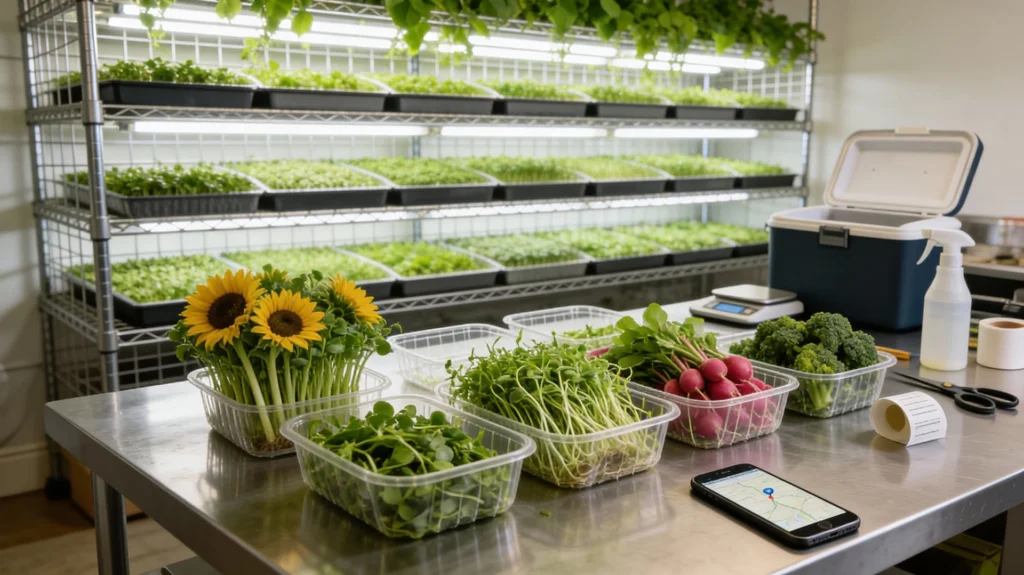
Selling microgreens from home is one of the simplest ways to grow a small business with real income potential. With just a few trays and the right steps, it’s possible to turn fresh greens into steady weekly sales.
This guide breaks everything down so you can get started without the stress. From choosing the right setup to finding loyal customers and building consistent orders, you’ll learn how to keep things simple and profitable.
No need for big investments or years of farming experience. Just follow the process and start turning those fresh, vibrant greens into a business that fits right into your lifestyle 🌿📈💼
Know Your Product: What Makes Microgreens Marketable
Microgreens are young, edible seedlings of vegetables and herbs, typically harvested 7 to 21 days after germination. What makes them highly marketable is a combination of nutrition, visual appeal, and their ability to be grown hyper-locally.
These tiny greens pack a serious nutritional punch. Studies have shown that certain microgreens contain up to 40 times more nutrients than their mature plant counterparts. For example, red cabbage, cilantro, and radish microgreens are known for their high levels of vitamins C, E, and beta-carotene. This has positioned them as a favorite among health-conscious consumers who are focused on clean eating and functional foods.
In the culinary world, chefs love them for their vibrant color and intense flavors. A sprinkle of microgreens on a dish can elevate its presentation and taste. This makes them valuable not just for health benefits but also for their contribution to gourmet plating.
Because microgreens grow quickly, they are well-suited for local small-scale growers. The quick turnover means you can produce and sell fresh crops every week, which appeals to consumers looking for fresh, chemical-free, and local produce. The short shelf life of microgreens actually works in favor of small growers because large industrial farms and long supply chains struggle to deliver microgreens as fresh as a local farmer can.
These factors combined—nutrition, taste, visual appeal, and local freshness—make microgreens highly sellable to both direct consumers and food service businesses.
Understand Your Customers: Who Buys Microgreens?
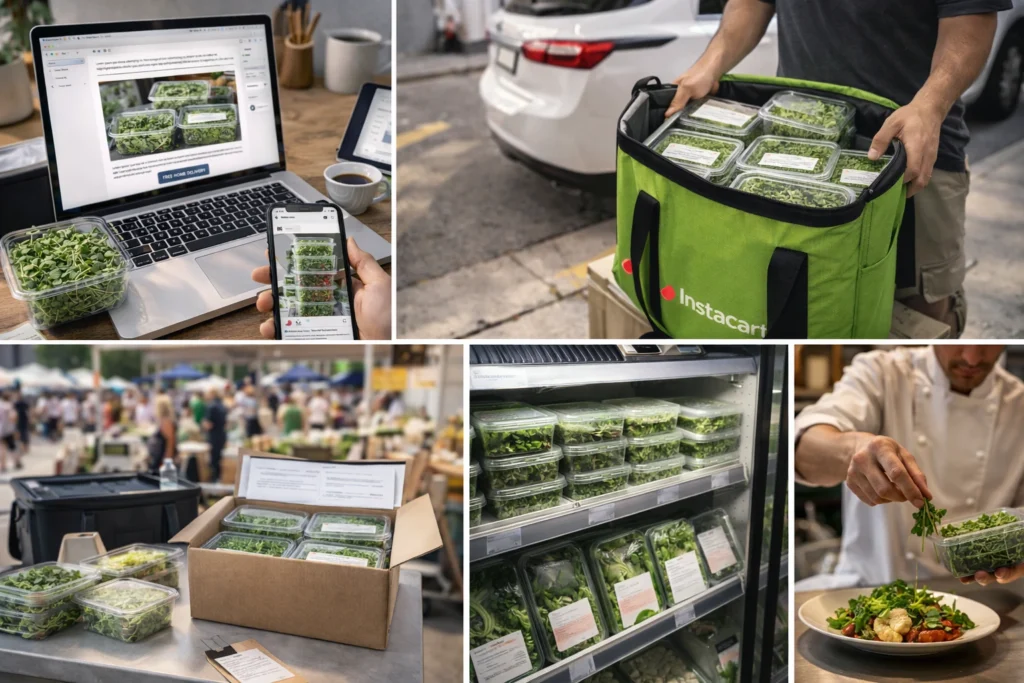
To sell microgreens effectively, it’s important to understand who your buyers are and what they care about. The microgreens market is diverse, but there are four main groups that consistently drive demand.
First, health-conscious consumers are a major target. These are people who actively seek out nutrient-dense foods and are often regulars at farmers’ markets, local grocery stores, or wellness spaces. They value freshness and are willing to pay a premium for produce that supports their health goals. This group responds well to education, so if you can explain the nutritional benefits of your crops, they’re more likely to become loyal customers.
Second, you have the farmers’ market crowd. These buyers are already primed to support local businesses. They’re used to shopping directly from growers and expect a relationship with the person behind the product. According to the seller’s experience, many of his early customers came from markets he attended on Fridays, Saturdays, and Sundays. These customers not only made purchases but also gave valuable feedback, which helped him improve packaging, pricing, and presentation.
Third, restaurants and chefs represent another key segment. However, the learning shared suggests that working with restaurants may not be for everyone. The focus here was more on reaching individual consumers, as restaurant sales can come with high expectations, lower margins, and tighter schedules. But for growers who enjoy building consistent supply chains and working with chefs who value specialty ingredients, this market can be rewarding.
Lastly, there are local health food and grocery stores. These retailers can be great partners if you can deliver consistently and maintain shelf life. Your packaging, branding, and ability to tell a story will be key in this space.
Each customer type values different things, but freshness, nutritional quality, and a clear local connection are universally important.
Calculate and Set Sales Goals
Before you start selling microgreens, you need to understand how much you need to grow and sell to hit a target income. A realistic and well-explained example was shared where $800 per week was achieved shortly after restarting a home-based grow operation. The math behind it is simple and useful.
Each tray of microgreens can bring in around $25 in revenue. Some crops and markets may push this slightly higher, but $25 is a reliable average. To generate $800 in weekly income, you would need to grow and sell 32 trays per week.
Knowing this, you can start to plan your infrastructure. A single grow rack can hold about 20 trays. That means two racks are enough to hit your $800 weekly goal with room to grow. The quick crop cycle of microgreens means each rack can be turned over weekly. This creates a consistent and scalable revenue stream, assuming you have a regular customer base.
It’s also important to track not just revenue but your costs. Many first-time growers make the mistake of overspending on equipment, poor-quality seeds, or supplies they don’t end up using. A lean startup approach allows you to recoup your investment faster and reach profitability sooner. In the example shared, starting with the wrong supplies led to about $4,000 in unnecessary spending. With better planning, the setup could have cost closer to $1,000.
Setting sales goals based on actual capacity, rather than guesswork, gives you clarity and confidence. You’ll know how many trays to plant each week and how many customers you need to serve.
Pick the Right Sales Channels
The channels you choose to sell microgreens will determine how quickly you can grow your business. There are several strong options, and each comes with unique advantages.
Farmers’ markets are an excellent place to start, especially if you are a new grower. One of the major benefits is that the customers who attend are already looking for fresh, local, and often organic produce. This built-in demand makes it easier to connect with people who are likely to be interested in your products.
At a farmers’ market, your interactions happen in real-time. You can test packaging styles, different crops, and pricing strategies, all while getting live feedback. You’re also talking directly to your customers, which gives you the chance to educate them on how to use your products and what makes them valuable. Many growers also use farmers’ markets as a place to collect emails and build a list for future subscription offers.
Another strong option is the home delivery subscription model. This involves delivering microgreens directly to your customers each week. It creates recurring revenue, helps you predict how much to grow, and builds long-term customer relationships. This model is especially powerful when built on initial contacts made at markets or events.
Restaurants are another viable market, though they come with higher demands. You’ll need to offer consistent quality, and they often require specific crops and delivery schedules. This channel is best suited for growers who are comfortable with tight logistics and enjoy working with food professionals.
Selling to local grocery stores or health food shops can help expand your reach. Retail requires good packaging and branding since you won’t be there to explain your product. It’s important to have clear labeling and freshness dates, and your ability to maintain a weekly delivery schedule will affect your success.
Online sales, especially for local delivery or pickup, are growing. These can be supported with a simple website, social media promotion, and local advertising.
Choosing the right mix of channels depends on your goals, location, and comfort with direct selling. For most people starting out, farmers’ markets and subscriptions offer the fastest path to steady sales.
🌿 Recommended Microgreens Supplies |
Build Your Brand and Story
In a market that values local, fresh, and healthy, your story matters just as much as your product. People like knowing who grew their food, where it came from, and why it was grown. This personal connection is often the reason a customer chooses you over a competitor.
Branding isn’t just about logos or colors. It’s about communicating your values, your mission, and the care you put into your work. A strong brand creates trust. It also helps customers remember you, recommend you, and return to you.
When you’re selling microgreens, especially in-person, you are the brand. Your presence at the market, the way you talk about your crops, and how you present your booth all contribute to how people perceive your business.
Your packaging should reflect the quality of what’s inside. Clean, consistent labels, clear product names, and reusable or compostable packaging can all reinforce your brand. Make sure your story is also printed somewhere—on your signage, in a brochure, or on your website.
When done right, your brand will build a relationship with customers that goes beyond a single purchase. It will help you turn one-time buyers into regular subscribers and turn happy customers into your best marketers.
Use Farmers Markets as a Launchpad
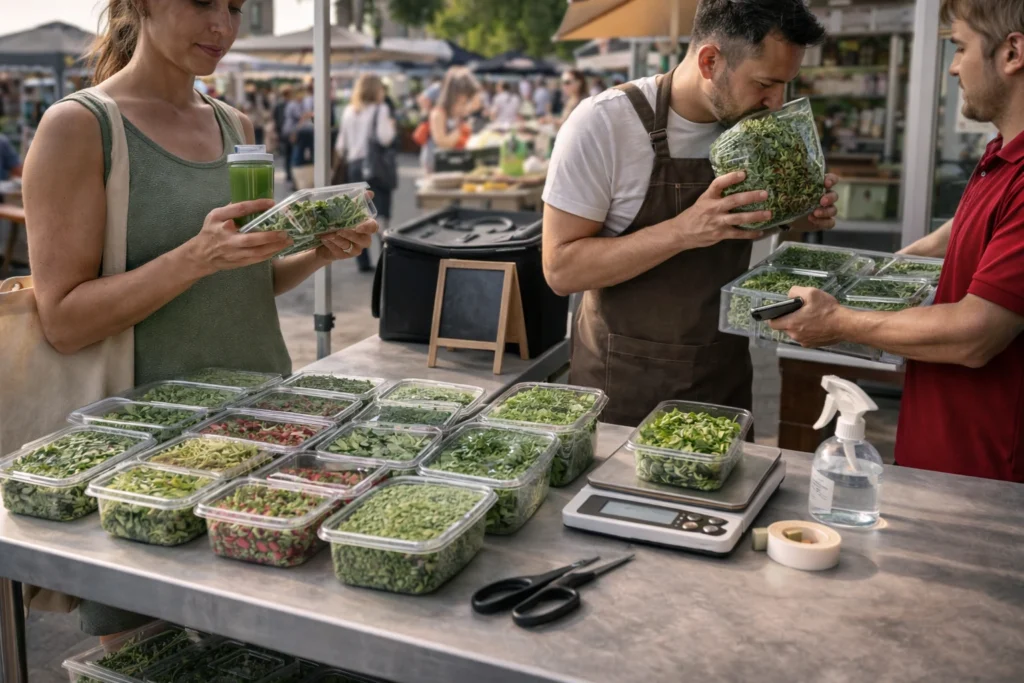
Farmers’ markets are not just a place to sell; they’re one of the best environments to learn about your customers, test your product, and build early traction. For a microgreens grower, especially in the beginning, farmers’ markets offer three powerful benefits.
First, the people attending these markets are already aligned with your product. They’re there because they care about fresh, local food and are open to trying new things. They’re actively looking for products like yours, which makes the sales process smoother and more natural. When someone walks by your booth and sees colorful, fresh microgreens, they’re likely to stop and ask questions. These conversations become opportunities not only to sell, but also to educate and build relationships.
Second, customers at farmers’ markets tend to be local. If your home-based farm is near the market, there’s a good chance your customers live nearby. That’s important, especially if you plan to transition them to a home delivery subscription later. These are the people who are most likely to become long-term customers, and the proximity makes logistics easier for weekly fulfillment.
Third, farmers’ markets give you live feedback. You’re able to see firsthand what people are interested in. You can experiment with crop varieties, packaging formats, pricing levels, and presentation techniques — and you’ll know immediately what’s working. This real-world interaction helps you improve quickly. It also builds your confidence in explaining your product and talking about its benefits, something that will help in every other sales channel.
It was mentioned that doing three markets per week — Friday, Saturday, and Sunday — helped one grower quickly get known in the community and build a customer base. While that level of intensity isn’t for everyone, even one or two markets can have a big impact. They can serve as a springboard for email list building, social media growth, and recurring orders.
Over time, once you’ve built a solid customer base, you can scale back on market days and shift more focus to recurring subscriptions and delivery.
Offer Subscriptions and Home Delivery
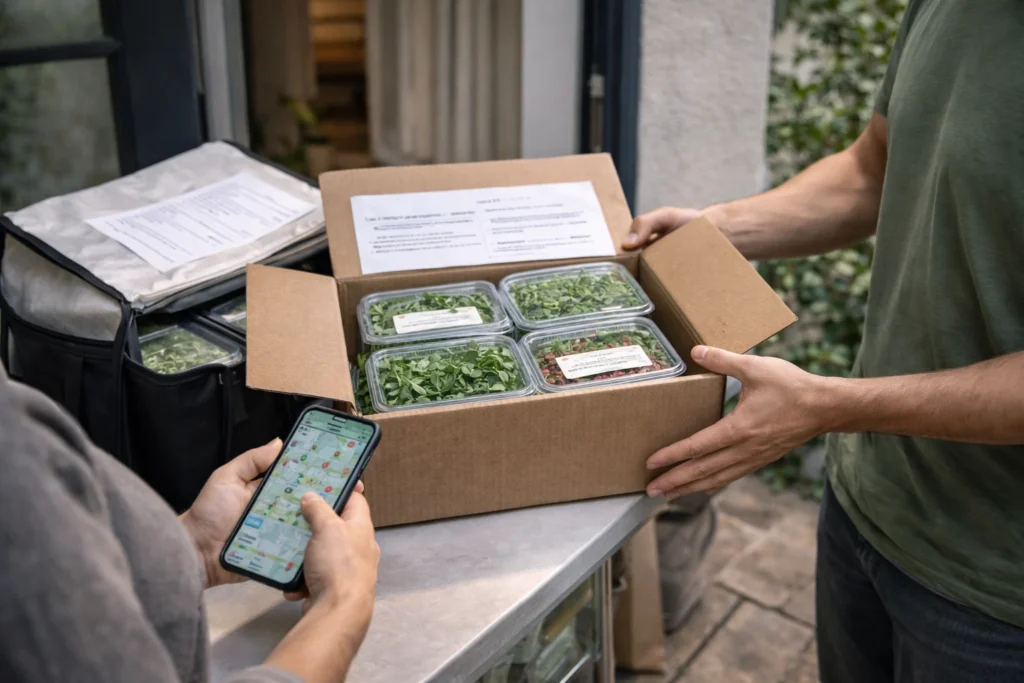
One of the smartest and most stable ways to sell microgreens is through a weekly home delivery subscription. Instead of relying on single sales or unpredictable market traffic, a subscription model gives you consistent revenue, helps with planning your growing schedule, and strengthens customer loyalty.
Here’s how it works. Once a customer tries and enjoys your microgreens — often through a farmers market or sample order — you invite them to join a weekly delivery plan. You offer a few options, like a small or large portion, and they receive fresh microgreens every week at their doorstep or a pickup point.
The beauty of this model is predictability. If you know you have 25 customers receiving one tray’s worth of microgreens each week, you know exactly how many trays to plant and harvest. That makes inventory, harvesting, and packaging far more efficient than trying to guess how much to bring to a market.
It also creates stronger relationships. Weekly deliveries keep your brand top of mind, and you can include simple touches like a handwritten note, recipe ideas, or a QR code linking to a video or storage tips. These small gestures build loyalty and can increase referrals.
There’s another benefit too — cash flow. With subscriptions, you can collect payments regularly, whether through PayPal, credit card platforms, or even cash on delivery. This helps smooth out your income and reduces the pressure to constantly chase new sales.
Transitioning from one-time sales to a subscription model usually happens gradually. You can start offering it to your most loyal market customers and build from there. Over time, it can become the foundation of your microgreens business, especially if you want to reduce market days and streamline your operation.
Price Your Microgreens Correctly
Pricing your microgreens is more than just choosing a number that sounds right. You need to understand your costs, market expectations, and what your product is truly worth to the customer. The average revenue per tray was around $25, and that number wasn’t picked at random — it’s based on real market experience.
To start, calculate your cost per tray. That includes soil or grow medium, seeds, electricity (for lights and fans), water, packaging, and labor. Once you know your cost to produce one tray, you can determine your profit margin. If your total cost per tray is $5 and you sell for $25, you’re making $20 per tray. That’s an 80% gross margin, which is very solid.
But pricing isn’t just about profit. You also need to look at what customers are used to paying in your area. At a farmers market in a health-conscious community, $5 to $7 per container (typically about 2 to 3 ounces) is common. For subscription customers, you can offer slight discounts for regular orders while still keeping margins healthy.
If you’re working with chefs or stores, your price per unit may need to come down, as they typically buy in volume but expect wholesale pricing. That’s why selling directly to individuals often gives the best returns when starting.
One smart strategy is to build value through education. Many consumers don’t initially understand why microgreens cost more than regular greens. Once you explain their nutrition, freshness, and local origin, they begin to see the value and are more willing to pay a premium. Packaging also plays a role. Clear containers, clean labels, and consistent sizing help justify the price visually.
Be confident in your pricing. Underpricing your product hurts your margins and can even reduce customer trust. People associate quality with price, especially in the health food space.
Use Real-Time Feedback to Improve
Selling directly to customers gives you something that larger producers rarely get — real-time feedback. Every conversation, every comment, every repeat order tells you something important about your product, packaging, pricing, or service. If you’re paying attention, this feedback becomes one of your most valuable tools for improving your business.
For example, at a farmers’ market, customers might ask questions about how long microgreens last or whether they should be washed. If multiple people ask the same thing, it tells you to include a storage guide in the packaging or add that info to your label. If someone says the mix is too spicy or not spicy enough, that’s an opportunity to adjust your blend or offer more customized options.
Packaging is another area where feedback can lead to quick improvements. You might find that certain containers are too flimsy, hard to open, or don’t stack well in a refrigerator. A few negative comments are enough to switch to a better option and create a smoother experience for the customer.
Price sensitivity also becomes clear when you sell in person. If you get lots of interest but few purchases, it might mean people love the product but aren’t convinced it’s worth the price — or they’re unsure what to do with it. That’s where sampling, demonstrations, or recipes can help.
Feedback doesn’t only come through spoken words. Repeat purchases are a form of feedback. So are referrals. If someone keeps coming back or sends a friend, they’re voting with their dollars and trust. Pay attention to what they’re buying and what they’re saying. Use that insight to refine your crop selection, improve your marketing message, or adjust your subscription options.
Always be open to feedback, but not reactive to every single comment. Look for patterns. If something is mentioned often, it’s likely worth addressing. This organic, ongoing feedback loop is one of the biggest advantages small growers have over larger commercial operations.
Keep Your Costs Low Without Cutting Corners
One of the biggest mistakes made early on in growing and selling microgreens is spending too much on equipment or supplies that don’t add real value. The excitement of starting a new venture can easily lead to overbuying — from fancy lights to high-end racks to exotic seeds — only to realize later that much of it wasn’t necessary.
A lean approach is better. Start with just what you need to get growing and selling. For example, two basic wire shelving racks can hold 40 trays — more than enough to reach $1,000 per week in sales if each tray brings in $25. Skip the custom-built setups or over-complicated automation in the beginning. As shared, the first attempt cost around $4,000, but could have been done closer to $1,000 with better planning.
Use trays that are sturdy but affordable, soil or grow mediums that have been proven to work well, and seeds that produce high germination and reliable crops. Choose varieties that are popular and easy to grow, like sunflowers, radish, broccoli, and peas. These not only give consistent results but are also favorites with customers.
Don’t skimp on cleanliness or safety, though. Proper washing stations, clean handling practices, and good storage containers are essential for building customer trust and staying compliant with food handling expectations.
As your business grows, you can reinvest profits into better tools, more efficient systems, or new varieties. But early on, keep it simple. That’s the best way to protect your investment, reach profitability faster, and avoid unnecessary waste.
Educate Your Customers
When selling microgreens, one of the most important but often overlooked steps is helping your customers understand what they are buying. Many people have heard of microgreens, but they may not know exactly what they are, how to use them in everyday meals, or why they are worth the price.
Begin by explaining that microgreens are young, edible plants harvested just after they sprout their first true leaves. Although they look small, they are packed with nutrients. In fact, certain varieties can contain up to 40 times more nutrients than their mature counterparts. For example, red cabbage microgreens have been shown to contain significantly more vitamin E and vitamin C than fully grown red cabbage. This high nutritional content makes microgreens a favorite among health-conscious individuals.
Beyond health benefits, people want to know how to use the product. Offering suggestions can make a big difference. Let them know they can sprinkle microgreens on top of eggs, add them to salads, blend them into smoothies, or use them as garnishes on soups and sandwiches. Simple usage tips give buyers the confidence to include microgreens in their regular meals.
When you are interacting with potential customers at a market or during a delivery, you have the opportunity to educate them in real time. Use this moment to talk about freshness, growing practices, and flavor profiles. Offer samples if possible, and be ready to answer questions. These conversations often lead to purchases and help build long-term trust.
Educating your customers also positions you as someone who truly cares about what you grow. People appreciate transparency and authenticity, especially when it comes to food.
Create a Simple Sales Funnel
Converting interest into a consistent stream of sales does not happen by accident. It happens when you intentionally guide people from first contact through to becoming a regular customer. This process is known as a sales funnel. While the term may sound complex, the actual steps can be very simple.
The first step is getting attention. This could happen through a farmers’ market booth, a social media post, a sample pack, or a recommendation from a friend. Once someone shows interest, the next step is to collect a way to stay in touch. This is usually an email address or phone number.
After collecting contact information, follow up with a friendly message. Thank them for their interest and give them a chance to learn more about your product. This could include a brief story about your growing process, details on how to place orders, or reminders about the health benefits of microgreens.
The goal is to make the next step easy. Offer a sample, a discount on the first weekly order, or a small welcome bonus. Once someone places their first order, you want to turn that into a habit. Regular weekly deliveries with consistent quality help customers build microgreens into their routines.
Keep the ordering process as simple as possible. Whether you are using an online platform or taking orders through text, people should be able to update, pause, or reorder without any confusion. The smoother the experience, the more likely people are to stick with it.
Ask for Referrals
Referrals are one of the easiest and most effective ways to grow your customer base. Happy customers are often willing to share your product with others, especially when they are already excited about the health benefits and freshness of your greens.
To get more referrals, you have to be willing to ask. After a few weeks of successful deliveries, reach out and say something simple like, “If you know someone else who might enjoy these microgreens, I would love to connect with them.” You can also include a note in your packaging asking customers to refer friends.
Offering a small thank-you gift can also help. A free container of greens, a small discount, or even a handwritten note goes a long way in making customers feel appreciated and more likely to recommend you.
Referrals tend to bring in customers who are already a good fit for your business. When people hear about your microgreens through someone they trust, they are more likely to try your product and more likely to become long-term buyers.
Keep your referral system easy to understand. The goal is to create a natural way for people to share your product without making it feel like a chore. Over time, word-of-mouth can become one of your strongest and most cost-effective marketing tools.
Use Social Media and Email Lists
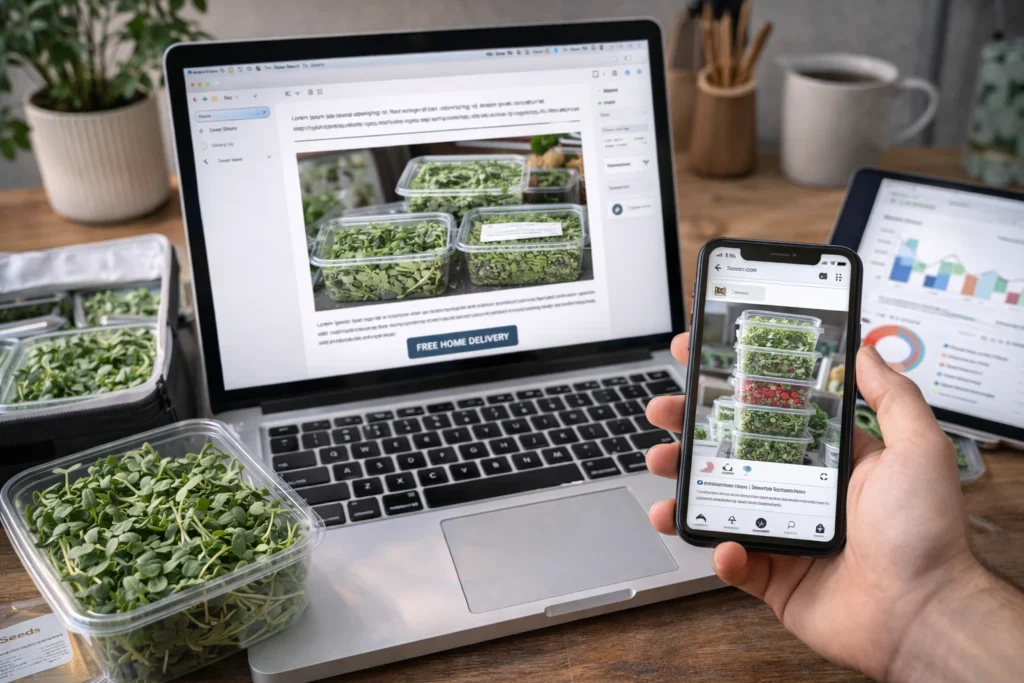
Staying in regular contact with your customers helps build trust, increase repeat orders, and keep your microgreens top of mind. Two of the best ways to do this are through social media and email lists.
Social media gives you a chance to show the daily life of your business. Share pictures of your grow racks, harvest days, and packaging setups. Post about different types of microgreens you are growing each week. If you are attending a market, let people know where you will be and what you are bringing. Keeping things simple and authentic helps people feel connected to you and your process.
Email lists are where you deepen the relationship. If you collect emails from customers at markets or through your website, send regular updates. You might include a weekly harvest update, simple recipe ideas, and order reminders. Even short emails are effective when they are personal and consistent.
These platforms let you maintain a connection even when you are not face-to-face. If someone has not ordered in a few weeks, a friendly message can remind them of your greens and invite them back.
You do not need to be everywhere. Start with one or two platforms you can manage comfortably and focus on quality over quantity. The most important part is showing up regularly and providing value. Over time, this builds a loyal audience that supports your business.
Start Small and Scale Sustainably
A microgreens business does not require a large space or an expensive setup to get started. In fact, you can begin with just one grow rack holding around 20 trays. At an average of 25 dollars per tray, this setup can generate approximately 500 dollars in weekly revenue, or about 2,000 dollars per month. That is a strong return from a small footprint.
Starting small has many advantages. It allows you to focus on learning how to grow and sell effectively without getting overwhelmed. You also keep costs low. Many beginners make the mistake of buying expensive equipment right away, only to find they do not need it or that it complicates their workflow. Staying lean means you can recover your investment quickly and reinvest profits into growth.
As demand increases, scaling is simple. Add another rack. Each rack holds about 20 trays, and if those trays sell, you add another 500 dollars in weekly income. This step-by-step model allows you to grow in a sustainable way that matches your customer base.
Avoid the temptation to grow faster than your market. It is better to have more demand than supply than to overproduce and deal with waste. Focus on building a strong foundation. Deliver consistently, build relationships, and let your business expand naturally as people share your product with others.
This approach keeps you in control. You are not depending on a large loan, a big contract, or a risky investment. You are building something solid from the ground up.