
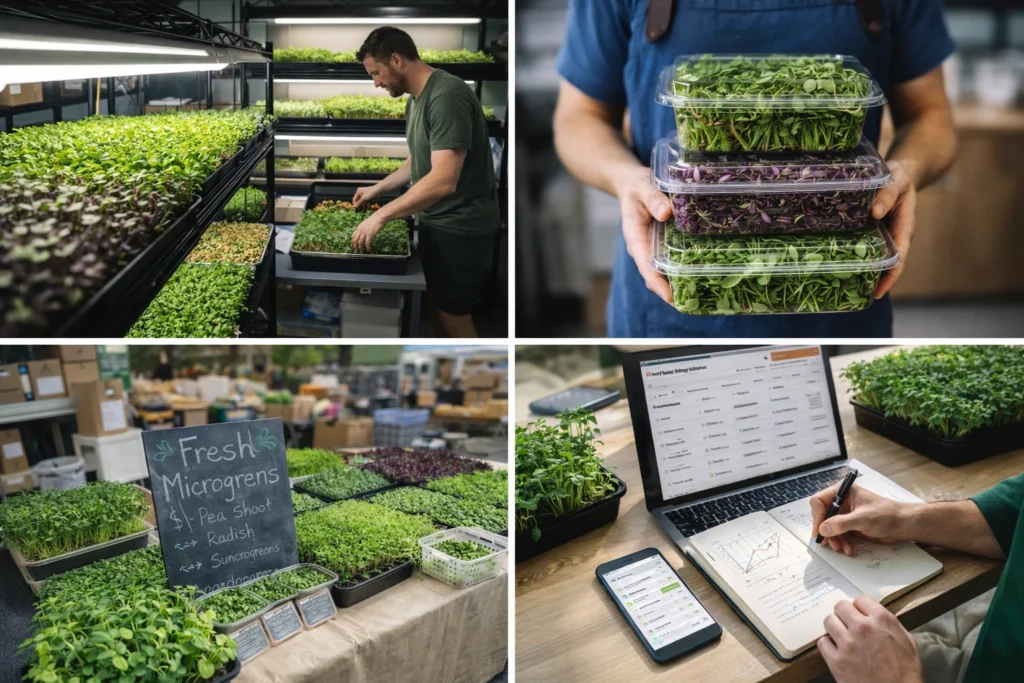
Starting a microgreens business in 2026 is one of the most practical ways to enter farming with low investment and high demand. Microgreens are tiny plants harvested within 7 to 21 days and are valued for their intense nutrition and fresh taste.
With the global market expected to reach over 7 billion dollars by 2032, this business offers beginners a clear opportunity to grow from home and scale into a reliable source of income. The best part is that you do not need acres of land or heavy machinery. A spare room, balcony, or garage can be enough to start.
This guide outlines the best microgreens business plan for beginners, covering setup, growing process, marketing, and financial planning for 2026 success.
Best Microgreens Business Plan for Beginners
What this plan is
This is a step-by-step blueprint to launch a small microgreens operation from home and grow it into a dependable income stream in 2026. It focuses on simple systems, predictable weekly production, and a customer model that brings steady orders. All numbers and examples come from the material you shared. Nothing is copied from outside sources.
Who this plan is for
- First-time founders who want a practical path from first tray to first paying customers.
- Home growers who already have a rack and lights and want to turn that into weekly revenue.
- People who prefer a direct-to-consumer model and want to keep control of quality and scheduling.
What you will learn
- How to choose a clear business model that fits solo founders.
- What to grow first and why those crops help you learn fast.
- How much space and equipment do you really need to start?
- What the realistic numbers look like from trays to clamshells to weekly revenue.
- How to scale routes without chaos once demand climbs.
🌿 Recommended Microgreens Supplies |
Quick market snapshot
Fast crop cycle and strong nutrition story
Microgreens are harvested seven to twenty-one days after sowing. That speed means your cash cycle is measured in days rather than months. The early leaf stage is widely promoted as highly nutrient-dense. In the material you shared, there is a repeated claim that young greens can be up to forty times more concentrated in certain nutrients than mature vegetables. This health angle drives interest among home cooks, gym goers, and wellness shoppers.
Demand figures are shared in your sources.
Several market size estimates were cited. One global estimate places the market at around 3.24 billion dollars in 2024, with a path toward 7.97 billion dollars by 2032. Another forecast cited a market of about 1.4 billion dollars by 2028 at roughly twelve percent compound annual growth. A regional snapshot for India estimated about thirty-five thousand crore rupees today, with growth toward one lakh crore rupees in roughly three years. These figures differ by source and methodology, but the direction is consistent. Interest is rising, and supply is still localized, which supports small regional producers.
Why 2026 is attractive
- Very short production cycle, so you can test pricing and product fit quickly.
- Customers increasingly ask for fresh local greens with clear handling and storage info.
- Home-based growing is viable with modest gear, which keeps startup risk low.
- A subscription approach can stabilize weekly demand, so production planning is easier.
Business model choices
The recommended core model
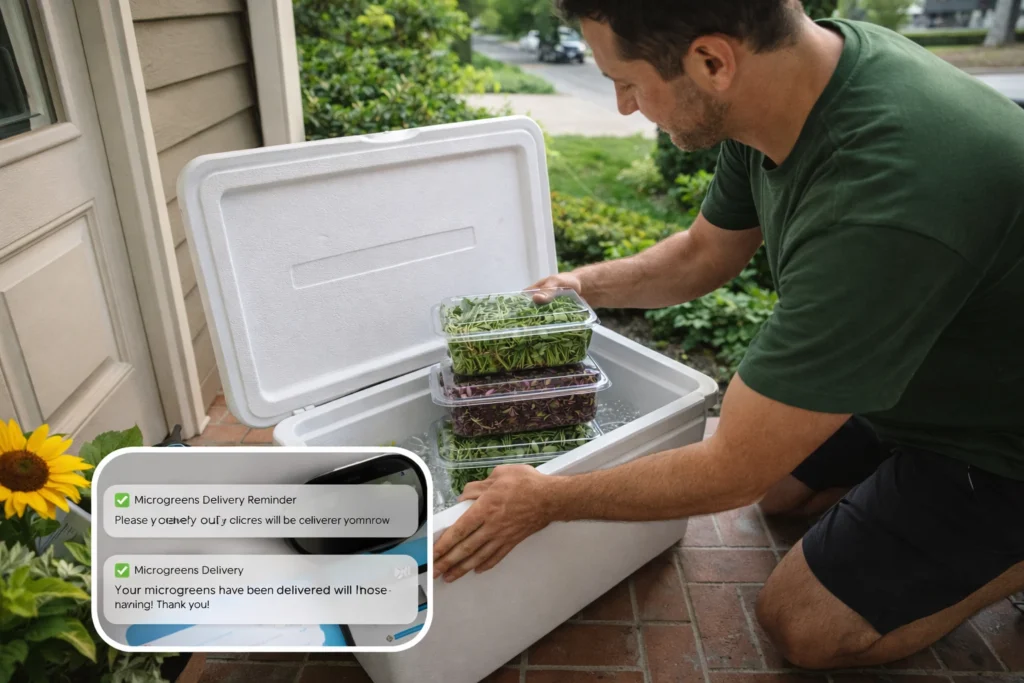
Weekly home delivery subscriptions for local households. This model was highlighted by an experienced grower who scaled to about three thousand dollars per week. The math is simple. One hundred active customers with an average weekly order of around thirty to forty dollars bring approximately three thousand dollars per week. Recurring billing and text notifications keep operations smooth. Customers receive a reminder the night before to leave a cooler and a delivered message at drop off. When a delivery route grows toward one thousand dollars in weekly revenue, it is split into two geographic clusters to shorten drive time. This is how you grow from one route to several without losing your harvest window.
Why this model suits beginners
- Orders repeat every week, which improves forecasting.
- You can grow a small menu consistently and avoid overextending on varieties.
- Direct relationships lower churn because you can teach storage and usage, which raises perceived value.
Supplemental channels
Farmers’ markets are a strong feeder into the subscription list. Offer samples and collect signups with a simple form and a three-week trial. Health food stores can add baseline volume once your weekly production is consistent. Chefs and restaurants are optional. They can be demanding, and orders can be unpredictable. Many first-time growers discover they prefer households first and trade accounts later.
What not to do in the early months
Do not add too many varieties. Do not promise large standing orders to any single buyer until your system is steady. Grow slowly and keep reliability high. This protects your reputation.
Value proposition and product lineup
Why customers buy
People want fresh produce that is clean, flavorful, and easy to use. They also want routines that help them eat better without extra planning. Weekly delivery solves all three. It arrives on the same day, in the same pack sizes, with a short note on how to use the greens in eggs, sandwiches, soups, bowls, and smoothies. This keeps the habit going, which lowers cancellations.
Starter products that work
Begin with four varieties that are popular and comparatively forgiving. Pea shoots, sunflower, radish, and broccoli. This set covers mild, nutty, spicy, and health-focused profiles. You can offer a simple spicy mix that blends radish with another brassica. Keep pack sizes standard in clamshells so harvest and labeling stay efficient. Rotate a single feature crop occasionally for variety once your core is stable.
Simple menu and pricing approach
Keep three to four core items in stock every week. Set retail price per clamshell at a premium that reflects freshness and handling. Use the same price across channels where possible. Consistency builds trust and helps you forecast revenue from active subscribers.
Space, equipment, and starter budget
Space you need to begin
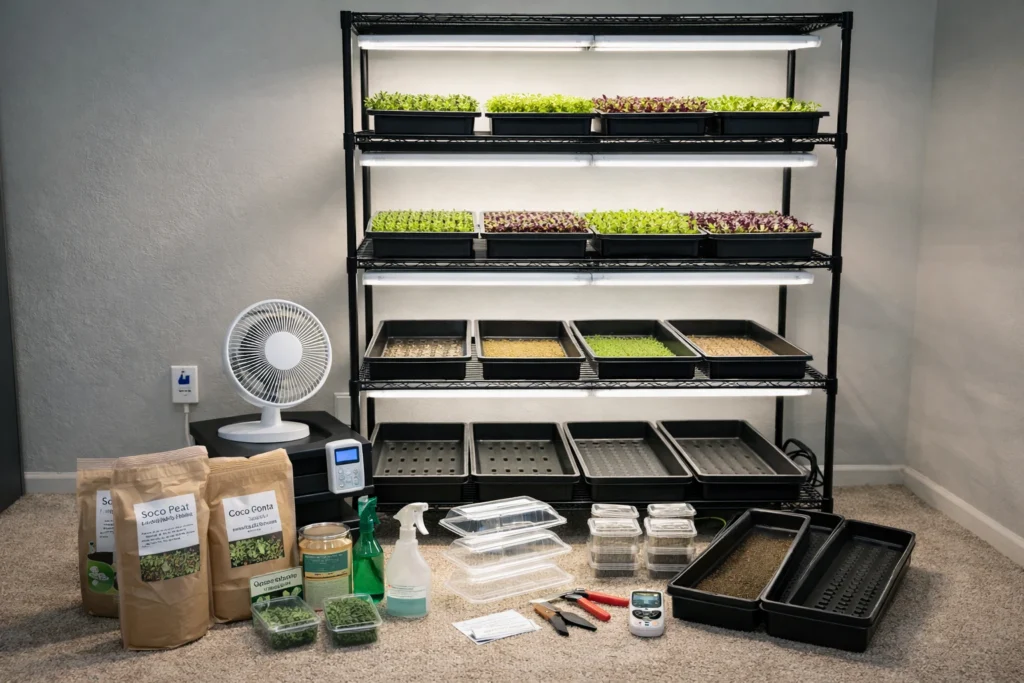
A spare bedroom, a balcony corner, a garage bay, or a clean section of a basement can work. You do not need a large footprint to get started. One sturdy rack with multiple shelves and a light on each shelf can produce a surprising number of clamshells once your routine is dialed in. If you choose to scale later, a room of about one thousand square feet can support a larger cycle, but that is not required for launch.
Essential equipment and supplies
You will need ten-by-twenty trays with and without holes, a metal or heavy plastic rack, LED shop lights with one light per shelf, basic timers, a small fan for airflow, a thermometer and hygrometer, a spray bottle and a watering can for different stages, food-safe shears, sanitizer, clamshell containers, and labels. For growing media, you can use clean soil, coco peat, or hydroponic mats. Seeds should be organic and non-GMO where possible. Start with small quantities while you learn. Buy in bulk only after you confirm your seed rates and yields.
Starter budget based on the sources you provided
A small home start in India can fit within about ten thousand to thirty thousand rupees for seeds, trays, racks, media, and basic lighting. Scaling that home setup with better lights and simple irrigation has been done for around one lakh rupees. One experienced grower in another market reported starting with about four thousand dollars and reaching net positive in roughly nine months, then about one hundred thousand dollars in revenue in year two. Results vary with pricing, demand, and efficiency, but these reported figures show that a lean start is possible and that careful scaling can bring meaningful revenue.
Climate control matters more than fancy gear.
Stable temperature, airflow, and clean workflow prevent many common problems, such as poor germination or surface mold. Keep variables to a minimum in the beginning. Use the same seed rates, the same blackout duration, and the same watering schedule across trays so you can change one factor at a time and see what truly improves outcomes.
First shopping list you can act on this week
- One sturdy multi-shelf rack and four LED lights
- Twelve to twenty seed trays with and without holes
- Coco peat or clean potting soil, and a bag of each starter seed
- Timer, small fan, thermometer, and hygrometer
- Food-safe shears, sanitizer, clamshells, sticker labels
This setup is enough to sow a handful of trays, harvest within seven to twenty-one days depending on variety, and begin sampling for your first subscribers.
Legal and compliance
Why you need to think about compliance early
When you are selling food directly to people, trust is everything. Customers need confidence that the greens are grown safely, handled properly, and packaged in clean conditions. Even if you are running from a spare room or a garage, taking simple steps toward registration and licensing helps you avoid problems later when you try to expand into larger accounts or online sales.
Basic registrations
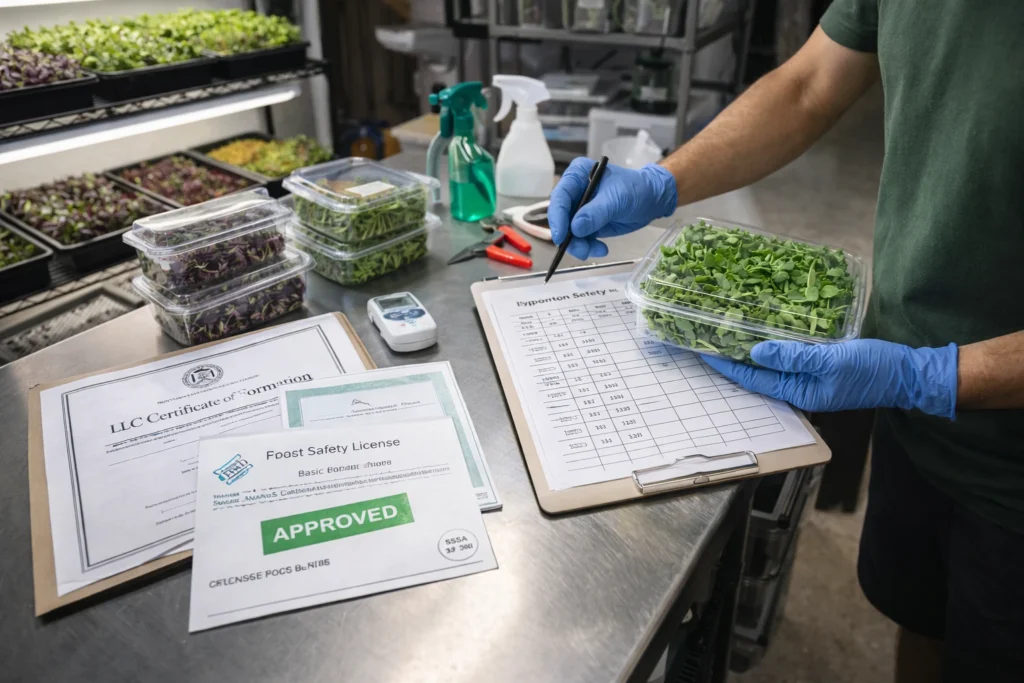
For small-scale sales to neighbors and farmers’ markets, many places do not require heavy licensing. However, once you are selling commercially or through platforms,s you should register your business as a formal entity. In India, registering as a Micro, Small, and Medium Enterprise (MSME) gives legitimacy and sometimes access to government support. Obtaining a basic food safety license, such as FSSA, is also a smart move when you plan to work with supermarkets or deliver through online grocery platforms.
In other regions, forming a Limited Liability Company (LLC) is common. This separates your personal finances from the business, helps with taxes, and protects your personal assets.
Food safety obligations
Food safety means having clear practices for cleaning trays, sanitizing tools, labeling products with harvest dates, and keeping products refrigerated. Customers and retail partners will want to see that you follow basic hygiene and handling standards. Create simple Standard Operating Procedures (SOPs) for sowing, watering, harvesting, and packing. Keep logs so you can show traceability if ever asked.
Benefits of registering
- Builds trust with new customers.
- Allows you to sell through platforms like grocery delivery apps.
- Positions you for growth into larger markets without starting over.
Growing system
The standard cycle
Microgreens follow a simple but precise process. Seeds are spread evenly across a shallow tray filled with soil or coco peat. After sowing, the tray is covered or stacked to block light for a blackout period, which encourages germination. After a few days, the tray is uncovered and placed under light. From there, daily watering and airflow management carry the crop to harvest, which usually occurs between seven and twenty-one days, depending on the variety.
Daily care
Although you do not have to watch the trays constantly, you do need daily touchpoints. Light watering or misting, checking temperature and humidity, and monitoring for mold or uneven germination are all important. Having a set routine each day makes problems less likely to get out of hand.
Why simplicity matters
The most common mistake is adding too many variables too soon. Beginners sometimes try multiple seed mixes, different mediums, and inconsistent lighting setups. This makes it impossible to know what is causing problems. Focus on a handful of varieties and one growing method until you achieve reliable trays. Then make small adjustments one at a time.
Harvest and handling
Harvest is done by cutting just above the soil line with sharp scissors or a sanitized knife. Microgreens should be dry at harvest. Wet greens spoil faster. Immediately after cutting, place them in clean clamshells and refrigerate. This extends shelf life and keeps quality high for delivery.
🌿 Recommended Microgreens Supplies |
Production math you can actually use.
The benchmark to keep in mind
One grower shared that three thousand dollars a week in sales equals about one hundred active subscribers, each spending around thirty dollars a week. In his case, average order values were closer to thirty-five or forty dollars. This is a helpful benchmark. You do not need thousands of customers. A focused group of one hundred committed households can sustain a strong home-based business.
Converting orders to trays
If a typical subscriber buys three clamshells per week and one tray yields about eight to twelve clamshells, then one hundred subscribers require about three hundred clamshells weekly. That means you need to sow and manage around thirty to forty trays every week. This is a manageable number on a standard rack setup if you stay organized.
Why tracking is essential
Keep a simple sheet with the date you sowed, how much seed you used, the yield in clamshells, and whether there were any problems. Over time, this gives you your actual numbers rather than relying on estimates. You can then forecast more accurately, order the right amount of seed, and avoid waste.
Scaling routes and harvest
As orders grow, harvest volume and fridge space become the real limits. One grower noted that every time his delivery route reached about one thousand dollars, he split it into two separate routes. This kept harvest manageable and deliveries efficient. Following this method helps you grow without losing quality.
Pricing, costs, and margins
Setting prices
Microgreens are premium products because of their freshness and nutritional profile. Pricing should reflect this. Small clamshells are usually priced higher per ounce than standard vegetables. Customers expect to pay more, but they also expect consistent quality.
It is important to stay competitive with other local growers while still positioning your product as a premium choice. This means clear labeling, clean packaging, and reliability in delivery.
Understanding costs
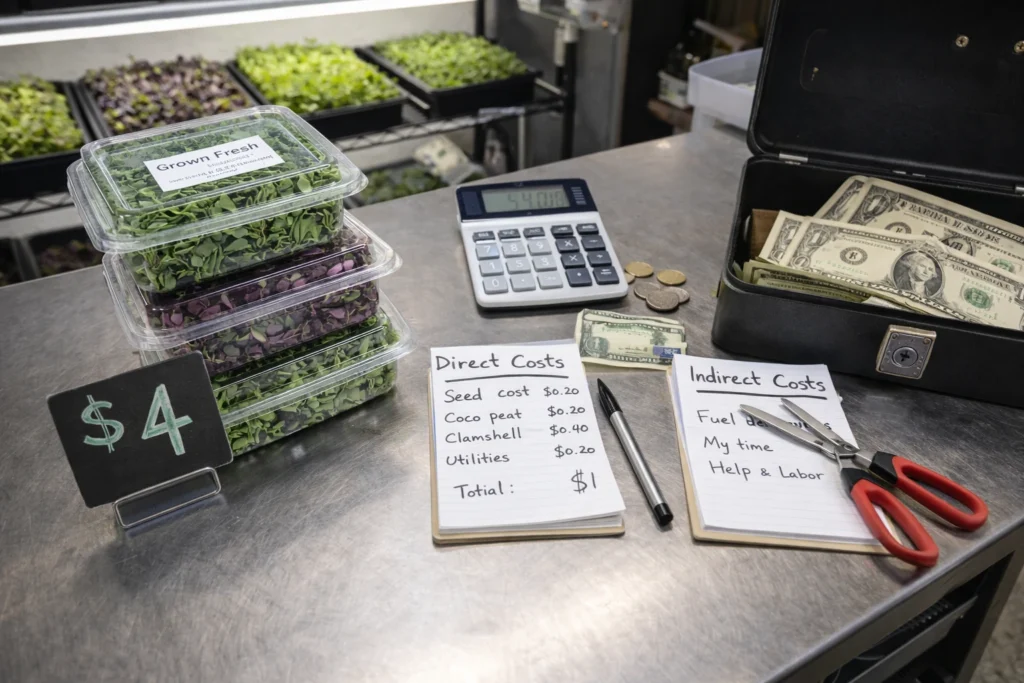
Each clamshell has direct costs: seed, growing medium, packaging, and a share of utilities and rent if applicable. As you grow more trays, you will also have indirect costs like time, fuel for delivery, and eventually help from employees. Keep track of these to understand your true cost per unit.
Margins in practice
Because inputs are relatively inexpensive compared to the selling price, margins can be strong. However, poor yield or spoilage can eat into profits quickly. Buying seeds and packaging in bulk once you have a steady demand will improve margins further.
Aim to understand your cost per clamshell early. For example, if your cost is one dollar and you sell for four, you have a good margin. If waste is high and your cost creeps to two dollars, your margin is cut in half. This shows why consistency is so important.
Go to market plan
First customer sources
Farmers’ markets are the easiest way to test products and find your first customers. Offer samples and invite people to sign up for a weekly delivery trial. Another strong path is through health food stores and local cafes that want fresh toppings for bowls and sandwiches.
Selling to chefs is possible, but many beginners find household subscriptions more predictable and easier to manage. Chefs may cancel orders or change requirements quickly. Households, once they see the value, often stay on for months.
Building trust with education
Customers may not know how to use microgreens beyond garnishes. Provide recipe cards, simple storage instructions, and short social media videos showing how to use them in smoothies, omelets, or sandwiches. This increases repeat use and lowers cancellations.
Launch offers
Offer the first week free when a customer signs up for a three-week trial. This lets them taste and build a habit while giving you time to prove reliability. Collect feedback in the first month and adjust your process before scaling to more households.
Marketing tools
Keep your efforts simple and consistent. Use a one-page website with sign-up forms. Post short clips on social media. Collect emails at markets. Follow up with text reminders. These small steps create a cycle where new customers keep entering, and old customers keep staying.
By focusing on local marketing, clear education, and repeat orders, you can build a dependable base of subscribers without needing a large advertising budget.
Subscription engine
Why subscriptions matter
One-time sales at farmers’ markets or small stores are good for exposure, but they do not create predictable revenue. A subscription system does. It allows you to know in advance how many trays to plant, how much seed to order, and how much cash will arrive each week. This stability is the backbone of a strong microgreens business.
How to set it up
Start with a weekly cycle. Customers choose their varieties and quantity. Payments are processed automatically with a credit card or online billing. They receive the same order on the same day every week. You can manage this with simple software that handles billing and delivery reminders. One grower who scaled to three thousand dollars a week used text notifications so customers knew when to leave a cooler outside and when deliveries arrived.
How many customers do you need?
The numbers are straightforward. With one hundred customers ordering about thirty to forty dollars per week, you reach about three thousand dollars weekly. That is a full-time income from a manageable group of households. At the start, aim for your first ten households. Then twenty. Build slowly and consistently, keeping service levels high.
Delivery and logistics
Routes that work
Deliveries need to be efficient. If you spend too many hours driving, your time vanishes, and fuel costs rise. A proven method is to group customers into routes worth about one thousand dollars each. When one route grows beyond that, split it into two smaller routes. This keeps each delivery day manageable.
Timing
Harvest, packaging, and delivery must happen in a tight window. Most growers harvest in the morning, refrigerate briefly, then deliver the same day. This ensures maximum freshness and shelf life. Customers notice and appreciate this consistency.
Tools that help
Simple routing software can map your deliveries and send automated reminders. Customers receive a text the night before to leave a cooler and another when their order arrives. This system reduces missed deliveries and builds professional trust.
Customer education and retention
Teaching customers how to use microgreens
Many households only know microgreens as restaurant garnishes. They may not realize they can be added to eggs, smoothies, soups, sandwiches, and bowls. Providing a short recipe card in each delivery box is a small action that increases usage. When customers know how to use more greens, they buy more and stay longer.
Why retention is better than constant marketing
It is easier and cheaper to keep one customer for a year than to replace them every month. That is why teaching customers and staying in touch is vital. A weekly text reminder, a social media post with recipe ideas, or a seasonal discount for loyal subscribers all contribute to long-term retention.
Handling issues with care
Deliveries sometimes go wrong. Crops may underperform. A customer may complain. The best response is quick, honest, and solution-focused. Replace a tray, add an extra clamshell, or apologize directly. These small gestures build trust and often turn mistakes into stronger relationships.
Team and roles
Starting solo
At the beginning, you will do everything yourself: sowing, watering, harvesting, packing, deliveries, marketing, and bookkeeping. This is normal and teaches you every aspect of the business.
When to bring help
As the business grows past one or two routes, tasks multiply. Harvest days become long and exhausting. Deliveries stretch into hours. This is the point to consider part-time help. Many growers hire drivers first because delivery is the most time-consuming and does not require deep technical knowledge.
Challenges of hiring
Finding reliable help is not always easy. One grower went through more than a dozen employees in a few years. Plants are easier to manage than people. Be prepared for turnover and always keep your systems documented so you can train new people quickly.
The long-term goal
Eventually, you may have a small team where one person manages production, another handles deliveries, and you focus on growth and customer relationships. Delegating effectively is the only way to scale beyond a solo operation without burning out.
Tools and systems
Why systems matter
Growing microgreens is simple. Running a business is complex. You need systems so that tasks happen the same way every time. This reduces mistakes, speeds up work, and allows others to step in if you are unavailable.
Core tools to consider
- Spreadsheets or farm management apps for tracking sowing, harvest, and sales.
- Accounting software such as QuickBooks is used to manage expenses and revenue.
- CRM or payment systems like Square or Stripe to handle subscriptions.
- Routing software for deliveries to save time and fuel.
- Simple design tools like Canva or Keynote for labels, flyers, and posts.
Building procedures
Write down your standard steps for sowing, watering, and harvesting. Document how to pack clamshells, how to clean trays, and how to record customer payments. These written procedures become your training manual for yourself and any helpers you bring on.
Financial planning
Knowing your numbers
Financial awareness is one of the most important habits for beginners. Every tray has a cost, and every clamshell has a selling price. If you do not know both, you are flying blind. Record the seed cost, growing medium, electricity, packaging, andthe time you spend. Then calculate your cost per unit. This shows you if you are pricing correctly and if your margin is strong enough.
Startup capital
A very small setup can begin with about ten to thirty thousand rupees (roughly one hundred to three hundred dollars) for trays, seeds, racks, lights, and packaging. On a larger scale, a more professional system with irrigation and lights might need one lakh rupees or a few thousand dollars. Compared to most farming ventures, this is a low barrier.
Tracking income and expenses
Use simple accounting software or even a well-structured spreadsheet. Track every purchase from seeds to scissors. Track every payment you receive. This makes tax season easier and prevents surprises. It also helps you see if money is leaking in small areas, such as packaging waste or fuel for delivery.
Cash flow awareness
Cash flow is about timing. You pay for seeds and packaging before harvest, but customers may pay you weekly or monthly. Keeping a reserve fund avoids stress when payments are delayed. Learn to plan and separate personal and business accounts early.
Growth strategy
Scaling routes
The proven method is to grow each delivery route to about one thousand dollars in weekly orders. Once you hit that point, split the route into two smaller ones and build each up again. This keeps harvest and deliveries efficient. Eventually, four or more routes can cover a wide area without overloading any single day.
Adding new crops
Start with easy varieties like radish, pea, sunflower, and broccoli. Once you have mastered those, you can slowly test more complex crops such as cilantro or basil. Always add one new crop at a time so you can troubleshoot effectively without losing reliability on your main offerings.
Diversifying sales channels
Household subscriptions are the most stable. After building a strong base, you can add farmers’ markets, small health food stores, or even online grocery platforms. Export may be possible in some regions, but local demand is usually more than enough. The key is not to stretch yourself too thin across too many channels early.
Marketing consistency
Social media can amplify growth if done regularly. Share quick recipes, behind-the-scenes farm shots, and customer testimonials. Farmers’ markets also act as a powerful marketing channel, often turning one-time buyers into long-term subscribers.
Risk management
Crop failure
Not every tray will succeed. Seeds may fail to germinate, mold may appear, or trays may dry out. Have extra trays in production so you are never short on orders. This buffer is your insurance against customer disappointment.
Customer turnover
Some customers will leave no matter how good your service is. Always be adding new households through markets, referrals, and simple promotions. A steady flow of new customers covers natural churn and keeps your routes healthy.
Employee reliability
Hiring help is not always smooth. Be prepared for turnover by keeping your systems clear and documented. Train backups and never rely on one person for critical tasks until you fully trust their consistency.
Market changes
Trends in food shift. Right now, health and wellness are strong drivers of microgreens demand, and the market is projected to grow to over seven billion dollars globally by 2032. Even so, stay adaptable. If consumer preferences change, be ready to introduce new varieties or adjust your model.