
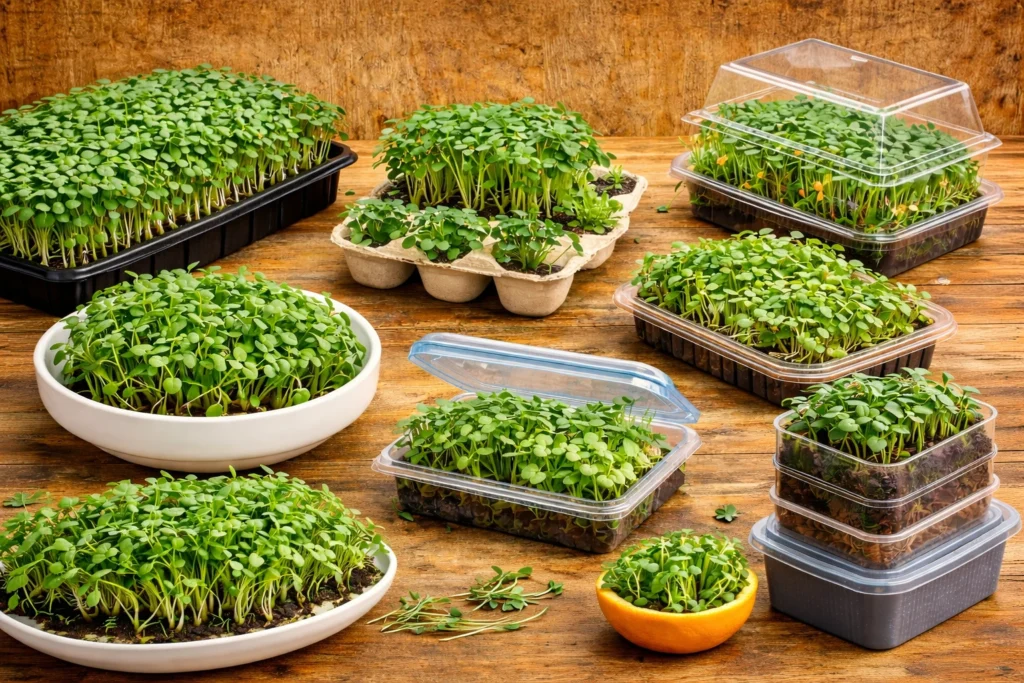
Growing microgreens at home is easier than most people think, and you don’t need to spend money on expensive trays. With the right microgreens containers, you can turn everyday household items into thriving mini gardens.
From recycled takeout trays and yogurt tubs to self-watering builds with wicks, countless budget-friendly options keep your greens healthy and fresh.
In this guide, we’ll explore more than 30 creative container ideas that anyone can try, whether you live in a small apartment or have a spacious kitchen.
Discover how simple it is to repurpose common items into practical microgreens containers and enjoy a steady harvest of nutritious greens year-round.
1. Black clamshell takeout trays with a flip lid
Why this container works
These trays are sturdy, food-grade, and the lid usually nests inside the base. That nesting creates a shallow platform for a thin layer of growing medium while the base holds water. It is an easy way to build a self-watering setup that keeps the surface evenly moist.
What you need
A clean clamshell tray, scissors or a tool to make two narrow slots in the inner lid, three to four layers of paper towel or a strip of one hundred percent cotton lamp wick, seed starting mix, seeds, and water.
Set up step by step
Seat the inner lid inside the base so it rests a little below the rim. Make two slots near opposite edges of the lid. Thread the folded paper towel through both slots so it dips into the water space by two to three inches. Fill the base with plain water. Spread a thin layer of seed starting mix on the lid to about one-half to three-quarters of an inch. Sow evenly. A reused spice shaker makes tiny seeds spread more evenly. Dust the surface with about one-quarter inch of fine medium. Mist the inside of a loose cover to hold humidity, then place it on top to create darkness.
Moisture, temperature, and light
Moisture moves up through the wick by capillary action, so frequent spraying is not needed. Aim for a warm room close to seventy eight degrees Fahrenheit. Avoid rooms under sixty degrees since many seeds stall in cool conditions. Peek after forty-eight hours. Most varieties begin to sprout in two to three days. Keep covered for about three days, then move to a bright window or under shop lights.
Harvest and reuse
By day seven to day nine, you often see stems about one to one and one quarter inches tall above roughly one half inch of medium. Cut low with scissors. You can keep the tray growing for about another week with occasional watering of the reservoir. Wash and reuse.
Common hiccups and fixes
If the wick is slow to wet the surface during the first day, lightly top water once to jump-start. If you notice surface fuzz, lower the seed density a little, add a tabletop fan for airflow, and keep the top dusting of medium thin but even.
2. Standard restaurant soup containers
Why this container works
These round containers are durable, food-grade, and easy to drill. They shine in the classic three-tray approach that gives reliable drainage and simple bottom watering.
Three-tray method in practice
Prepare three containers of the same size. Drill many small holes in the base of one. Leave the other two intact. Pre-moisten peat moss or coco coir so it forms a clump without dripping, then breaks apart. Fill the drilled container to one-half to three-quarters of an inch and press the surface level. Place it over a solid container that acts as a catch tray. Sow evenly, then sift about one-quarter inch of fine medium over the seed. Water until the top quarter to half inch is clearly saturated.
Weighted cover for quick germination
Invert the third container on top and set two small rocks on it. The gentle weight improves seed to soil contact for the first two to three days. Store in a dark spot during this time. Check after forty eight hours, then uncover on day three and move to light.
Care and timeline
Check moisture two to three times per day in warm rooms. Bottom water by adding to the catch tray once roots are through the holes. Typical height is around one inch by day seven. You can harvest them or wait two to three more days. After cutting, the mat usually holds for another week with occasional watering.
🌿 Recommended Microgreens Supplies |
3. Poke bowl containers
Why this container works
Wide shallow bowls give a large, even surface, which makes a thick, uniform canopy. The shape also helps light reach the whole tray once uncovered.
Setup options
Choose either thethree-trayy drainage approach or a wick reservoir. For drainage, drill the base and set the bowl on a second bowl to collect runoff. For a wick reservoir, cut a thin insert from a food-safe lid to sit inside the rim, then thread cotton wick or a folded paper towel through two slots so it dips into water. Fill with seed starting mix to about one-half to three-quarters of an inch, sow with a shaker, and dust with one-quarter inch of fine medium.
Moisture and light management
At sowing, water thoroughly so the upper quarter to half inch is wet. With a wick, the reservoir takes over after that. Keep covered for roughly three days, then move to a bright window or simple shop lights. A small fan nearby reduces surface moisture and helps prevent fuzz.
Harvest notes
Expect a usable cut around day seven to day nine, depending on variety and room temperature. Stems often measure about one to one and one-quarter inches when they look full and upright.
4. Steam fresh or TV dinner trays with built-in strainers
Why this container works
Some meal trays include a perforated inner piece that sits over a lower basin. This creates a ready-made grow deck over a reservoir, which is ideal for clean bottom watering.
How to use the insert
Place the perforated insert inside the outer tray. Add seed starting mix on the insert to about one-half to three-quarters of an inch. Sow and apply a light top dressing. For the first three to four days, mist the surface or use a loose cover to keep humidity high. After roots begin to anchor, add water through a fill hole or corner so moisture wicks up from below.
Care and timeline
Keep the covered tray in the dark for about three days. Move to light on day four. Water by filling the lower basin rather than wetting the top. Stems are usually one inch by day seven. The tray design makes harvesting neat since the mat sits above any standing water.
Extra tip
If the outer tray is clear, wrap the outside with foil or paint it opaque to block light from the reservoir and discourage algae.
5. Rectangular takeout trays with fitted lids
Why this container works
Many common rectangular trays have lids that seat neatly inside the base. The interior lip holds a shallow bed of medium, and the base serves as a water chamber.
Wick-based build
Make two narrow slots in the seated lid near opposite edges. Thread three to four layers of folded paper towel through both slots so several inches dip into the lower chamber. Fill the base with water. Spread the seed starting mix to about one-half to three-quarters of an inch. Sow evenly and top with one-quarter inch of fine medium. Cover loosely with a second lid or with foil misted on the underside.
Temperature and blackout
Keep the covered tray warm and relatively dark. Around seventy eight degrees Fahrenheit speeds germination. Avoid rooms under sixty degrees. Most seeds begin to show in two to three days. Remove the cover on day three or four and move to light.
Watering and harvesting
The wick maintains even moisture, so the surface stays damp without frequent spraying. Harvest around day seven to day nine, then wash and repeat. A five-by-five pad often fits neatly on the seated lid if you prefer pad growing.
🌿 Recommended Microgreens Supplies |
6. Small snack tubs from discount stores
Why this container works
Compact tubs create convenient single serve crops. You can place several on a shelf and harvest only what you need for a meal, which reduces waste.
Best practices
Use either drilled drainage with a matching catch tub or a tiny wick dipping into a small water space. Keep medium depth near one-half to three-quarters of an inch and use the spice shaker trick for even seeding. A light top dressing improves contact and curbs surface moisture.
Daily care
Because these tubs are small, they can dry faster before roots reach the bottom. During the first three to four days, check moisture two to three times a day and mist lightly if the surface dries. After roots are set, water and keep under steady light. Expect a tidy harvest in about a week, then start another round.
7. Sippy cups used as micro decks
Why this container works
Some lidded cups have a removable top that can be flipped to form a stable little platform. The cup beneath works as a water chamber for a tiny self-watering unit.
Build details
Flip the lid so the flat side faces up and rests securely. Cut two small slots in the lid. Thread a cotton wick or folded paper towel through both slots and down into the cup. Add water to the cup. Spread a thin layer of seed starting mix on the lid and sow a very small portion of seed to keep airflow healthy. Cover with a dampened piece of foil to create a dark, humid chamber for about three days.
Care and use
Move to a bright window once sprouts appear. Because the surface area is tiny, use fast-growing varieties and harvest young. This format is also handy for starting slips or small plants with a pool noodle collar in the opening when you want to root before moving to a larger container.
8. Regular takeout trays with five-by-five grow pads
Why this container works
A five-by-five pad often fits perfectly on the seated lid of many takeout trays. Pads simplify cleanup and make moisture control straightforward.
Pad method with bottom watering
Seat the inner lid inside the tray base to make a shelf. Place the pad on the shelf. Pre-wet the pad evenly. Sow with a shaker for uniform coverage. For the first few days, dust the seed very lightly with fine medium or mist generously and cover to maintain humidity. Once roots grow through the pad, keep the base filled so the pad wicks moisture from below.
Care and timeline
Keep covered and warm for about three days, then move to light. Check the reservoir daily. By day seven to day nine, most pad crops are ready for a first cut. Pads are convenient for quick reloading when you want continuous harvests.
9. Paper milk cartons cut to tray height
Why this container works
Paperboard cartons hold moisture well and are easy to trim into shallow trays. The interior coating resists leaks long enough for a full crop cycle. The rectangular shape gives an even bed for a dense canopy.
Set up step by step
Rinse and cut a clean carton to a height of about two inches. Poke several small drainage holes in the base and set the carton on a shallow catch tray. Pre-moisten peat moss or coco coir until it clumps without dripping and then breaks apart easily. Fill to a depth of about one-half to three-quarters of an inch and press level. Sow evenly. A spice shaker helps spread tiny seeds. Sift a light top layer of fine medium about one-quarter inch thick for good seed contact. Water until the upper quarter inch is fully saturated.
Blackout and temperature
Cover loosely with foil or another carton top to keep it dark and humid for roughly three days. Aim for a warm room near seventy eight degrees Fahrenheit. Avoid temperatures below sixty degrees, where germination slows.
Light, watering, and harvest
Move to a bright window or simple shop lights on day three or four. Bottom water via the catch tray once roots reach the holes. Typical harvest arrives around day seven to day nine when stems are about one to one and one-quarter inches above the medium.
Extra tip
If the carton softens near the end of the cycle, place it inside a second shallow tray for support without affecting airflow.
10. Plastic milk jugs converted to planters
Why this container works
Milk jugs are sturdy and easy to carry using the handle. They can be shaped into a front opening that exposes a shallow bed while keeping the sides rigid. The narrow footprint fits tight windowsills.
Set up step by step
Rinse well. Cut a window on one wide face, leaving the bottom intact as a shallow tray. Drill several small drainage holes in the base and place the jug in a shallow catch tray. Fill withpre-moistenedd seed starting mix to about one-half to three-quarters of an inch. Sow evenly and sift a one-quarter-inch top layer. Water thoroughly so the top quarter to half inch is wet.
Light management
For the first two to three days, set a loose cover over the window opening to create darkness and humidity. Remove the cover as soon as you see early sprouting and place the jug under bright light.
Watering and harvesting
Bottom water through the catch tray once roots establish. Expect harvest in about seven to nine days with stems near one inch tall. The handle makes it simple to move the jug for cutting and cleaning.
Extra tip
If the jug is clear or translucent, wrap the outside with an opaque layer such as foil to prevent light from reaching any water that collects in the base.
11. Orange juice bottles repurposed for small beds
Why this container works
Juice bottles offer similar benefits to milk jugs but often have thicker plastic and a slightly different shape that stands well in narrow spaces. They are reliable for compact crops.
Build options
Create a rectangular window on one side and drill drainage holes in the base, then use a catch tray beneath. For a self-watering approach, keep the bottle intact as a reservoir and seat a shallow insert on top with two wick slots. Thread a strip of one hundred percent cotton wick or a folded paper towel so it dips a few inches into the water.
Media and sowing
For either style, add seed starting mix to about one-half to three-quarters of an inch. Sow evenly with the shaker trick. Dust with a quarter inch of fines. Maintain darkness for about three days, then move to light.
Care and harvest
Check moisture two to three times daily during the first days to ensure the surface stays damp. Once roots are set, rely on bottom watering or the wick. Harvest around day seven to day nine. The bottle shape is easy to grab when trimming.
12. Peanut butter tubs for wide-mouth trays
Why this container works
The wide opening creates a generous flat surface for even growth. The rigid sides resist bowing, and the screw top can act as a blackout cover during the first days.
Set up step by step
Clean thoroughly to remove any oil residue. Drill small drainage holes in the base and pair with a shallow catch tray. Fill withpre-moistenedd peat or coco to about one-half to three-quarters of an inch and press level. Sow evenly and sift a quarter inch of fine medium. Water until the upper layer is fully wet.
Blackout, light, and airflow
Set the lid on loosely for a dark, humid chamber for roughly three days. Remove and place under a bright window or shop lights. A small fan nearby promotes air movement and helps prevent surface fuzz.
Harvest and reuse
By day seven to day nine, stems usually reach about one to one and one-quarter inches. Cut low with scissors. These tubs wash easily and hold their shape for many cycles.
13. Coffee canisters for compact micro beds
Why this container works
Coffee canisters are rigid and resist deformation, which keeps the surface flat. Many include a snap lid that doubles as a blackout cover for the germination phase.
Set up step by step
Drill several small drainage holes in the base and place the canister on a catch tray. Add pre-moisten edd medium to a depth of one-half to three-quarters of an inch. Sow evenly and top with about one-quarter inch of fine medium. Water thoroughly to saturate the top layer.
Germination and temperature
Cover with the snap lid, but leave it slightly ajar for a bit of airflow. Keep warm near seventy eight degrees Fahrenheit for about three days. Avoid cool locations below sixty degrees.
Lighting and harvest
Move to light at day three or four. Bottom water as needed. Harvest when the canopy looks dense and upright, commonly around day seven to day nine.
Extra tip
If the canister is opaque and deep, consider cutting a low window to improve light access aftera blackout while keeping the rim for stability.
14. Butter or margarine tubs with wick channels
Why this container works
These tubs often have a slight interior lip that naturally holds a wick in place. That makes them excellent for a small self-watering system that keeps the surface evenly damp.
Self-wicking setup
Seat a thin insert inside the rim or use the tub lid as a shallow deck. Cut two small slots opposite each other. Thread three to four layers of folded paper towel or a strip of one hundred percent cotton lamp wick so that several inches dip into water in the base. Spread a thin layer of seed starting mix to about one-half to three-quarters of an inch. Sow evenly and add a light quarter-inch top dressing. Fill the base with plain water.
Blackout and growth
Cover loosely for about three days. Maintain room warmth near seventy eight degrees Fahrenheit. The wick supplies steady moisture, so frequent misting is not needed.
Harvest timing
Move to bright light aftera blackout. Expect a cut in roughly a week. Refill the reservoir as needed to keep the wick wet until harvest.
15. Large yogurt tubs for shallow media beds
Why this container works
Family-size tubs provide a broad, shallow footprint that is ideal for the recommended medium depth. The smooth rim makes it comfortable to handle during sowing and harvest.
Set up step by step
Drill multiple small drainage holes in the base and use a matching catch bowl. Fill with pre-moistened seed starting mix to one-half to three-quarters of an inch. Sow evenly and top with about one-quarter inch of fines. Water until the top quarter to half inch is well saturated.
Blackout and light
Use the clean lid or a piece of foil as a loose cover for around three days. Shift to bright light afterward. Check moisture twice daily during the first four days, then bottom water as needed.
Harvest
Stems usually reach about one inch by day seven. The curved sides make it simple to cut low without damaging the container, so it lasts through many cycles.
16. Dollar store small cups with pop-in tops
Why this container works
These cups come with insert-style tops that sit snugly inside the rim. The insert can become a small growing deck while the cup below holds water for a wick-based setup.
Wick build
Remove the insert and cut two narrow slots near the edges. Thread a folded paper towel or a cotton wick through the slots and into the cup so the tails reach down two to three inches. Fill the cup with water and seat the insert. Add a thin layer of seed starting mix to about one-half inch and sow a small portion of seed. Dust lightly with fine medium.
Blackout and early care
Cover with a piece of dampened foil for about three days to keep humidity high. Keep warm. If the wick lags behind early moisture demand, lightly top water once to ensure the surface stays damp until roots reach the wicking zone.
Light and harvest
Move to a bright window or lights after a blackout. Because the surface is small, crops mature quickly. Expect a tidy harvest in about a week. Start a second cup every few days to keep a steady supply.
17. Dollar store lidded snack boxes
Why this container works
Snack boxes with clip-on lids are lightweight, food safe, and often shallow enough for microgreens. The lid doubles as a blackout cover in the first few days, and the rectangular base creates a wide sowing bed.
Set up step by step
Clean thoroughly. Drill or poke several drainage holes in the base, then set it inside a second solid container to catch runoff. Fill with pre-moistened seed starting mix to about one-half to three-quarters of an inch. Sow evenly across the surface. A spice shaker helps keep distribution consistent. Dust with a fine quarter-inch layer of soil or coir and water gently until saturated.
Care and growth
Clip the lid on loosely or rest it over the surface for about three days. The closed lid helps trap humidity while blocking light. Keep the box in a warm spot near seventy eight degrees Fahrenheit. After three days, remove the lid and place the tray near a bright window or under a grow light.
Harvest and reuse
Cut the crop around day seven to day nine when stems reach one to one and one-quarter inches. Snack boxes are easy to wash, stack, and reuse for multiple growing cycles.
18. Opaque dollar boxes painted to block light
Why this container works
Some plastic storage boxes are translucent, which can let light into the reservoir and encourage algae growth. Painting the outside black, then white, blocks light while also reflecting heat.
Set up step by step
Rinse the container, then spray paint the outside black, followed by a coat of white. Drill drainage holes in the base and pair with a catch tray. Add one-half to three-quarters of an inch of pre-moistened growing mix, sow evenly, and cover with a quarter inch of fine soil. Mist lightly after sowing.
Blackout and lighting
Use the painted lid as a blackout dome for the first three days. Keep warm near household room temperature, around seventy to seventy eight degrees Fahrenheit. Once germination begins, remove the lid and place it under a window or lights.
Harvest
Expect strong growth by day eight or nine. The painted surface helps keep the inside cooler and free of unwanted light, which means healthier roots and less algae.
19. Generic “take-alongs” style containers with inserts
Why this container works
These budget containers often come with small snap-in inserts that create a shallow tray above a reservoir. They are almost tailor-made for wicking systems.
Set up step by step
Seat the insert into the container. Cut two small slots in the insert and thread cotton wick ora folded paper towel so the tails dip two to three inches into the lower chamber. Fill the chamber with water. Spread a thin layer of seed starting mix on the insert and sow evenly. Lightly cover the seed with a fine dusting of medium.
Blackout and early days
Cover the container with its lid to keep the environment humid and dark for about three days. Keep it in a warm spot. If needed, mist the surface lightly during this stage.
Growth and harvest
Remove the lid when sprouts appear. Roots grow down through the insert into the water chamber, making the crop nearly maintenance-free. Harvest around day seven to day ten, depending on the variety.
20. Disposable turkey or basting trays
Why this container works
Large aluminum or plastic trays sold for roasting poultry are inexpensive and sold in multi-packs. Their shallow depth is perfect for microgreens, and the wide surface area produces big harvests.
Set up step by step
Puncture small drainage holes in the base with a nail or skewer and set the tray inside another to catch runoff. Fill with one-half to three-quarters of an inch of pre-moistened medium. Sow thickly across the surface and cover with about a quarter inch of fine soil. Water thoroughly until the surface is saturated.
Care and timeline
Cover the tray with foil or a fitted lid for about three days to create darkness and hold in moisture. Keep it in a warm room. Move to light around day three or four. Check moisture daily and water from below when needed.
Harvest
With such a broad surface, these trays can yield several large handfuls of greens. Cut from day seven to day ten when stems are around an inch tall.
21. Rubbermaid TakeAlongs with snap-in inserts
Why this container works
Rubbermaid TakeAlongs often include inner trays that can sit above the main compartment. This creates a perfect separation between roots and a water chamber.
Set up step by step
Insert the snap-in tray. Cut two narrow slots and thread a cotton wick through to reach the bottom. Add water to the base, spread seed starting mix to about one-half to three-quarters of an inch on the insert, and sow evenly. Top with a fine quarter-inch dusting.
Blackout and growth
Cover with the main lid for three days in a warm room. Remove the lid when sprouts appear and move the container to a window or under lights.
Harvest
Roots will hang into the reservoir, so you rarely need to water from above. Harvest around day eight to day ten. Because of the neat insert system, cleanup is very easy.
22. Spice shaker for even seeding
Why this container works
While not a growing container itself, an empty spice shaker helps distribute small seeds evenly over the soil or pad. Even spreading reduces clumping, mold risk, and wasted seed.
How to use
Fill the shaker with dry seed and gently shake across the surface of pre-moistened medium. Aim for a dense but not overcrowded coverage. This tool helps especially with fine seeds such as amaranth or mustard.
Benefit
Uniform seeding ensures better airflow and light penetration, which supports healthier growth and fewer disease problems.
23. Kitchen sieve for fine soil top dressing
Why this container works
A fine mesh sieve is useful for sprinkling a thin, even layer of soil over seeds after sowing. This ensures seed contact with moisture while still allowing air flow.
How to use
Fill the sieve with dry growing mix and gently shake it over the seeded tray. Aim for about a quarter-inch coverage. The sieve ensures only fine particles fall, which helps avoid burying the seeds too deeply.
Benefit
This simple step improves germination rates and reduces surface mold because the fine soil layer keeps seeds moist without staying overly wet.
24. Pool noodle collars for rooting slips
Why this container works
Cut sections of pool noodles can replace expensive cloning collars for holding stems or slips above water. This method is often used for rooting sweet potato slips or similar plants in water.
Set up step by step
Cut the noodles into one-inch thick slices. Slice one side to the center so you can open it. Insert a stem cutting or slip into the slit and place the collar in the opening of a container lid so the bottom touches water. Roots begin forming in plain water and later extend into a nutrient solution.
Benefit
This is a very low-cost alternative for starting new plants. It is also reusable and easy to handle.
25. 100% cotton lamp wicks for self-watering builds
Why this container works
Cotton lamp wicks act as excellent capillary systems. When threaded through a container insert, they pull water upward into the soil layer, keeping the medium consistently moist without the need for constant spraying.
Set up step by step
Cut lengths of one hundred percent cotton wick, making sure they dip two to three inches into the reservoir below. Seat the wick through slots in the lid or insert, with the top portion resting under the soil. Add half tothree-quarterss of an inch of pre-moistened seed starting mix. Sow evenly, then dust with a fine quarter-inch layer of soil.
Benefits
Because the wick provides steady moisture, you reduce the risk of forgetting to water. Cotton decomposes naturally and is food safe, unlike synthetic blends.
26. Paper towel wicks folded through slots
Why this container works
Paper towels are cheap, available in every home, and wick water effectively when folded in layers. They make an easy option for turning simple takeout containers into self-watering trays.
Set up step by step
Fold three to four layers of paper towel until it is about an inch wide. Thread it through two narrow slots cut in the container insert, leaving two to three inches dipping into the water. Spread the folds wide under the soil surface. Add half an inch of seed starting mix, sow, and lightly top dress.
Benefits
Paper towel wicks hold enough water for several days and can be replaced easily with each new sowing. They are perfect for small trays used in quick crop cycles of seven to ten days.
27. Hemp or cellulose 5×5 grow pads
Why this container works
Pads made of hemp or cellulose fibers provide a clean growing medium without soil. They fit neatly intofive-by-five-inchh sections of takeout trays neatly and maintain even moisture through bottom watering.
Set up step by step
Pre-wet the pad thoroughly until it is evenly damp. Place it flat on the insert or tray base. Spread the seed evenly with a shaker. Mist to settle the seed and cover with a blackout lid for three days. After the roots anchor into the pad, water only through the reservoir below.
Benefits
Pads make cleanup simple because they can be composted after harvest. They also produce tidy root mats that lift out easily for cutting.
28. Strainer inserts from frozen meal kits
Why this container works
Some frozen meals come with trays that have built-in strainer inserts. These inserts act as ready-made grow decks, allowing excess water to drain into the lower chamber.
Set up step by step
Rinse thoroughly. Place the strainer insert back into the outer tray. Add half tothree-quarterss of an inch of pre-moistened medium, sow evenly, and dust lightly with fine soil. Mist until the top layer is damp. Cover loosely for three days to create humidity and darkness.
Benefits
This system is almost identical to professional grow trays, but at no cost. Oncethe roots anchor, you can water through a corner hole so the reservoir below stays filled.
29. Aluminum foil blackout hats
Why this container works
During germination, microgreens need darkness to simulate being underground. A simple sheet of aluminum foil, misted on the inside, makes an effective and inexpensive blackout dome.
Set up step by step
After sowing, mist the foil on the underside and place it gently over the tray. Pinch the edges lightly so it rests without sealing tightly. Check after two to three days. If sprouts are beginning to push upward, remove the foil and move the tray to light.
Benefits
Foil covers hold humidity, reduce the need for misting, and block light completely. They can be reused multiple times before disposal.
30. Mini dinner table trays for fresh cutting
Why this container works
Serving-size trays make it easy to bring microgreens directly to the table. Guests can cut what they want fresh, which reduces waste and keeps the rest growing until eaten.
Set up step by step
Choose shallow trays that hold about one-half to three-quarters of an inch of medium. Sow a portion suitable for one meal’s use. Grow as usual under blackout and light. When ready, place the tray on the dining table for harvest at the meal.
Benefits
This method ensures maximum freshness and gives a fun, interactive dining experience. It also encourages sowing small amounts often, which keeps the supply continuous.
31. Narrow windowsill tubs
Why this container works
Narrow tubs fit snugly on windowsills where space is limited. They take advantage of natural sunlight for growth without requiring artificial lights.
Set up step by step
Drill drainage holes in the base and pair with a catch tray. Add half to three-quarters of an inch of pre-moistened seed starting mix, sow evenly, and top dress with fine soil. Cover loosely for three days, then remove the cover and set the tub back on the sill. Turn the container daily to avoid leaning toward the light.
Benefits
Windowsill tubs make efficient use of natural light and can produce a steady supply of greens in small living spaces.
32. One-person clamshells
Why this container works
Small clamshells, like those used for side salads or leftovers, are perfect for single-serving crops. They prevent overproduction and ensure you harvest only what you need.
Set up step by step
Clean the container and poke small drainage holes in the base. Place it on a solid tray to catch runoff. Add half an inch of seed starting mix, sow a single packet or portion of seed, and cover lightly. Use the clamshell lid as a blackout cover for the first three days. Move to light once sprouts appear.
Benefits
One-person clamshells encourage staggered planting. By starting a new tray every couple of days, you can enjoy continuous harvests without overwhelming amounts of greens.