
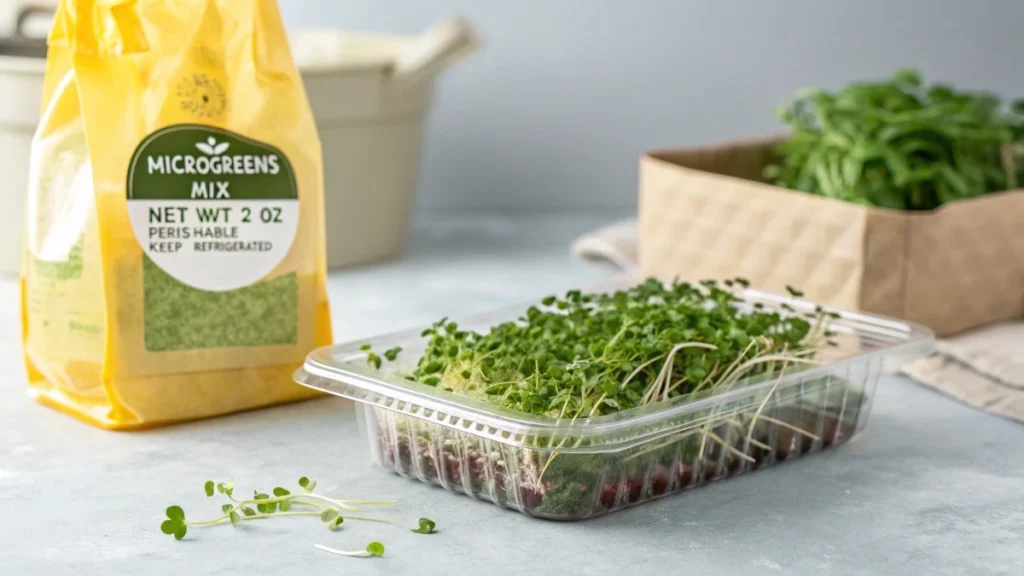
Looking for microgreens packaging ideas that actually work at the table and on the shelf. This guide shows how to choose food-safe materials, match formats to your sales channels, and build labels that stores accept.
You will see when a clear clamshell makes sense and when a simple produce bag delivers longer shelf life with a snug twist tie. We cover proven sizes like 5×5 for two-ounce retail packs, 8×8 for around eleven ounces, and 12×8 for twenty-plus ounce mixes.
We also talk about cost since clamshells can run about four times more than bags. Use these practical steps to boost freshness, speed, and presentation, and trust.
Why microgreens packaging matters and what good looks like
Packaging decides how long microgreens stay fresh, how safe they are to eat, how your brand shows up on the shelf, and whether the numbers work at the end of the week. A clear clamshell lifts visual appeal and shields tender stems in transit so the pack arrives looking crisp. The flat lid gives you a clean canvas for a readable label and a scannable barcode, which helps stores process inventory without fuss and helps shoppers see ingredients and weights at a glance.
Cost and storage are the quiet drivers behind every choice. One grower moved from simple bags to clamshells and saw packaging cost rise by about four times. That upgrade can make sense for retail presentation, but it will squeeze margins in price-sensitive channels. Clamshells also take up space. Buying cases to get better unit pricing means stacks of nested shells filling shelves and coolers. Bags use far less space, and you can load them quickly when volume spikes.
The most reliable plan balances safety and shelf life with display and throughput. Many operations lean on clamshells for retail-facing items and produce bags for restaurants and bulk orders. At markets, reusable totes with a pack-to-order flow save pre-pack time, create natural booth activity, and let you build custom mixes that match what shoppers want that day.
Food safe first
Anything that touches microgreens should be approved for food contact. The simple way to ensure that is to buy from suppliers who carry food-approved materials and can provide a certificate of compliance when you ask. This is especially important when a deal looks unusually cheap. A certificate confirms that the plastic or paper is suitable for direct contact with fresh produce.
Oversight exists in every region. In Canada, the Canadian Food Inspection Agency regulates materials that contact food. In the United States, the Food and Drug Administration fills that role. Wherever you operate, keep documentation on file and align with the authority in your area so you can answer questions from retailers and health inspectors without delay.
Reusable containers deserve the same care. If you use totes for market work or restaurant deliveries, select plastics that are appropriate for food, choose lids that seal tightly, and check that the footprint fits your coolers and fridges. Support that hardware with a simple written routine for washing and sanitizing so every tote returns to service in a safe state.
🌿 Recommended Microgreens Supplies |
Match the package to the sales channel.
Retail grocery rewards clarity and consistency. A five-by-five-inch clamshell fits common produce shelving, looks tidy when faced, and protects delicate leaves from stacking and customer handling. The lid takes a front-facing label and barcode, which reduces friction for receiving teams and keeps your product compliant on the shelf. For microgreens on a standard shelf, two ounces in a small clamshell is common, with larger shells reserved for mixes or family-size packs.
Restaurants and grocers who buy in bulk want speed and price. Standard produce roll bags are cost-effective and make fast work of packing. You can fill large volumes quickly and label by weight, lot, and date without slowing the line. In this channel, the product itself does the selling, so the extra cost of large clamshells rarely pays back.
Farmers’ markets reward flexibility and interaction. Reusable totes paired with pack to order service let you cut prep time and offer custom mixes on the spot. Shoppers notice when you are weighing, filling, and sealing. That motion draws people to the booth and turns questions about flavor and use into sales. It also keeps inventory lean since you pack what leaves the table rather than guessing before you travel.
As an Amazon Associate, Microgreens Hub may earn from qualifying purchases.
Format options with real numbers
Clamshells
A small clamshell, around five by five by three inches, is a reliable workhorse for retail microgreens. It commonly carries two ounces and can hold up to about three ounces for denser crops such as peas. A mid-size option at eight by eight by three and a half inches works well for mixed microgreens at roughly eleven ounces. A larger size, at twelve by eight by four inches, can carry more than twenty ounces when you combine microgreens with lettuce or spinach.
Some operations standardize by weight as well as by size. A mini pack at zero point seventy five ounces serves as a sampler. A standard retail pack at one point five ounces offers an approachable price point. A three-ounce pro pack is useful for catering and restaurants that want a bit more volume while staying in a tidy container.
Clamshells bring strong protection and a crystal clear display. They are recyclable in many programs, and the rigid lid makes label placement simple. Watch for two tradeoffs. Closure can pinch stems and bruise tender greens during packing. Storage space adds up quickly, and most teams test several sizes before finding the best fit. Some growers try compostable or recycled content options. Outcomes vary, and several report that regular rigid plastics may be more likely to enter existing recycling streams than certain soft or compostable formats.
Produce bags
Bags shine for shelf life and unit cost. With a snug twist tie, microgreens in a produce bag often outlast the same product in a clamshell. Bags are cheaper per unit, which is attractive for bulk and foodservice. Clear one-gallon and half-gallon bags suit lettuces because shoppers expect to see the leaves. A half gallon has been used successfully for about four ounces or a single head. A one-gallon container has been used for about eight ounces or two to three heads. For microgreens, colored breathable bags have shown excellent longevity in day-to-day use. Keep end of life in mind since soft plastics are often harder to recycle than rigid ones.
Reusable totes
Reusable bins support markets and large restaurant drops. The right bin has a tight-fitting lid, stacks cleanly in your cooler and fridge, and uses materials that are suitable for food contact. Track these totes since they cost more upfront and can wander. Sanitation is essential. Each cycle should include washing and sanitizing before the next load.
Labeling that meets grocery expectations
Labels do more than name a product. They signal professionalism, help retailers receive and scan inventory, and guide customers on storage and use. A budget-friendly starting point is a four-by-two-inch printable sheet. With a clean layout, you can include the variety name, net weight in ounces and grams, storage guidance, and your brand identity. These labels work on bags and on small clamshells and let you improve the design as you learn.
For five-by-five clamshells, a three-by-five-inch label is a smart fit. Place it so the lower edge sits on the base ridge, and the top reaches the lid. That position keeps the barcode facing forward and also acts as a light seal across the opening. It looks neat on the shelf and helps reduce extra handling. For larger eight-by-eight and twelve-by-eight shells, a five-by-five-inch label provides space for a full ingredient list for mixes, a clear brand mark, a storage reminder that the item is perishable and should be kept refrigerated, and a barcode that scans cleanly.
Most grocery buyers will ask for a UPC. Reserve clear space for it and test the barcode with a basic scanner before delivery. Include the pack date or lot code for traceability. Keep weights consistent across your line so shoppers and staff can compare similar products without confusion. Keep typography legible. A label that is easy to read builds trust and reduces friction at the register, which is exactly what you want when you introduce a new microgreens brand.
Shelf life engineering for microgreens packaging
Microgreens packaging ideas work best when moisture and temperature are managed from the first cut. The fastest gains come from simple steps that keep water away from leaves and stems while maintaining a steady chill. A short rest under a fan for wetter crops such as radish reduces surface moisture before mixing and packing. Uniform dryness across components makes mixes look brighter and slows early breakdown inside the package.
An absorbent liner adds another layer of control. A single sheet of paper towel placed in the clamshell base captures condensation that forms as packs move from prep to the cooler and then to display. Some growers place liners under a UV lamp before use to keep them as clean as possible. The goal is simple. Prevent water pooling, and you extend life without changing the product.
Filling density matters. A five-by-five clamshell that comfortably holds two ounces will look full without pressing leaves against the lid. Pressed greens bruise easily and release moisture that fogs the window. Dense crops like peas can reach about three ounces in a small shell because the stems support themselves. Large mixed packs sit better in an eight by eight clamshell at roughly eleven ounces or in a twelve by eight by four when you move beyond twenty ounces with lettuce or spinach added.
Temperature closes the loop. Move finished packs to the cooler right away and keep the cold chain tight during transport. Use sealed totes to block warm air while loading and unloading. Bags benefit even more from a steady chill since the film retains humidity around the product. A snug twist tie on a produce bag often delivers longer life than an equivalent clamshell because the microclimate stays stable as long as free water is controlled.
Cut consistency helps too. Trimming tough ends from pea shoots and cutting into thirds gives a uniform texture that packs evenly. Even packing reduces compression points and keeps stems from breaking during closure.
Sanitation and workflow that scales
Food safety and speed can live together when the sequence is clear. Protective gear goes on first, with hair nets and clean gloves. Tools get attention before the first cut. Wipe away debris, then sanitize scissors and surfaces. Many teams keep a bottle of a hydrogen peroxide mix at the station so they can re-sanitize quickly between varieties. Gloves are treated the same way. If you touch your face or step away, swap for a new pair and sanitize again before returning to the table.
Staging reduces waste. Keep the work area organized with trays for each component of a mix. Delicate items such as amaranth are harvested early and set aside to stay clean. Components that arrive a little damp get a brief fan session before mixing. When the mix is ready, toss by hand in a clean tote so colors and textures distribute evenly. Place liners in clamshells ahead of time so the pack step becomes fill, close label, and move to the cooler in one motion.
Finished trays of greens can return to the rack after the first cut if the crop and schedule allow for regrowth. This practice lowers waste and keeps a steady supply for repeat orders. The key is to maintain the same sanitation standard during and after the harvest, so the next flush is as clean as the first.
Reusable totes need their own routine. Choose food suitable for plastics with tight lids. Confirm dimensions match your fridges and coolers so stacks are stable. Track each bin because replacement costs add up when a few go missing. Clean and sanitize totes between cycles and store them closed so the interior stays clean until the next load.
Cost storage and sustainability trade-offs
Clamshells look great on a shelf, but they can be expensive. One operation that moved from simple bags to clamshells saw packaging costs rise by about four times. That increase can be more than the margin on a small pack if the price point is tight. Bags keep costs low and move fast down the line, which is why restaurants and bulk buyers prefer them.
Storage is the second lever. Clamshells arrive in large cases that occupy shelves in dry storage and take space in coolers once labeled and filled. Bags arrive in compact rolls that sit in a small bin. If you are testing sizes, ask suppliers for samples and run a few dry fits in your fridge and cooler. Pay attention to the way lids snap. Some closures can catch stems and bruise them during packing, which shortens their life and spoils the look.
Sustainability choices are rarely one size fits all. Rigid plastic clamshells are recyclable in many areas, and some suppliers offer options made from recycled content. Soft plastics can be harder to recycle in practice, which is important when you are deciding between bags and shells. Biodegradable or compostable items do not automatically deliver a better outcome if they are not collected and processed correctly. Some customers will pay a little more for recycled content or a clearly recyclable material. Balance that willingness against your unit costs and your channel. Stores that highlight eco stories may prefer recycled content shells for front-facing displays, while restaurants may prefer the lowest cost bag that delivers freshness.
Plug and play SKU map for microgreens packaging
Retail microgreens
A five-by-five clamshell is the standard for small packs and fits most produce shelves. Two ounces is the common fill. Dense items such as peas can reach about three ounces in the same shell. When you need a larger retail unit for families or mixes, move to an eight-by-eight clamshell at around eleven ounces. A twelve by eight by four shell works when you bundle microgreens with lettuce or spinach and want more than twenty ounces.
Sampler and specialty
A mini clamshell at zero point seventy five ounces works as a trial size or an add-on at markets. A one point five ounce standard is another familiar choice that fits retail price ladders without jumping to a full two ounces. A three-ounce pro clamshell serves restaurants and catering that want a tidy unit for garnishes and small plates.
Lettuce and leafy blends in bags
Half-gallon clear produce bags have been used successfully for about four ounces or one head. One-gallon clear bags have been used for about eight ounces or two to three heads. Customers expect to see lettuce through a clear film, which is why clear bags win here. For microgreens, many growers report strong results with colored breathable bags that keep quality high when sealed with a tight twist tie.
Channel mapping
Grocery shelves favor clamshells because they protect the product and present a wide label face with a UPC. Restaurants and grocers buy bulk lean toward bags because they pack quickly and cost less. Farmers’ markets sit in the middle, where reusable totes and pack-to-order service let you fill either clamshells or bags on demand.
Quick decisions and checklists that keep you moving
Fast choices for common scenarios
If you need shelf appeal and protection for a small unit, choose a five-by-five clamshell at two ounces with a clear label across the front. If you need the longest life on a tight budget, choose a produce bag with a snug twist tie and keep the pack cold. If you need flexibility at a market, bring reusable totes and pack to order so shoppers can request custom mixes while you keep prep time low.
Supplier checklist for microgreens packaging ideas
Ask for a food contact certificate for every material. Request samples to test closure strength and stem pinch. Confirm lids are tight so stacks do not open in transit. Measure case sizes and confirm that stacked clamshells or totes fit your cooler and fridge. Check lead times and case counts so you are not short in peak weeks.
Label checklist that meets store expectations
Reserve space for a UPC and confirm it scans before delivery. Include product name and variety, ingredients for mixes, net weight in ounces and grams, a clear statement that the item is perishable and should be kept refrigerated, and a pack date or lot code. On a five-by-five clamshell, place a three-by-five label so it spans the ridge, which keeps the barcode facing forward and adds a light seal. On eight-by-eight and twelve-by-eight shells, use a five-by-five label so everything stays legible at a glance.
Quality control before the cooler
Look for dry leaf surfaces and no visible pooling near the liner. Check that stems are not trapped in the closure. Confirm the fill sits level without compressing the product. Move finished packs to the cooler immediately and keep doors closed as much as possible during loading. These small habits turn good microgreens packaging ideas into reliable shelf life that shoppers notice.