
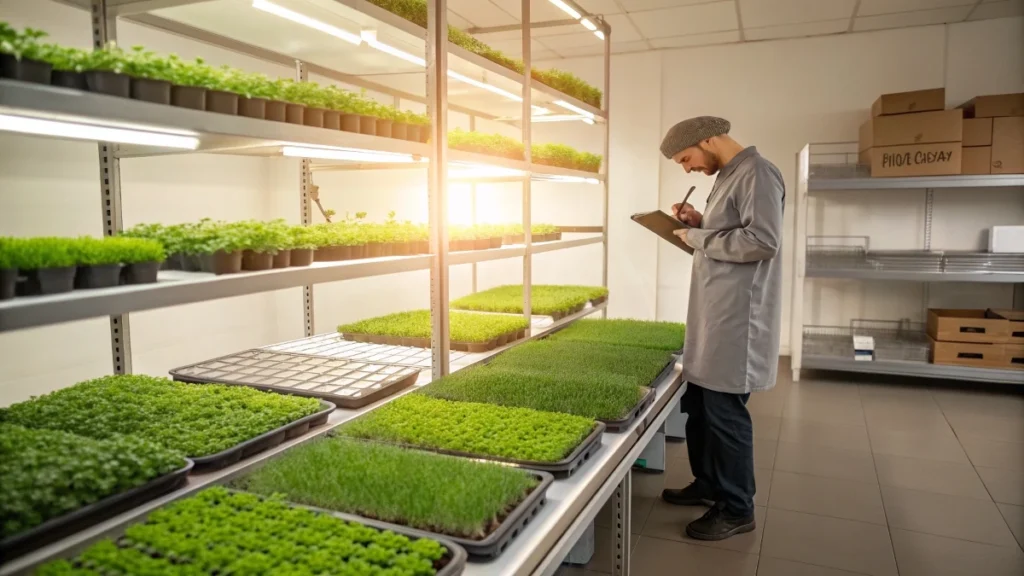
Starting a microgreens business can be rewarding, but understanding the permits and licensing requirements is what separates a hobby grower from a legitimate enterprise. Every sales channel, whether farmers’ markets, restaurants, or online stores, comes with specific rules and costs.
In many states, living trays sold directly to customers do not require a food license, while cut and packaged greens often need retail or manufacturing permits. Business registration, food handler training, and labeling standards are also part of the setup.
This guide explains the requirements, costs, and step-by-step process to help you start selling microgreens legally, confidently, and ready to grow a successful and compliant business.
What Counts as Processing versus Produce
Living trays versus harvested microgreens
A living tray is sold with roots and growing media intact. It is treated much like whole produce because the consumer finishes the last step by cutting it at home. There is no cutting or mixing by the seller at the point of sale. For many local markets, this falls under whole produce rules rather than packaged foods. It still benefits from a clean grow room and clear care instructions. A simple care card works well. Keep near a bright window. Mist lightly. Harvest within three to five days for the best flavor.
Harvested microgreens are different. The crop is cut above the seed line and packaged by the grower. From a regulator’s perspective, this becomes a ready-to-eat item. That change means more attention to clean tools, clean hands, and cold holding because the product is no longer protected by its growing media. If you cut and pack once with no washing or mixing, many jurisdictions view it as minimal handling. The moment you rinse in a sink, blend mixes, or portion across many containers, you move deeper into processing territory.
Single cut and pack at the farm versus multi-step processing
A single cut followed by immediate packing and refrigeration reduces exposure time. Build a habit of sanitizing scissors before each tray, lining a clean table with food-grade paper, and getting clamshells into the cooler within fifteen minutes. Use a timer on harvest days so the routine never drifts.
Multi-step work raises the bar. Washing microgreens, mixing multiple varieties, or repacking for a reseller are common triggers for higher-level permits. If you plan to wash, invest in potable water testing, dedicated salad spinners used only for greens, and a written cleaning schedule. Document each step with dates and initials, so you have proof during an inspection.
Why are sprouts regulated differently from microgreens?
Sprouts are germinated and eaten with the seed attached after warm and moist conditions that favor bacterial growth. That is why inspectors treat sprouting as a specialized process. Microgreens are grown in media with light and air flow. You harvest above the seed hull and do not consume the root zone. The risks and the rules are not identical. Keep your product and your marketing language clear so you are not evaluated as a sprout producer when you are not sprouting.
🌿 Recommended Microgreens Supplies |
Sales Channels Determine Your Permit Path
Direct to consumer at farmers’ markets and subscriptions
When you sell face-to-face at a farmers’ market or deliver a weekly box to homes, you are the retailer. Living trays commonly sit under produce rules. A single cut and pack sold by you directly is often allowed with basic vendor approval and simple labeling. Market managers focus on clean display, cold storage, and honest weights. Bring a calibrated scale if you sell by weight. Keep a log of thermometer readings for coolers. Consistency builds trust with inspectors and customers.
Restaurant and grocery sales as wholesale
The moment your product is sold to another business that resells it, the rules usually change. Wholesale customers expect uniform packs, lot codes, and invoices. Many states require a food manufacturer or wholesaler license for this channel. Distributors also ask for a certificate of insurance and a recall plan. Price your cases to cover added compliance costs. Plan for mock recalls twice a year so your records prove you can trace a lot within minutes.
Online orders, delivery, and third-party resellers
Direct online sales mimic retail but bring packaging and transit time into the safety picture. Use insulated mailers or rigid coolers for local courier delivery and include a cold pack for any route longer than one hour. If a third-party store lists your product and fulfills from its own refrigerator, this can be treated as resale. Clarify who owns the food while in storage. The answer determines who holds the permit and who carries recall risk.
The Core Permits and Licenses You May Need
Business registration and local tax IDs
Register the business name and secure a local tax account so you can collect and remit any required sales tax. Fees for a basic registration often fall between fifty and three hundred dollars, depending on your city and entity choice. Keep your registration certificate in a binder you bring to market.
Retail food permit versus food manufacturer license
A retail food permit applies when you sell directly to the final customer and handle ready-to-eat food. A food manufacturer’s license is aimed at making and packaging food for resale or for self-service. If you cut, mix, and package for grocers or restaurants, expect to be evaluated under manufacturing rules. Ask your local health office which permits maps to your exact workflow. Share your floor plan, equipment list, and a sample label so the decision is easy and quick.
Cottage food laws and why fresh microgreens rarely qualify
Cottage food programs focus on shelf-stable items with very low moisture. Fresh-cut greens have high moisture and need refrigeration. That is why most cottage lists do not include microgreens. If you plan to sell value-added items like shelf-stable seasoning salt that uses dried greens, that item may qualify, while your fresh packs do not. Treat them as separate product lines with separate rules.
City or market vendor permits and inspections.
Many cities require a seasonal vendor permit for market booths. Markets may also require proof of a food handler certificate. Expect fees between fifty and five hundred per season. Read your market handbook carefully. Some require a handwash station with warm water and paper towels at your booth, even if you bring prepacked clamshells.
🌿 Recommended Microgreens Supplies |
Labeling Essentials For Packaged Microgreens
Product name, net weight, farm identity pack, or harvest date
Keep labels simple and truthful. List the common name such as pea shoots or radish microgreens. Provide net weight in both ounces and grams. Include your farm name and a way to reach you. Add a pack or harvest date so buyers can rotate stock. For living trays, a care date and best-by window help reduce waste.
Storage statements like Keep Refrigerated
A clear storage statement sets expectations and satisfies inspectors. Keep Refrigerated is the standard line for cut greens. Many growers add Rinse Before Use to guide the customer. Use waterproof labels so condensation does not blur text in the cooler.
When lot codes and allergens apply
If you sell to restaurants or stores, add a lot code that ties a package to a single harvest session. A simple format is year, month, day, plus tray batch. Allergens are rare for plain microgreens, but if you add seeds or toppings, confirm whether any are major allergens and state them plainly. Clean the table and tools between mixes to avoid cross-contact.
Food Safety Foundations Inspectors Look For
Clean harvest workflow tool: sanitation and water quality
Start with a daily checklist. Sanitize scissors and knives. Wash your hands. Line the work table. Use potable water if you rinse. Keep a spray bottle of sanitizer and test strips to verify concentration. Replace cloth towels with single-use paper towels on harvest days. Record each task with initials and time. This small habit shows control and becomes your best defense during audits.
Time and temperature practices for cut greens
Cut greens benefit from rapid cooling. Move filled clamshells to a refrigerator or iced cooler at once. Aim to hold the product at refrigerator temperature during storage, transport, and display. Use a probe thermometer to validate your cooler before every market and keep readings with dates in your binder.
Transport and market day cold holding
Transport in closed totes so the sun and dust stay off the food. At the booth, place coolers in the shade. Open only when you need to restock the display. A small digital thermometer with a visible face helps you and the inspector. If the market lasts more than four hours, plan a second set of ice packs to swap at midday.
Step-by-Step Setup Blueprint
Choose the sales mode and map the matching permits.
Decide if you will start with living trays only or add single-cut packs. Decide if you will sell only to end customers or also to restaurants. This choice sets your permit path. Write it down so you can explain it clearly to the health office and the market manager.
Register the business and get tax IDs.
File your chosen entity and secure any local sales tax account. Order an inexpensive binder and keep copies of the filings inside,e along with your identification. Create a digital folder with the same files in case a buyer requests them by email.
Secure the right permit for your channel.
Call your local health office with a one-page summary of your workflow. Include an equipment list such as shelves, trays,s scissors, sanitizer cooler, and refrigerator capacity. Ask which permit matches that workflow. Confirm application fees and inspection timing. Submit a simple floor plan that shows where you harvest, pack, and store.
Set up labeling batch logs and cold chain.
Design a small label that includes product name, weight, farm identity, and storage statement. Number each harvest session with a lot code. Keep a log that ties each lot code to the date and the trays used. Verify your refrigerator holds temperature when fully loaded. Record the readings.
Prepare your market vendor packet and standard operating procedures
Markets appreciate organized vendors. Build a packet with copies of your registration permit, food handler card, and product labels. Add one page of standard procedures for harvest and booth setup. Bring a handwash setup if your market requires it. Keep the packet in your cash box so it is always on site.
Costs To Expect and How To Budget
Business registration and filings
Plan a small setup budget even for a lean launch. A basic business name filing or DBA commonly falls in the range of fifty to one hundred dollars. Forming a simple limited liability company often costs between one hundred and three hundred dollars, depending on your state’s filing fees. Build this into month zero so there are no surprises.
Health permits and market fees
Local retail permits and farmers market vendor fees vary widely. Many growers report seasonal market fees in the range of fifty to five hundred dollars. If your model requires a food manufacturer or wholesaler license, expect an annual fee that can range from two hundred to one thousand dollars based on facility size and state schedules. Set aside funds for an initial inspection if your jurisdiction charges separately.
Training and certifications
Some markets and health districts ask for a food handler card for each person who serves customers. Online courses often cost between ten and thirty dollars per person. A food manager course is more advanced and can run between eighty and one hundred fifty dollars when required.
Labels, tools, and cold chain
A starter pack of waterproof labels and a basic scale usually costs under one hundred dollars. Two reliable thermometers and sanitizer test strips add another thirty to fifty dollars. For cold holding, plan on one quality cooler plus ice packs per booth table. A practical starting setup often totals one hundred to two hundred dollars.
Annual planning
Create a simple cash flow sheet. List one-time costs in the first month and spread annual fees over twelve months so you know the true monthly cost of staying compliant. This keeps pricing honest and protects margins as you grow.
Texas Example from Real World Calls
Living trays are sold by you directly.
Growers who sell living trays directly to customers often operate under whole produce expectations. The product leaves the booth with roots and media intact. You provide care guidance, and the customer harvests at home. This path is frequently used by small farms because it fits cleanly within produce rules at many markets.
One cut and pack is sold by you directly.
Many Texas growers report that a single cut and immediate pack for direct sale has been allowed at markets when basic sanitation and labeling are in place. The focus remains on clean tools, simple labels, and cold holding. You are the seller, and the product goes from you to the end customer.
When resale enters the picture
If you sell to a cafe or grocer that will resell your product, you move toward manufacturer or wholesaler licensing in many cases. Private label or self-service packaging can also change your permit category. Before you promise cases, call your local authority and describe your exact workflow. Clear communication up front prevents delays later.
Confirm the local layer.
Texas health rules are interpreted through state and local offices, and each farmers’ market can add its own requirements. Always confirm with your specific city health office and the market manager. A short call with a one-page summary of your process often saves weeks of back and forth.
Insurance LLCs and Risk Separation
What permits do and do not do
A permit allows you to operate within food rules. It does not absorb liability if something goes wrong. You still carry the business risk. Insurance and thoughtful structure add the safety net that a permit alone cannot provide.
Liability coverage basics
A general liability policy with product coverage is common for food businesses. Entry-level policies for small vendors can start around three hundred to six hundred dollars per year, depending on limits and location. Ask for a certificate of insurance that names a market or restaurant as additional insured when required. Keep copies in your vendor binder.
Where an LLC helps
An LLC can help separate business obligations from personal assets when it is formed and maintained properly. It also creates a clean home for contracts and insurance policies. It is not a shield against careless practices. Keep records, follow your procedures, and treat the LLC as a real business with its own bank account.
Documentation You Should Keep from Day One
Safety and sanitation logs
Create a simple set of checklists that you complete on harvest days and market days. Include tool sanitation, handwashing reminders, and sanitizer concentration checks. Record the date, time, and initials. These small logs tell an inspector that your process is controlled.
Harvest and temperature records
Assign a lot code to each harvest. Record the date, crop, tray count, and who harvested. Note refrigerator temperatures at the start and end of the day. Keep market cooler readings at setup, midday, and breakdown. Three data points per market day provide a clear picture of control.
Label proofs and supplier records
Save a printed copy of each label version with the date you started using it. Keep invoices or receipts for seeds, substrates, and packaging. If you test water or sanitize with test strips, file the results. A tidy folder with these items turns a stressful inspection into a short visit.
Inspection Day Playbook
What inspectors often check
Expect a look at your handwash setup if required by your market, the condition of tools and cutting surfaces, and the temperature of your cooler. Labels should be clear and accurate. Your binder should include permits, insurance certificates, certifications, and logs.
Small fixes that prevent common issues
Bring extra paper towels and extra gloves. Keep a backup thermometer in case one fails. Store personal items away from food. Keep the booth clean and uncluttered so the food area looks intentional. Replace any cracked containers that are hard to clean.
How to respond and document corrections
If an inspector points out a gap, thank them, correct it on the spot when possible, and note the change in your log with the date and the specific fix. Send a short follow-up email with a photo if they ask for proof. Professional communication builds trust and shortens future visits.
Scaling Up Without Surprises
Moving from retail to restaurants and grocers
Restaurants and grocers need consistent pack sizes, lot codes, and reliable delivery windows. They may ask for a mock recall drill. Practice by picking a recent lot and tracing it from seed to customer in five minutes. If it takes longer, tighten your logs.
Private label and self-service packaging
If a store wants your greens under their brand, confirm who holds the permit and who is responsible for recall notices. If your packs will sit in a self-service cooler, rules may shift toward manufacturing. Ask the regulator to review your label and packaging plan before you print thousands of clamshells.
Facility choices as you grow
Some farms keep harvest in a home workspace while renting a small commissary room for washing and packing. Others build a dedicated room with washable walls and a hand-wash sink. List the requirements from your permit category and choose the most practical path that meets them. Plan electrical capacity for refrigeration before adding more accounts.
🌿 Recommended Microgreens Supplies
These are the tools and supplies I personally recommend for growing healthy and flavorful microgreens at home.
As an Amazon Associate, I earn from qualifying purchases.