
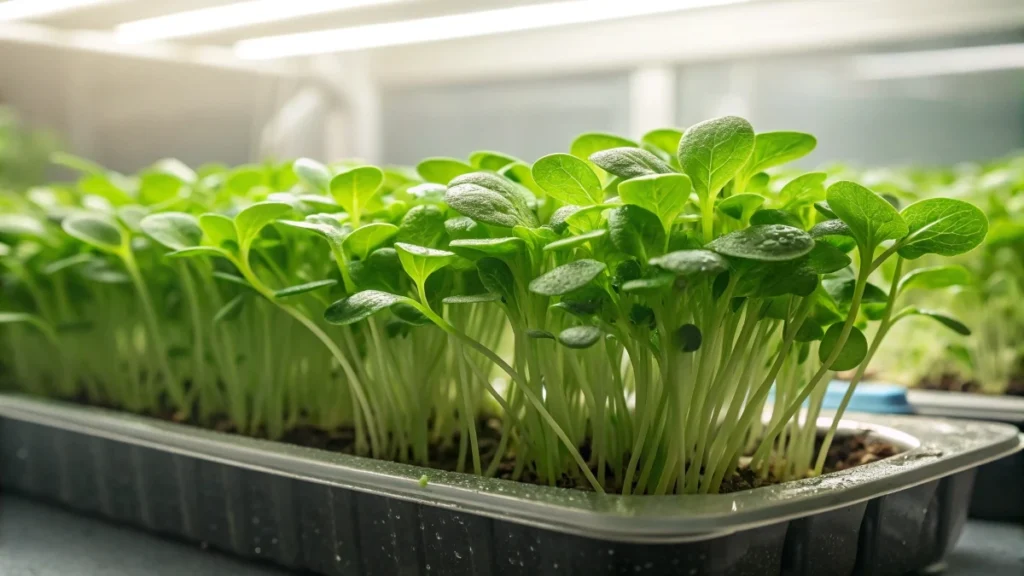
Chinese cabbage microgreens bring a clean brassica bite with a soft crunch and a hint of sweetness. They look delicate but stand up well in bowls and sandwiches. Most growers use Napa types for a mild, juicy green that finishes quickly and colors evenly.
In a small space, you can take them from seed to plate within one to two weeks, which makes them friendly for beginners and efficient for a basement rack.
Flavor is best when cotyledons are fully open,n and the first true leaves are just about to show. At that moment, you get tenderness, bright color, and a gentle mustard note without harsh spice.
Why growers choose Chinese cabbage
They germinate fast. They forgive minor mistakes in moisture. They do not need nutrients in most cases. They fit a tight crop plan because you can stagger trays every two to three days and maintain a steady supply. Chefs like the uniform leaf shape, and home cooks like the fresh crunch that does not wilt quickly on warm food.
Quick Facts and Growth Overview
Chinese cabbage microgreens are among the quickest brassicas to finish. Plan your room and schedule around these benchmarks and then fine-tune to your environment.
Timing
Sowing to harvest usually takes 7 to 10 days at room temperatures in the low twenties Celsius. If your space sits cooler at night near 18 Celsius, expect the long end of the range. If you can hold 21 to 23 Celsius consistently, you will often harvest a day sooner.
Seeding rate
For a standard 10-by-20 tray, 20 to 30 grams of seed is the sweet spot for dense, even coverage without matting. For a 10 by 10 tray, use 10 to 15 grams. Start mid-range, then adjust by one or two grams based on your cultivar and media. Too light gives wispy stands. Too heavy a rain raises humidity in the canopy and invites damping off.
Light
After a blackout, aim for a photosynthetic photon flux density of around 150 to 250 micromoles per square meter per second with a photoperiod of 14 to 16 hours. This range fuels sturdy stems and broad cotyledons without toughening the leaves. If you see stretch, increase intensity, or lower the lights a little. If leaf edges curl downward or look washed out, you may be too intense or too close.
Temperature and humidity
Hold the room near 20 to 22 Celsius during the day and allow a slight night drop. Keep relative humidity around 45 to 60 percent with light air movement. Higher humidity slows transpiration and can soften stems. Lower humidity taxes watering and may lead to tip burn near harvest.
Yield and harvest height
Expect 300 to 500 grams of fresh weight from a well-grown 10 by 20 tray at the seeding rates above. Harvest at 5 to 7 centimeters from the media surface. That height keeps stems juicy and keeps cut debris out of the clamshell.
🌿 Recommended Microgreens Supplies |
Selecting and Preparing Seeds
Seed quality drives uniform stands and clean flavor. Choose untreated seed with a germination percentage in the mid to high nineties when available. Napa types labeled for microgreen use are consistent and give broad cotyledons that plate well.
Variety notes
Napa or wong bok lines produce mild, juicy greens with bright green leaves. Tatsoi gives a deeper green and a slightly stronger brassica note with spoon-shaped cotyledons. Pack Choi sits in the middle with a balanced flavor. If you plan mixed trays, keep varieties with similar timing so you can harvest all at once.
Germination checks
Before you invest in a large bag, run a small towel test with one gram of seed. Moisten a paper towel, spread the seeds, cover, and keep warm at 22 Celsius. You should see strong, even radicles within 24 to 36 hours. If many seeds lag beyond 48 hours, expect patchy trays.
Seed sanitation
Brassica seeds are smooth and easy to sanitize. A common approach is a short soak in a food-safe sanitizer at the label rate, followed by thorough rinsing with clean water and quick drying on a mesh. Use potable water for all rinses. Good sanitation reduces early losses and keeps your postharvest shelf life consistent.
Best Setup for Indoor Growing
Focus on tools that improve uniformity. You do not need fancy gear to grow excellent Chinese cabbage microgreens.
Trays and lids
Use rigid 10-by-20 trays without holes nested over shallow trays with holes for the crop. This lets you bottom water without splashing the canopy. Shallow dome lids or an empty tray on top work well during blackout and make stacking simple.
Lights and placement
LED bars or panels with an even spread are ideal. Place lights 25 to 35 centimeters above the canopy after blackout, then adjust to hit your target intensity. A basic handheld meter or a reliable phone-based PPFD app gives useful guidance.
Growing media
Chinese cabbage thrives on fine-textured media. A light potting mix with coco and peat is forgiving and holds moisture evenly at a depth of around 1 centimeter. Coco coir alone also works with careful moisture control. Hemp or jute pads keep cleanup quick and pair well with bottom watering, though first-time users should watch moisture to prevent dry corners. Choose one medium and master its water-holding pattern before you experiment.
Space and airflow
A simple wire rack with two to four tiers and a small clip fan per tier is enough for a starter system. Aim the fan across the aisle rather than straight into the canopy. You want gentle leaf movement, not wind stress.
Self-watering options
If you prefer lower daily labor, a capillary mat under hole trays inside a watertight tray can extend intervals between waters. Check that the mat stays evenly moist and refresh the reservoir with clean water every day.
Sowing and Germination
Even coverage and proper moisture at the start set the tone for the whole crop.
Media prep
Fill trays with your chosen medium to about 1 centimeter depth. Level the surface and press lightly so seeds have contact points. Pre-moisten until the surface is uniformly dark and cool to the touch. If free water pools when you tilt the tray, it is too wet. Let it drain for a few minutes.
Seeding
Spread the seed evenly by hand or with a shaker. You should see a close, single layer of seeds without stacking. Lightly press seeds into the surface with a clean tray or a roller so each seed touches the medium. Do not bury.
Blackout and weighting
Mist the surface lightly, then place a clean, empty tray on top as a blackout cover. Add a small weight across the tray so seeds bond with the medium while they push roots. Two to three days is enough for Chinese cabbage. A warm room of around 21 to 22 degrees Celsius keeps the blackout short. Check once daily. If the surface looks dry, remove the cover briefly and mist.
First check after the blackout.
When most seedlings are two to three centimeters tall with seed coats shedding, remove the cover and move the trays under lights. If many seed coats cling, you can mist once and gently brush the canopy with a clean hand to release husks. Do this only once to avoid bruising.
Light, Watering, and Care
Once trays are under lights, your job is steady water, steady light, and gentle air.
Light management
Set your photoperiod to 14 to 16 hours. Start with a moderate intensity and watch the stems for the next day. If stems lean or stretch, increase intensity slightly or lower the lights a few centimeters. If you see pale patches at the center under very bright fixtures, raise the lights.
Bottom watering rhythm
Switch to bottom watering as soon as trays come out of blackout. Pour clean water into the no-hole tray so the crop tray can wick for 10 to 15 minutes, then pour off any leftover. Early in the run, you may water every other day. Near harvest, daily watering is common because the canopy transpires more. The medium should feel evenly moist but never soggy. If corners dry faster, rotate trays a quarter turn at each watering.
Water quality
Use potable water with a neutral to slightly acidic pH. If you grow on hydro pads or very inert media, a very light nutrient feed once during mid growth can help keep color dark green. Keep electrical conductivity very low, in the range of 0.3 to 0.6 milliSiemens per centimeter, and keep pH between 5.8 and 6.2. Soil-based media rarely need any feed for this crop.
Airflow and humidity control
Keep a soft cross breeze over the canopy and maintain relative humidity near 50 to 60 percent. If you see moisture beading on leaves, increase airflow or slightly lower humidity. If leaf edges are crisp, you are likely too dry or too intense with light. Small changes solve most issues within a day.
Keeping trays clean and safe
Rinse watering trays daily and let them air dry. Keep tools like misters and rollers clean. If any tray shows a patch with fuzzy growth at the media surface, remove that tray from the rack and decide whether to harvest early or compost it. Early removal protects the rest of the room.
Harvesting and Post-Harvest Handling
Chinese cabbage microgreens are ready when cotyledons are fully expanded, and the stand looks even and glossy.
Readiness cues
Stems reach about 5 to 7 centimeters tall. Leaves are broad and bright green. The canopy tops out flat and even. Flavor tastes mild with a gentle sweet finish. If you wait until true leaves push hard, texture softens, and flavor gains a sharper brassica note.
Cutting technique
Chill the room if possible for one hour before harvest. Use a sharp stainless blade and cut just above the media surface while lifting the canopy with your other hand. Avoid dragging the blade through the medium. Place cuts into clean food-grade tubs or directly into clamshells.
Yield and sorting
A dial tray commonly gives 350 to 450 grams. Exceptional trays reach the high four hundreds. Remove seed coats or pale leaves during packing. Keep the product loose so air can move around the leaves.
Cooling, drying, and storage
Cool quickly after harvest. Spread a thin layer on a clean screen for a few minutes to let surface moisture flash off. Do not wash unless you must. If you do wash, spin dry gently, and pack with an absorbent liner. Store between 2 and 4 degrees Celsius. Realistic shelf life is 6 to 8 days with good airflow and stable cold. Label with the cut date for easy rotation.
Nutritional Profile and Health Benefits
Chinese cabbage microgreens sit in the same nutrient-rich brassica family as broccoli and pak choi. The leaves are tender but concentrated, so small servings deliver noticeable nutrition.
Key micronutrients
A typical 50-gram serving supplies a meaningful amount of vitamin C and vitamin K, along with folate and beta carotene. You also get minerals such as potassium and calcium in modest amounts. The bright green color signals carotenoids that support eye health. Since these greens are eaten raw, you keep heat-sensitive vitamins intact.
Phytochemicals
Brassica microgreens naturally produce glucosinolates, which convert to isothiocyanates during chopping and chewing. These bioactive compounds are studied for cell protection and normal inflammatory balance. Chinese cabbage sits on the mild end of the brassica spectrum, which makes it easy to add daily without strong bitterness.
Practical serving sizes
Use 25 to 50 grams per meal for color and crunch. That is a loose handful for a wrap or bowl and two small handfuls for a salad topper. Regular small servings tend to be easier for the stomach than a single very large serving.
Gentle on flavor and digestion
Compared with spicy mustards or radish, Chinese cabbage brings a soft bite and sweet finish. Many people who avoid strong brassicas enjoy this one in smoothies or warm bowls because the taste stays light and clean.
Culinary Uses and Flavor Pairing
Think of these greens as a fresh herb plus salad leaf in one. They brighten dishes without taking over.
Raw uses that keep color and snap.
Layer on sandwiches and wraps. Toss into mixed salads. Finish rice bowls and poke bowls right before serving. Add to cold noodle salads with sesame and citrus. The leaves stay glossy and lift dressings.
Warm uses without wilting away
Stir the miso soup off the heat. Fold into egg fried rice during the last thirty seconds. Top steamed dumplings or grilled fish. Finish a stir fry after you turn off the flame so the greens warm gently but keep their texture.
Flavor friends
Soy sauce and tamari. Sesame oil and seeds. Ginger, garlic, scallion oil, and rice vinegar. Citrus such as yuzu or lime. Mild proteins like tofu, chicken, white fish, and soft-boiled eggs. For crunch, pair with cucumber, shredded carrot, or toasted peanuts.
Recipes with Chinese Cabbage Microgreens
Sesame Ginger Microgreen Slaw
Serves two as a side
Ingredients
Chinese cabbage microgreens 80 grams
Shredded carrot 60 grams
Thinly sliced cucumber 80 grams
Rice vinegar 1 tablespoon
Soy sauce 1 tablespoon
Toasted sesame oil 1 teaspoon
Honey or maple 1 teaspoon
Freshly grated ginger 1 teaspoon
Toasted sesame seeds 1 tablespoon
Method
Whisk vinegar, soy, sesame oil, honey, and ginger. Toss vegetables and microgreens with the dressing. Finish with sesame seeds. Serve at once for the best crunch.
Egg Fried Rice with Microgreen Topper
Serves two
Ingredients
Cooked and cooled rice 2 cups
Eggs 2
Neutral oil 1 tablespoon
Garlic, minced 1 teaspoon
Frozen peas half cup
Soy sauce 1 tablespoon
Scallions 2 thinly sliced
Chinese cabbage microgreens, 60 to 80 grams
Method
Heat oil and scramble eggs soft then set aside. Sauté garlic for a few seconds. Add rice and peas and stir until hot. Return eggs. Season with soy sauce and scallions. Plate and crown each bowl with a generous handful of microgreens.
Udon With Tofu and Microgreens
Serves two
Ingredients
Fresh udon 2 portions
Light vegetable broth, 3 cups
Soy sauce 1 tablespoon
Mirin 1 teaspoon
Soft tofu cubes 1 cup
Shiitake slices 1 cup
Chinese cabbage microgreens 80 grams
Method
Simmer broth, soy, and mirin. Add mushrooms and cook until tender. Warm tofu gently. Boil udon in a separate pot, then divide into bowls. Ladle broth and toppings. Add microgreens on top just before serving.
Citrus Miso Dressing for Microgreen Salads
Makes half a cup
Ingredients
White miso 1 tablespoon
Lemon juice 2 tablespoons
Orange juice 2 tablespoons
Olive oil 3 tablespoons
Honey 1 teaspoon
Grated garlic, a small pinch
Water 1 tablespoon to loosen
Method
Blend until smooth. Toss with a full bowl of Chinese cabbage microgreens and sliced cucumbers for a fast side salad.
Growing Cost and Profit Potential
Use these example numbers to plan a small weekly cycle. Adjust to your local prices and tray size.
Example inputs per 10 by 20 tray
Seed rate: 25 grams
Seed cost assumption: 14 dollars per kilogram
Seed cost per tray is about 0.35 dollars
Growing medium 1 centimeter depth of coco or mix, about 0.60 to 0.90 dollars
Utilities and wear 0.20 to 0.30 dollars
Packaging one clamshell costs 0.18 to 0.30 dollars
Yield and pack plan
Typical fresh yield is 350 to 450 grams per tray. If you sell 50-gram clamshells, that is 7 to 9 units per tray.
Simple revenue snapshot
Price per 50-gram clamshell is 3.50 to 4.50 dollars for home delivery or small retail.
Revenue per tray is 24.50 to 40.50 dollars, depending on price and yield.
Direct costs per tray often land between 1.50 and 2.50 dollars before labor.
If harvest and packing take 20 to 25 minutes per tray, you can model a fair hourly target and set your price accordingly.
Notes that move profit
Dense and even seeding raises yield and reduces sorting time. Clean postharvest handling stretches shelf life, which reduces returns. Regular deliveries each week build steady repeat orders.
Common Issues and Solutions
Patchy germination
Cause often dry spots or old seed. Solution level the medium carefully and pre-moisten evenly. Run a quick germ test on new lots. Keep the blackout temperature near 21 to 22 Celsius.
Leggy pale stems
Cause low light or late blackout removal. Solution raises PPFD into the 150 to 250 range and uncovers as soon as most seedlings shed coats. Add a gentle cross breeze.
Damping off at the surface
Causes excess moisture and stagnant air. Solution: lighten the seeding rate if very dense. Switch fully to bottom watering after a blackout. Keep relative humidity near 50 to 60 percent and clean trays between cycles.
Yellowing after uncovering
Causes low light or cold shock. Solution: increase light gradually over the first day and hold the temperature near 20 to 22 Celsius. Color usually deepens within 24 hours.
Bitter flavor near harvest
Causes late harvest or heat stress. Solution cut when cotyledons are mature and true leaves are just peeking. Keep the room cool during the last day, and chill greens quickly after cutting.