
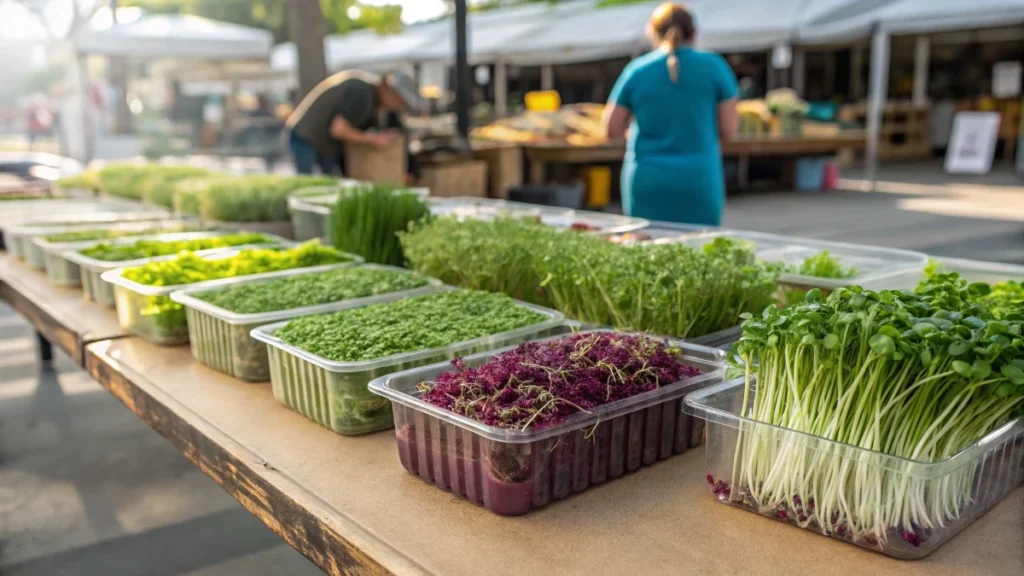
Wondering which microgreens actually sell week after week is the right question, because demand matters more than what looks cool under lights. Growers who sell consistently tend to converge on the same small crop list for one reason: customers recognize the flavors, the trays grow predictably, and the numbers work without drama.
Below is a cleaned-up, practical version of your guide that keeps your real-world tray math, pack sizes, and timelines, but reads tighter and more “ready to publish.”
The core four that outsell everything else
Broccoli microgreens
Broccoli is the weekly repeat buy for a lot of sellers because it feels safe. It has a mild taste, it fits almost any meal, and buyers already associate it with health benefits. That makes it easier to sell to first-timers and easier to sell the next weekend.
Real-world tray math
A typical tray produces about 4 to 4.5 clamshells at 2 oz each. At $6 per 2 oz, that’s $24 to $27 per tray.
Timeline
Most growers harvest around day 7 to day 10.
What keeps it consistent
A short blackout with weight helps the canopy come up straighter and more uniform. Broccoli also tends to look clean in the pack, which matters in clear lids.
Pea shoots
Pea shoots are the “looks generous” crop. A clamshell looks full, the bite is sweet and crunchy, and customers understand exactly how to use it. Peas also help your table look premium because the product has height and volume.
Real-world tray math
The common market win is 4 oz packs at $10. A well-grown tray yields about four 4-oz packs, so about $40 per tray.
Timeline
Harvest tends to land around day 9 to day 10 at roughly 5 to 6 inches.
What keeps it selling
Peas are forgiving, and they hold up well when you keep moisture steady and airflow gentle. They also work as a base green, which increases repeat demand.
Radish microgreens
Radish is a cash-flow crop because it cycles fast. It’s also a “photo crop” because the color sells the pack before the customer reads the label.
Real-world tray math
A common outcome is 7 clamshells at 2 oz each. At $6 per 2 oz, that’s $42 per tray.
Timeline
Usually day 6 to day 8.
What makes or breaks it
Radish grows thirsty, so uneven watering shows up fast. Avoid overly heavy seeding because dense canopies trap humidity and shorten shelf life in clamshells.
🌿 Recommended Microgreens Supplies |
Sunflower microgreens
Sunflowers often produce the biggest top-line number per tray. Customers love it because it tastes nutty, feels hearty, and samples extremely well at markets.
Real-world tray math
Growers often report 10 clamshells at 2 oz each per tray. At $6 per 2 oz, that’s $60 per tray.
Timeline
The common harvest window is around day 8 to day 12, depending on your setup and seed.
The tradeoff
Sunflower asks for more attention, mainly hull management and airflow. Once you standardize a seed source and a simple hull routine, it becomes a reliable top earner.
The top sellers table you can paste into your post
Assumptions based on your numbers
2 oz packs at $6 for most crops
Peas sell best as 4 oz at $10
Tray refers to a standard 10×20
| Crop | Typical harvest window | Best pack size | Packs per tray | Price per pack | Revenue per tray | Notes that affect profit |
|---|---|---|---|---|---|---|
| Broccoli | Day 7 to 10 | 2 oz | 4 to 4.5 | $6 | $24 to $27 | Easiest repeat seller. Clean packs. Strong health story. |
| Pea shoots | Day 9 to 10 | 4 oz | 4 | $10 | $40 | Looks full. Great for samples. Needs even moisture and airflow. |
| Radish | Day 6 to 8 | 2 oz | 7 | $6 | $42 | Fast cashflow crop. Do not overseed or shelf life drops. |
| Sunflower | Day 8 to 12 | 2 oz | 10 | $6 | $60 | Top revenue. Extra labor for hulls. Airflow matters a lot. |
| Golden Acre cabbage | Day 8 to 12 | 2 oz | 5 | $6 | $30 | Great crunch, strong pack weight, holds well in fridge. |
| Red cabbage | Day 8 to 12 | 2 oz | Varies | $6 | Varies | Color sells mixes. Use as a premium add in blends. |
| Wasabi mustard | Day 6 to 10 | 2 oz | Varies | $6 to $8 | Varies | Chef crop. High perceived value. Small volume, big impact. |
| Cress | Day 5 to 7 | 1 to 2 oz | Varies | $5 to $6 | Varies | Fast and peppery. Harvest on time or it flops. |
The rising stars that keep buyers curious
These are not always your biggest weekly volume, but they make your table and your menu mixes feel fresh.
- Golden Acre cabbage: steady seller, crisp texture, strong pack weight. Around 5 packs at 2 oz is common, which at $6 is $30 per tray.
- Red Acre cabbage: purple color does the marketing for you. Great in mixes to make the clamshell pop.
- Wasabi mustard types: restaurant-friendly, high perceived value, tiny amount delivers punch. Great as an “upgrade” ingredient in chef blends.
- Cress: fast and peppery, better as a specialty accent than a bulk mover because it can flop if held too long.
Why do mixes outsell singles?
Most shoppers want one grab-and-go pack that covers flavor, crunch, and color without thinking. A good mix does that and increases repeat buying because it becomes a routine item.
The fastest-moving mix many growers report
Pea + radish + broccoli
- Peas give volume and sweetness
- Radish gives color and a little bite
- Broccoli gives the “healthy” comfort story
Pack sizing that reduces friction
- 2 oz clamshells: great for broccoli, radish, cabbage, mustard
- 4 oz clamshells: peas usually sell better here because 2 oz looks light by volume
Smart packaging and pricing that actually works
Pricing sells when it’s simple. The pattern you already wrote is the one most small sellers stick with because customers learn it fast.
- $6 for 2 oz
- $10 for 4 oz peas
- Optional “step-ups” that help without complicating harvest: 8 oz and 1 lb for chefs
Label basics that improve reorders
Variety name, net weight, harvest date, and one short-use tip. Clear clamshell lids help your product sell itself, but only if you keep the greens dry enough to avoid lid fog.
The behind-the-scenes levers that protect shelf life
These matter more than people think, especially if you’re doing any light wholesale.
Seed consistency
Even germination makes your canopy look clean, and that reduces complaints. Sunflowers and peas especially reward you for testing seed sources until hulls and debris are manageable.
Coconut coir
Growers mention coir often because it holds water without staying swampy. That helps keep stems crisp and reduces the “wet pack” problem.
Airflow
A gentle fan that keeps leaf surfaces dry is one of the cheapest shelf-life upgrades you can make. It also makes sunflower hull handling easier because the crop dries evenly.
Density discipline
Heavy seeding can look great at harvest and still fail at retail because moisture gets trapped. Slightly lower density often gives longer shelf life and cleaner packs.
Best seller lineups by market type
Farmers market table
Broccoli, peas, radish, sunflower
Add one curiosity crop: red cabbage or wasabi mustard
Restaurant route
Peas as a base green
Broccoli for the health crowd
Radish for color
Wasabi mustard for punch
Red cabbage for plate pop
Grocery and light wholesale
Keep it boring on purpose
Broccoli, peas, radish, sunflower
One ready mix: pea + radish + broccoli
Quick profit snapshot
Here’s your tray math in one place, so planning is easy.
- Sunflower: 10 x 2 oz at $6 = $60 per tray
- Radish: 7 x 2 oz at $6 = $42 per tray
- Peas: 4 x 4 oz at $10 = $40 per tray
- Golden Acre cabbage: 5 x 2 oz at $6 = $30 per tray
- Broccoli: 4 to 4.5 x 2 oz at $6 = $24 to $27 per tray