
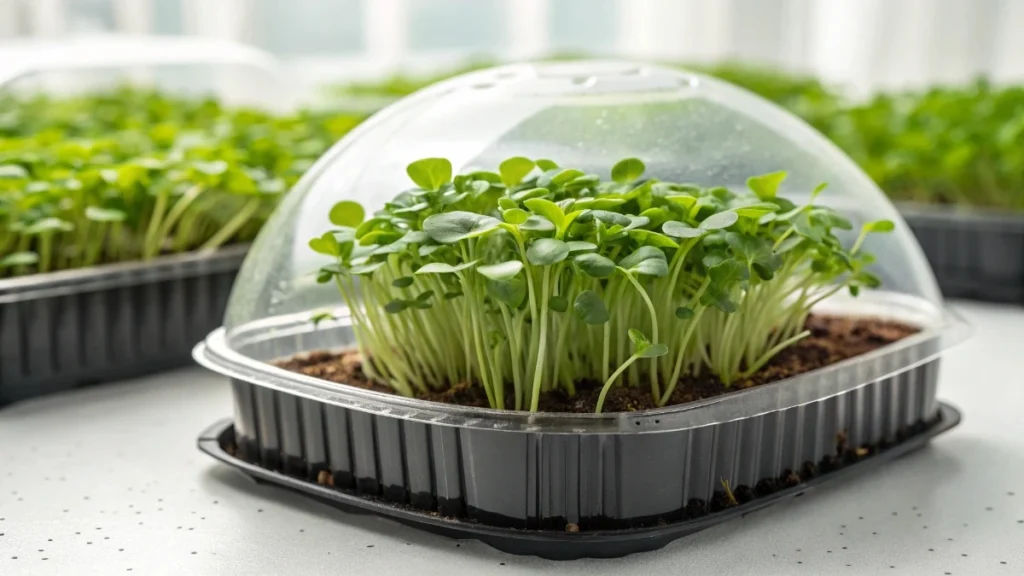
If you’re serious about growing microgreens at home or for profit, the right seed tray and humidity dome can make or break your harvest. Flimsy containers, poor drainage, and uneven moisture lead straight to mold, weak roots, and disappointing yields.
In this guide, we review the best seed trays and humidity domes for microgreens, including deep-dive pros and cons, durability, and ease of use.
You’ll discover which systems work for dense 1020 microgreen trays, blackout and germination, and small test batches. Whether you’re a beginner or scaling a microgreens business, this buying guide will help you choose equipment that boosts growth, delivering healthy, flavorful, nutrient-packed microgreens in every harvest cycle.
Top 5 Picks
Microgreens don’t behave like regular seedlings. They like:
- Shallow, wide trays for even growth
- High humidity at germination, then good airflow
- Bottom watering or careful surface watering to avoid mold
Below is how each of your five products performs specifically for microgreens, not just general seed starting.
1. 5-Pack No Drip Seed Starter Trays with 4″ Humidity Dome (240 Cells, 2.76″ Deep)
Best for microgreens: Using the bottom tray + dome for germination — not the deep cell inserts.
Microgreens rating: ⭐ 6/10 (OK, but not designed for microgreens mats)
These trays are built for deep-rooted seedlings, not classic microgreens mats. The 2.76″ deep 48-cell inserts make it hard to:
- Broadcast seeds evenly
- Form a uniform root mat
- Harvest with scissors or a knife
However, the drip-proof 4″ dome is actually very useful for microgreens, especially for the blackout/germination stage. If you skip the deep cell insert and just use a shallow tray or grow mat inside the bottom tray, this kit becomes more microgreen-friendly.
✅ Pros for Microgreens
- Great 4″ humidity dome for germination
- Drip-proof design keeps shelves clean
- Thick, durable plastic for long-term use
- Good for pre-sprouting tougher microgreens
❌ Cons for Microgreens
- Deep cells are not ideal for microgreen mats
- No drainage holes → must watch for overwatering
- Not efficient for high-density microgreens production
💡 How to Use It for Microgreens
- Use the bottom tray + dome only
- Place a shallow insert tray, a coco mat, or a hemp mat inside
- Keep dome on for 2–3 days (or until strong germination), then remove and move under lights
Amazon link:
👉 5-Pack No Drip Seed Starter Trays with 4″ Humidity Dome
2. MIXC 7″ Tall Humidity Dome (for 1020 Trays, 4 Vents)
Best for microgreens: Germination/blackout on standard 1020 shallow trays
Microgreens rating: ⭐ 9.2/10 (Excellent dome for serious microgreen growers)
This one’s a winner for microgreens, especially if you’re already using shallow 1020 trays (the standard in microgreens).
The MIXC dome is:
- Tall (6.77″) → great for peas, sunflowers, and taller early growth
- Designed for 10×20 (1020) trays
- Has 4 adjustable vents, which is huge for mold prevention
You can germinate microgreens under this dome, then start opening vents or removing the dome once they’re up to avoid overly humid, stale air.
✅ Pros for Microgreens
- Perfect height for peas, sunflowers, and the stretch phase
- Fits standard 1020 microgreen trays
- 4 vents = great airflow/humidity control
- Ideal for commercial-style microgreen setups
❌ Cons for Microgreens
- Dome only — you must already have trays
- Plastic is durable but not as thick as pro-grade domes
💡 How to Use It for Microgreens
- Fill a shallow 1020 tray with soil or mats
- Seed densely, water, and cover with this dome
- Keep vents mostly closed for germination, then open gradually
- Remove the dome completely once greens are established to avoid damping-off
Amazon link:
👉 MIXC 7″ Tall Extra Strength Humidity Dome for 1020 Trays
3. 10-Pack Humidity Dome (21.5″ × 11.5″ × 3.15″)
Best for microgreens: Budget-friendly germination covers for multiple trays
Microgreens rating: ⭐ 8/10 (Great value for early stages)
These domes are shorter (3.15″), so they’re best for:
- First 2–3 days of germination
- Fast-growing microgreens like radish, broccoli, mustard, and arugula
They’re transparent, heavy-duty plastic and sized to work with RooTrimmer 72/128/200-cell and 1020 trays, which overlap nicely with shallow microgreen trays.
The downside: no vents, so you get great humidity, but you must be disciplined about removing them early to avoid mold.
✅ Pros for Microgreens
- 10-pack = ideal for running many trays at once
- An affordable way to cover lots of microgreens
- Clear, thick plastic for good light transmission
- Very good for boosting germination rates
❌ Cons for Microgreens
- 3.15″ height can be limiting for peas/sunflowers
- No vents → you need to manually lift/remove to ventilate
- Again, domes only (no trays included)
💡 How to Use It for Microgreens
- Use as a temporary germination dome for days 1–3
- Remove as soon as the seedlings are clearly up
- For peas/sunflowers, consider flipping the dome or using something taller after day 2
Amazon link:
👉 10 Pcs Clear Plastic Humidity Domes for 1020 Trays
4. 120-Cell Self-Watering Seed Starter Tray with Grow Light (2× 60 Cells, Domes, LED)
Best for microgreens: Micro-herbs & small test batches, not bulk trays
Microgreens rating: ⭐ 7.5/10 (Great for tiny trial batches, not mass microgreens)
This kit is amazing for seedlings and indoor herb starts, but for classic microgreens (dense seeding in shallow 1020 trays), the small individual 60-cell layout is not optimal.
That said, it has big advantages if you:
- Want to test lots of microgreen varieties in small patches
- Are short on light and like the included LED grow lights
- Prefer a self-watering system for hands-off germination
✅ Pros for Microgreens
- Great for micro-herbs and “sample rows” of microgreens
- Self-watering mat reduces watering mistakes
- LED strips simulate sunlight for indoor growing
- Adjustable humidity vents for better control
❌ Cons for Microgreens
- Small cells are not ideal for dense microgreen mats
- Harder to harvest than a standard microgreen tray
- Better suited for transplanting seedlings or herbs
💡 How to Use It for Microgreens
- Plant lower density and harvest as baby greens rather than dense microgreens
- Use it to trial new varieties before dedicating a full 1020 tray
- Great for people in apartments who just want small amounts of fresh greens
Amazon link:
👉 120-Cell Self-Watering Seed Starter Tray with Grow Light (2-Pack)
5. AC Infinity Humidity Dome Kit (3mm Thick Dome, 5×8 Cell Tray, Drip Tray)
Best for microgreens: High-end germination/propagation tool + small experimental trays
Microgreens rating: ⭐ 7/10 (Premium build, but not a classic microgreens format)
This is a premium, heavy-duty kit aimed more at cloning and seedling propagation. The 3mm thick dome is extremely sturdy, and the drip tray is leak-proof and durable.
For microgreens, the 5×8 cell insert tray (40 cells) is again not ideal for traditional dense sowing. But the dome + drip tray are very useful if you:
- Want a pro-grade germination chamber
- Like to start microgreen seeds or herbs in small “test plugs.”
- Have limited space but want equipment that lasts for years
✅ Pros for Microgreens
- Very durable 3mm dome (won’t crack easily)
- Height extension panels offer flexibility
- Great humidity control for germination
- Drip tray prevents mess indoors
❌ Cons for Microgreens
- Only 40 cells — not efficient for microgreen production
- Not a shallow, wide tray format
- More expensive compared to basic domes
💡 How to Use It for Microgreens
- Use as a high-end germination station
- Start with small plugs of herbs, basil, or trial microgreens
- Transplant or upsize to shallow trays for full microgreens production
- Great if you also do cloning, cuttings, or regular plants alongside microgreens
Amazon link:
👉 AC Infinity Heavy-Duty Humidity Dome & Germination Kit
🛒 Microgreens-Specific Buying Guide
When you’re buying gear specifically for microgreens, here’s what matters most:
1. Tray Type (Most Important!)
For true microgreens, you want:
- Shallow trays (1.25″–2.0″ deep)
- No individual cells → just an open, flat area
- With drainage holes if you bottom-water
- Size: usually 10×20 (1020) for standardization
👉 From your list, #2 (MIXC dome) and #3 (10-pack domes) work best with separate shallow 1020 microgreen trays that you either already own or will buy separately.
2. Domes & Blackout
Microgreens love:
- High humidity in days 1–3 to kickstart germination
- A blackout or weighted period (especially peas, sunflower, radish)
What to look for in domes:
- Good height (4–7″) so seedlings don’t hit the roof
- Vents for airflow control (reduces mold)
- Clear or tinted, depending on your setup (clear is most common)
Best from your list for this:
- MIXC 7″ Dome (#2) → Tall, vented
- 10-Pack Domes (#3) → Great for bulk germination (no vents though)
3. Mold & Airflow
Mold is the #1 enemy of microgreens.
Good mold prevention comes from:
- Not keeping domes on too long
- Using vents (like MIXC #2)
- Good airflow in the room (fan on low)
- Proper watering (bottom watering is ideal)
4. How Much Do You Want to Grow?
- Just starting / small family use:
– A dome + 1–2 shallow trays is enough
– The self-watering kit with lights (#4) is great if you also want herbs and baby greens - Scaling up / selling microgreens:
– Stack of 1020 shallow trays + 10-pack domes (#3) for germination
– Consider something like the MIXC 7” Dome (#2) for tricky crops or taller types
5. Recommended Use-Case Summary
- If your main focus is microgreens production:
👉 Get proper shallow 1020 trays and use:- MIXC 7″ Dome (#2)
- 10-Pack Domes (#3)
for germination and humidity.
- If you want a multi-purpose system (microgreens + seedlings + herbs):
👉 Combine:- Self-Watering Kit with Grow Lights (#4) for herbs/starts
- MIXC Dome (#2) for microgreens on 1020 trays
- If you want premium, long-lasting hardware and also do propagation/cloning:
👉 AC Infinity Dome Kit (#5) is your “lifetime” dome, plus use separate microgreen trays.
🌿 Recommended Microgreens Supplies |
📌 Important Disclaimer
This content is for informational and educational purposes only. Product availability, features, and pricing on Amazon may change at any time without notice. Always check the latest details, reviews, and Q&A on the Amazon product pages before purchasing.
Some of the links provided may be affiliate links, which means you may earn a small commission if a reader purchases through them — at no extra cost to the buyer. This does not affect the objectivity of the product information presented here.