
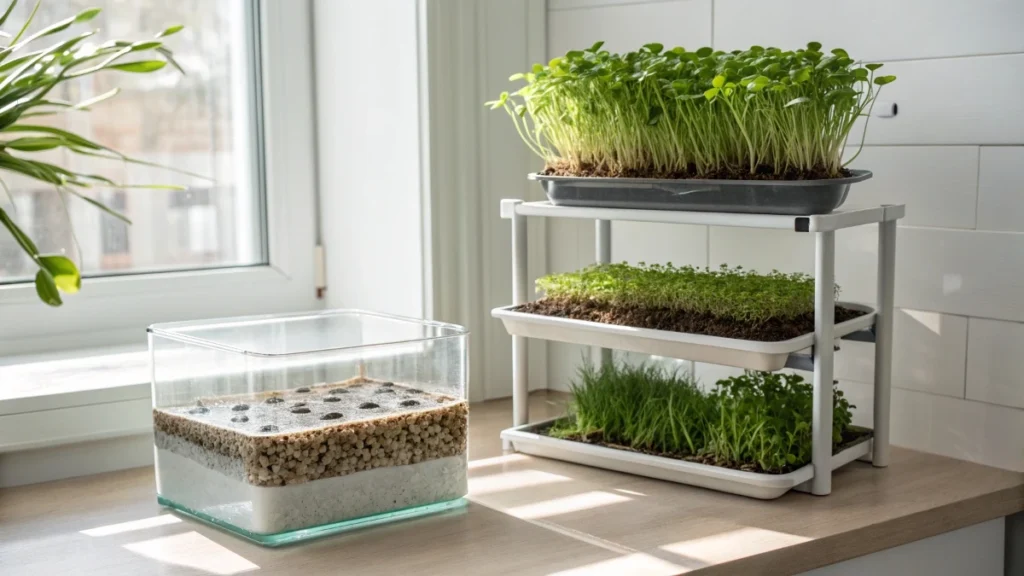
Aquaponics microgreens let you raise flavorful greens while a small fish tank powers nutrients. This guide shows how to grow microgreens, harvest quickly, and profit.
Learn how bacteria change ammonia to nitrate for plants, bell siphons aerate water, and why a pump under one amp can run a lane. Timelines include an eight to ten hour seed soak, sprouting in one to two days, and radish ready in about a week at sixty eight to seventy eight degrees Fahrenheit.
See how one setup ran four months without water top-ups, and how pea trays sell for eighteen to twenty-five dollars while ten-by-ten radish flats sell for ten.
Aquaponics Microgreens Overview and Why It Works
Aquaponics microgreens combine a tiny ecosystem with a steady crop of nutrient-dense plants. Fish live in a tank below. Their waste contains ammonia. Water moves to the grow beds where beneficial bacteria live on the surface of the media. Those microbes convert ammonia to nitrite and then to nitrate. Microgreens take up the nitrate as their main form of nitrogen. The water returns to the tank cleaner than before. The result is a compact loop that feeds plants while the plants help keep the water suitable for the fish.
This approach scales down to a small home kit and scales up to racks with multiple beds. A small kit with a betta and three mini trays can sit on a counter and grow radish microgreens and wheatgrass. A larger build can use full-sized media beds with automated filling, bell siphons, and even vertical towers later. Microgreens fit both ends of that spectrum because they germinate fast, mature quickly, and can be kept evenly moist through bottom watering from the recirculating tank.
Microgreens can also support a bigger project while you learn to run it. One grower used microgreens sales through colder months to offset operating costs while building out racks, plumbing, and lighting. That approach lets you master the lower beds first before adding more levels above.
Core Mechanics of the Aquaponics Loop
Nitrifying bacteria are the quiet workers that make aquaponics possible. Two groups matter most. The first converts ammonia to nitrite. The second converts nitrite to nitrate. Media with lots of surface area give these bacteria a home. Lava rock fits well because it is light and porous, which means a very high microbe population per bed. Clay pebbles are another common choice for smaller kits.
Flood and drain beds use a bell siphon to move water in pulses. The bed fills to a set height. The bell siphon triggers and drains the bed quickly. That drop back into the tank disturbs the surface and mixes oxygen into the water, which is important for fish health. This simple device also helps keep roots from sitting in stagnant water.
Power needs can be modest when the flow is managed well. One lane of beds ran on a pump drawing less than one amp after the team downsized from a twelve-amp pump. They sequenced which bed was filled at any moment using valves and timing so one small pump could serve many beds.
Water efficiency is a major advantage. A four-lane setup went about four months without adding makeup water. The main water loss was simple evaporation. Compared with overhead sprinklers in field growing, where a lot of water never reaches the root zone, media beds deliver water directly to the roots and reuse it again and again.
🌿 Recommended Microgreens Supplies |
System Setups You Can Copy
Countertop kit for aquaponics microgreens
A simple home unit can use a three-gallon tank with a small pump that carries water up into a drip tray. Three interlocking mini trays sit above. Each tray holds rinsed clay pebbles. Water wicks up from below and keeps the seed zone evenly moist. A small screen fits in the return slot to keep plant debris out of the tank. Soak radish and wheatgrass seeds before planting to speed germination. A small heater is useful for a betta since it is a tropical fish. Seedlings can root through the tray and hang roots into the wet area, which keeps moisture steady without overhead watering.
Greenhouse rack with media beds
A larger build can use eighteen media beds in total. Start with two beds on each lane so you can tune valves, siphons, and lighting without being overwhelmed. In the example, each bed was about twelve feet long. Two beds per lane gives about twenty-four linear feet of grow area per lane before you add anything vertical. Beds were filled with lava rock to host bacteria. A single small pump with automation cycled the inflow to each bed. As the system matures, vertical towers can be added above the beds to turn one square foot of floor space into a much more productive canopy.
Media Trays and Prep that Actually Work
Coarse number two vermiculite performed well in microgreen trays. The texture is stable, the pieces are large enough to limit dust, and the structure helps keep seeds from washing into the drain slots. The course instructor had tested burlap, perlite, coco coir, and soil mixes. Coco coir works, and some growers start there, but the team considered moving to mat-based methods to reduce handling and cleanup.
Clay pebbles are a good choice in smaller aquaponics kits where the trays sit directly in a wet deck. Rinse them thoroughly before use so fine particles do not clog the return. Rinse the trays, tank, and pump parts as well. Clean gear reduces the risk of cloudy water and helps the flow path behave as designed.
Tray sizes matter for seeding rates and timelines. A ten-by-twenty tray is a practical size for pea shoots. A ten-by-ten tray suits radish and other small seed mixes. Both sizes benefit from slotted bottoms placed on a nursery deck so water can wick up from below. Bottom watering gives even moisture without splashing the stems, which keeps damping off in check.
🌿 Recommended Microgreens Supplies
These are the tools and supplies I personally recommend for growing healthy and flavorful microgreens at home.
As an Amazon Associate, I earn from qualifying purchases.
Pea Shoots SOP for a 10×20 Tray
Fill the bottom of the tray with about two cups of coarse vermiculite. Spread it evenly so the base covers the slots and supports the seeds. Measure out one cup of pea seeds. Bulk cover crop peas, such as sweet English pea are an affordable choice and work well for shoots. Broadcast the seed across the surface so the distribution is uniform.
Give the tray a short blackout period to encourage strong shoots. You can sprinkle about one cup of vermiculite over the top, or you can place an empty tray upside down as a cover. Two to three days is enough for the first stage. Keep the tray over a deck that allows bottom watering so the medium stays consistently damp.
Maintain a room temperature in the range of 68 to 78 degrees Fahrenheit. Warmer conditions within that band will shorten germination time. Early germination can appear in one to four days,s depending on warmth and the amount of water available. Remove the cover once the seeds have cracked and are pushing up. Continue steady bottom watering. Harvest at around two weeks for tender shoots. If your customers like tendrils, let the tray grow for about three weeks for more curl.
Radish and Tiny Seed SOP for a 10×10 Tray
Place a thin layer of coarse vermiculite in the tray, and be sure it covers the drain holes. This layer is important because it stops small seeds from falling through or pooling in the corners. For radish, use about two tablespoons per ten-by-ten tray. For very small seeds such as kale, mustard, or spicy mixes, use about three tablespoons to get even coverage.
Set the tray on a microgreen deck that wicks water from below. Keep the room in the same temperature range used for peas. You will see germination quickly in warm conditions. Maintain consistent moisture without spraying heavily from above. Avoid stirring the seeds after you place them. Stirring can knock them through the gaps between pebbles or into the vermiculite in uneven clumps. Harvest at about two weeks for a dense canopy with good color and flavor.
Ultra Small Kit Day by Day Timeline
Begin by soaking seeds for eight to ten hours. The small kit used about one teaspoon of radish per mini tray and one teaspoon of wheatgrass for the middle tray. For a thicker stand of wheatgrass, one tablespoon makes sense. Rinse the clay pebbles and spread them in the trays. After soaking, drain the seeds and spread them evenly across each tray. Keep the trays on the wet deck so water wicks up from below. If the room is dry, a light mist can help during the first day.
Growth can be visible within the first day or two. In one case, a gallon of water from an established fish tank was added to the new unit before adding a fish, which carried nutrients and beneficial microbes into the loop right away. By day three and day four, the sprouts were pushing leaves, and white roots were visible dangling beneath the trays. Clay pebbles helped those roots find moisture while keeping the tops relatively dry.
By day six or day seven, radish microgreens were ready to clip and eat. At that point, a betta was introduced to the tank along with a small amount of gravel for the base. A small heater was ordered since tropical fish prefer warmer water. A small net placed in the return slot caught plant debris and kept the pump path clear. Feeding was done through the dedicated opening in the top so the fish could be cared for without disturbing the trays.
This tiny setup shows how aquaponics microgreens can move from dry seed to harvest within a week under warm indoor conditions while gently cycling water through a living loop.
Food Safety and Handling
Aquaponics microgreens need a clean medium and simple hygiene to stay safe and reliable. Use a medium so customers cut shoots above the seed and root. If shoots are sold with seed and root attached, they can be treated as sprouts, and that moves you into a different set of rules. Coarse number two vermiculite works well in trays because its texture supports seeds without slipping through slots, and it produces less dust. Rinse vermiculite before use and spread a thin, even layer so seeds sit on a stable base. Clay pebbles belong in the small kit trays that sit inside a wet deck. Rinse them thoroughly so fine particles do not cloud water or clog the return.
Bottom watering keeps stems and cotyledons drier, which reduces damping off. Keep a simple screen at the return to catch stray husks or leaves so they do not reach the pump. When harvesting, cut above the medium. For peas, let the pods reach the point you prefer and clip cleanly. For radish and tiny seed mixes, aim for a dense, even canopy and cut just above the surface so no medium ends up in the clamshell.
If you work with vermiculite, avoid breathing the fines. Use the coarser grade and pour gently. Clean the pump intake on a routine schedule. The intake collects bits of hulls and threads of roots over time. A clear intake keeps the flow steady and prevents warm spots where algae can start.
Water and Energy Efficiency in Aquaponics
An aquaponics microgreens loop shines because water is delivered directly to the roots and then returned to the tank. In one build, four lanes operated for about four months without adding water. The only meaningful loss was evaporation from the open surfaces. Compared with field irrigation, where a lot of water never reaches the plant, a media bed puts water in the root zone and then sends it back to be reused.
The bell siphon does more than drain a bed. It sends water back with a strong drop that disturbs the surface in the fish tank. That movement mixes oxygen into the water, which matters for fish health and for the microbes living on every surface. The same build cuts energy needs by matching the flow to what the beds require. A single pump drawing less than one amp ran a lane after replacing an older unit rated around twelve amps. Flow was directed by valves so that only one bed was filled at a time. That simple control let a small pump do the work of a much larger unit.
Designing as if water is scarce leads to better habits. The team aimed to make one square foot of floor area do the work of two by adding vertical towers once the lower beds were dialed in. Aquaponics already reduces waste compared to sprinklers and drip lines outdoors. The builder also noted that traditional agriculture can use far more water than a closed recirculating bed and quoted a figure of roughly ninety percent more water in the field when comparing approaches. They also reminded viewers that most of the planet’s water is saltwater, around ninety-six and a half percent by their note, which is why efficient use of fresh water matters even in a greenhouse.
Real World Unit Economics
Costs were broken down to make planning simple. A typical flat uses about twenty to thirty cents of vermiculite. Seed runs about fifty cents to one dollar for most crops and around seven dollars for shiso as an outlier. The tray itself adds about fifty cents. That puts the input near one dollar and fifty cents per planted flat.
Selling prices fell into two clear bands. Pea shoots in a ten-by-twenty tray sold between eighteen and twenty-five dollars to local buyers. Radish in a ten-by-ten flat sold around ten dollars. Chefs clip a tray all week to garnish soups, salads, and sandwiches, so they often order these alongside bulk heads of lettuce.
A winter snapshot gives context. One greenhouse brought in about one thousand two hundred dollars a month from microgreens. Heating the same building ran about one thousand six hundred dollars a month on propane in the cold season. Sales also fell due to a large local fire that slowed tourism. The gap shows how microgreens can carry a large share of the bills in winter and can cover even more once demand rebounds and when heat needs decline in spring.
Break-Even Planning
Start with a single bill you want microgreens to cover. If the target is one thousand six hundred dollars for monthly heat, work backward from your average selling price. At twenty dollars per ten-by-twenty pea tray, you would need eighty trays in a month, which averages to twenty trays per week on a four-week month. At ten dollars per ten-by-ten radish flat, you would need one hundred sixty flats in a month, which averages to forty flats per week.
Now layer in your known input. The cost per flat is about one dollar and fifty cents for vermiculite, seed, and tray. That means a ten-dollar radish flat yields about eight dollars and fifty cents of gross margin before rent and labor. A twenty-dollar pea tray yields about eighteen dollars and fifty cents gross margin before overhead. You can mix crops to fit demand. For example, a week could be twelve pea trays and sixteen radish flats to hit the same revenue as twenty pea trays. Keep an eye on the items chefs ask for most. Some will pay a little extra for pea tendrils at three weeks, while others prefer the classic two-week harvest.
Plan cycles so trays are seeded and harvested on a rhythm. Peas at two weeks and radish at two weeks let you set a weekly sowing day, a weekly cleaning day, and a weekly delivery day. Use that rhythm to size your seed orders and to keep the nursery deck and benches fully utilized without overloading your space.
Troubleshooting and Tuning
Seeds can clump if they are poured wet. Spread them in two passes across the tray and resist the urge to stir after they are placed. In one small kit, the grower stirred radish seeds to improve distribution, and many of them fell between clay pebbles where they took longer to emerge. A thin layer of vermiculite across the base helps prevent tiny seeds from sliding into the drain slots.
Slow growth usually comes down to heat, light, or moisture. Aim for a room temperature between sixty eight and seventy eight degrees Fahrenheit. Keep a steady wick from below and avoid soaking the tops. If the room is dim, add a simple light close to the canopy to keep internodes tight and color strong.
On larger beds, a bell siphon needs the right standpipe height and a tight bell cover to pull air and trigger the siphon. The drain also needs enough drop back to the tank to create a good splash and re-oxygenate the water. If the siphon occasionally fails to break, inspect for fine roots or pieces of media around the standpipe and clear them. Keep pump intakes free of husks. Use the small net screen in the return so bits do not travel to the pump. In a tiny kit, a small amount of water from an established tank helped jump-start growth by adding nutrients and bacteria to the loop before a fish was added.
Scaling Up Without Losing Control
Grow into the space with intention. The larger build started with the lower beds only. Two beds per lane were planted first. Each bed was about twelve feet long, which gave about twenty-four linear feet of growing area per lane. That made it possible to tune valves, bell siphons, and lighting before adding vertical layers. With that base running, towers can be added to multiply the canopy per square foot.
Microgreens can fund the learning curve. In one winter, the small line of microgreens brought in about one thousand two hundred dollars a month, which covered most of the heat bill. The operator planned to continue using microgreens revenue while building out other systems, including a digester that might, in the future, provide methane for heat. Keep in mind that demand can swing with the season and local events. A regional fire cut restaurant traffic and lowered sales in that season. Build a small buffer and add varieties like kale, radish, and peas so chefs can choose the color and texture they need.
One Page Starter Checklist
A short checklist makes the weekly cycle smoother. The gear list includes trays in ten-by-twenty and ten-by-ten sizes, coarse number two vermiculite, clay pebbles for small kits, a nursery deck for bottom watering, a pump matched to the lane with valves to sequence flow, a simple screen for the return, a reliable thermometer, and a small heater for a tropical fish in a tiny tank.
Keep a seeding cheat sheet for the common crops. For peas in a ten-by-twenty tray, note two cups of vermiculite as the base and one cup of pea seed with a blackout of two to three days. For radish in a ten-by-ten tray, note a thin vermiculite base that covers the drain holes and two tablespoons of seed. For tiny seeds, note about three tablespoons. Keep the target room temperature of sixty eight to seventy eight degrees Fahrenheit at the top of the card.
Run a seven-day micro kit timeline for homes and classrooms. Soak seeds for eight to ten hours. Plant and set trays on the wet deck. Look for sprouting on day one or day two. Expect a strong push on day three and day four. Clip radish on day six or day seven. Clean trays and set the next round.
Use a weekly production planner tied to your break-even number. If the goal is twenty pea trays per week, block sowing time for those trays, schedule harvesting and delivery, and leave a small block for extras that chefs request. Add a cleaning and safety mini SOP that lists the order of rinsing media and trays, pump intake checks, and a glance at the return screen so your aquaponics microgreens loop stays stable and predictable.