
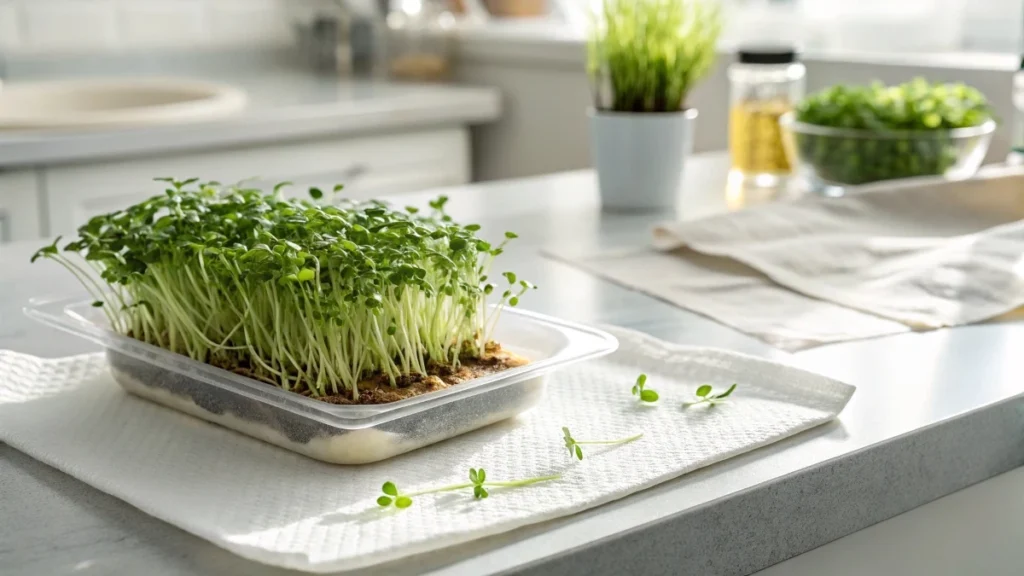
Growing microgreens on paper towels is one of the simplest ways to start producing fresh greens at home. This method requires no soil, is inexpensive, and keeps cleanup easy, making it perfect for beginners or small kitchens.
With just seeds, water, and a tray lined with paper towels, you can grow nutritious crops like broccoli, radish, amaranth, or even lentils. While yields are often lighter compared to soil or coco coir, paper towels can still support healthy, flavorful microgreens when managed correctly.
Understanding how to maintain moisture, encourage root penetration, and avoid common mistakes can help you succeed. In this guide, you’ll learn step-by-step how to grow microgreens on paper towels, including tips for better germination and harvest.
Choosing the right seeds
Crops that anchor well on paper towels
Some crops push roots through paper fibers without much drama. In the trials you shared, broccoli and red garnet amaranth consistently sent roots through the towel and moved into blackout and light on schedule. Radish also works, but growth tends to be shorter and the canopy tighter on towels than on sturdier media. Lentils do sprout and grow on towels, though the harvest was noticeably lighter than the same seed grown in soil.
Crops that struggle on paper towels
Cilantro and Swiss chard germinated, yet many seeds stayed perched on the surface instead of driving roots through the towel. The result was uneven anchoring and early signs of dehydration. In one run, the tips of chard radicles browned while sitting on top, a classic sign that moisture at the root zone was not consistent.
What the numbers say
Radish on towels produced an average harvest weightof around 51 grams per tray in a small sprouting setup, compared with about 57 grams on stainless mesh and about 60 grams on silicone sheets. That is roughly ten to fifteen percent lower than the reusable options. In a larger radish run, two coco coir trays yielded about 410 and 435 grams, while two towel trays yielded about 292 and 210 grams. The averages work out to roughly 420 grams for coco and roughly 251 grams for towels, which is about forty percent lower for towels. For lentils, the soil harvest weighed about twice as much as the towel harvest using the same seed quantity.
Practical choice
If you want the easiest wins on paper towels, start with broccoli, radish, amaranth, or lentils. If you want cilantro or chard specifically, be ready to adjust technique to improve downward pressure and moisture management, or consider a different medium for those crops.
Preparing paper towels as a medium
Towel type and layering
Use two-ply towels that are plain and free of added scents. Two layers per tray worked well in the multi-crop test and cost about eight cents per tray. In another radish run, a single layer was used with the edges folded over, and the doubled edges seemed to hold a touch more moisture. Thicker towels are not always better. Very dense weaves can resist root penetration and encourage seedlings to sit on top.
Tray choice
A mesh bottom tray helps a lot with towels. Roots can grab the mesh openings as they pass through the towel, which improves anchoring and even makes harvesting easier in one trial. Slotted trays provided less soil,ip and more seedlings stayed shallow.
Moisture baseline Pre-wet
Pre wet the towel until it darkens, and you can just see the seed color through the surface. The aim is even dampness without pooling. Paper towels hold far less water than soil or coco. One grower noted that coco can hold cups of water while towels only hold several teaspoons. That difference drives everything about how you manage moisture later.
🌿 Recommended Microgreens Supplies |
Seeding and watering
Seeding rates from the tests
Six grams of Hong Vit radish per small sprouting tray produced full coverage on all media. For a full-size tray, the team used about twenty grams of broccoli, thirteen grams of Swiss chard, six grams of split cilantro, and eight grams of amaranth. Treat these as starting points and adjust for your tray size and the seed lot you have.
Soaking or not
Lentils performed best when soaked for six to eight hours before sowing. That sped up sprouting and improved the final stand. Leaving them in water longer led to fermentation. In the paper towel trials for cilantro and Swiss chard, no pre-soak was used, and both crops struggled to root through. If you plan to grow those on towels, a short soak can help level the playing field.
First wetting
Mist the towel lightly before seeding so seeds do not bounce across the surface. After seeding, mist again until the towel is evenly saturated without puddles. Overwatering at this stage leads to a stale smell and later to mold. Underwatering leaves seeds perched and dry along the edges.
Germination stage
Weight and darkness
Place a tray or plate directly on the seeds and add a steady weight. The teams used a seven-pound brick for small stacks and a fifteen-pound paver for larger stacks. Keep the stack in a dark place. Check morning and evening for the first few days.
Why does even pressure matter?
Uneven pressure was the single biggest reason for failures on towels. When the weight did not actually touch the seed surface, Swiss chard germinated but never pushed roots through the towel. The seedlings curled above the surface, and the root tips browned. When the weight pressed evenly across the tray, broccoli and amaranth drove roots through and progressed normally.
The top towel trick
Covering the seeds with an extra-wet towel can boost humidity on day one. It also invites the roots to grow upward into that top layer. When that layer was removed on day two, many seedlings tore or lifted. If you try this, remove the top layer early and very gently, and only if you see uniform anchoring below.
Early signs to watch
On day two of a radish run, many towel-grown seeds were still stuck to the lid, whilethe coco had already rooted into the medium. The same run lost only a handful of cocoa seeds to sticking, but lost a large number from the towel trays. A quick sniff test was useful. If you smell stagnant water, you are keeping the towel too wet.
Blackout and light transition
When to move from weight to blackout
Move to blackout once most seedlings are anchored and can stand under their own tension. In many towels, this happened a day or two later than in Coco or soil. In the radish example, crops that were ready for light on coco were still behind on towels and needed extra time under blackout.
When to introduce light
Introduce light once the canopy is even and cotyledons are opening. In the towel runs, the cotyledons often opened more slowly, and the canopy remained tighter and shorter even when healthy. One towel harvest at day nine produced good flavor but showed a smaller, more closed canopy than silicone and stainless trays standing right beside it.
Crop-specific timing
Lentils were held in darkness for longer to grow taller stems. The grower introduced light around day ten to get crunchy length before harvest around day fifteen. By contrast, radish on towels usually moved to light around day five after a short blackout and was harvested around day eight or nine before true leaves made the flavor too intense.
Watering during growth
Bottom watering only after roots penetrate
Check underneath the tray. If roots are visible through the towel and reaching the reservoir, begin bottom watering. If not, keep misting from above and avoid filling the reservoir. Bottom watering too early on towels leaves water sitting unused and invites odor.
How much water to add
For paper towel trays, a small volume goes a long way. In one case, about half a cup was added to a towel tray to avoid pooling, while the coco trays received much more with no issue. Start small and observe. If water remains in the channel hours later, use less next time.
Signs of stress
Red or pink stems on radish and yellow or ombre cotyledons appeared more often on towel trays, especially when moisture was inconsistent. These trays also tended to be a little shorter than Coco or reusable media at the same age. When you see these signals, increase monitoring frequency, add tiny amounts of water more often, and confirm that roots are actually touching water below.
Expect a narrower window.
Because towels dry quickly, the window between too dry and too wet is tight. Paper towelsmayn need attention two or three times a day during germination and early growth, especially at the edges. Once roots are fully through, the routine gets easier, but compared with soil or coco, you will still refill more often.
Great, let’s continue and expand on the remaining outlines with the same depth and natural style.
Harvesting and yields
Harvest timing
Paper towel crops usually take a day or two longer to reach a similar stage compared with soil, coco coir, or reusable mats. Radish on towels was harvested at day eight or nine, while coco-grown trays were ready by day six or seven. Lentils grown on towels reached around seven to nine inches by day fifteen, while soil-grown trays reached that stage earlier and with denser canopies.
Yield differences
The numbers show a consistent pattern. Coco coir trays of radish averaged around 420 grams per tray, while paper towel trays from the same seed lot averaged about 251 grams. That’s roughly a 40 percent drop. Lentils on soil produced about twice the harvest weight of those on towels. In a smaller sprouting system, paper towels gave radish harvests of about 51 grams per tray, while silicone reached about 60 grams and stainless steel about 57 grams.
Harvesting ease
One unexpected advantage of towels is how clean the cut stems are. With no soil or coco clinging to the stems, there is less debris at harvest and often no need to rinse before eating. This makes them appealing for kitchen experiments, even ifthe yields are lighter. On the downside, cutting too quickly or with a dull knife can pull entire seedlings off the towel since the roots are shallow compared to the soil.
Comparing paper towels with soil, coco, and reusable mediums
Growth performance
Soil and coco provide a stronger anchor, steady hydration, and higher yields. Roots dive into these loose media easily, branching and creating dense mats. On towels, root mats are thinner, and seedlings sometimes stay perched on the surface. Reusable media like silicone and stainless mesh behave more like coco, allowing roots to penetrate and spread while still being easy to clean.
Moisture balance
Coco holds cups of water, creating a naturally humid zone for germination. Towels hold only teaspoons, so growers must mist more often and be alert for drying. Silicone and stainless steel hold water better than towels and support more consistent moisture levels without risk of pooling at the bottom.
Canopy and appearance
Towel-grown microgreens often form shorter, tighter canopies. Cotyledons can be slightly yellow or red from stress, especially if water is inconsistent. Coco and reusable media produce taller, fuller canopies with uniform color. For appearance and volume, soil and coco usually win, while towels produce a lighter, sometimes more colorful but less uniform crop.
Common problems and troubleshooting
Poor root penetration
One of the biggest issues with towels is seeds germinating but failing to push roots through the fibers. This was especially common with cilantro and Swiss chard. To improve success, ensure even pressure during germination and try using a mesh-bottom tray so roots can grip as they grow.
Moisture imbalance
Too little water causes browning tips and red stems. Too much water creates a stagnant smell within a day or two, which often signals mold risk. The safest approach is frequent light misting until roots show through the bottom.
Uneven germination
Clumps of seed on towels sometimes dry unevenly, leaving bare patches. Sowing evenly and pressing seeds into the towel with a flat tool helps. Folding towel edges over slightly can also create zones with better moisture retention.
Top towel mishaps
Using a second towel to increase humidity can work for day one, but it often causes seedlings to root upward into it. When removed, large patches can tear away. If you try this method, monitor closely and remove the cover before roots get too attached.
Cost and sustainability aspects
Cost per tray
Paper towels are the cheapest option tested. One double-ply towel setupcostst about one cent to eight cents per tray, depending on brand. Coco trays typically cost between thirty and eighty cents each. Reusable silicone or stainless inserts cost more up front but can be cleaned and reused many times, bringing long-term costs down.
Reuse and waste
Paper towels are single-use and head straight to compost after harvest. They break down quickly and take up little space. Coco also composts,s but inlarge volumese. Silicone and stainless steel create no organic waste and can be sanitized for repeated use, but they are not compostable at the end of life.
Trade-offs
Paper towels save money per crop but demand more labor and yield less. Reusable options strike a balance by requiring cleaning but providing reliable harvests. Soil and coco cost more per run yet provide the most consistent and heavy yields.
Best practices for success
Start with forgiving crops.
Broccoli, radish, amaranth, and lentils have shown the best results on towels. Try these before moving on to trickier seeds like cilantro and Swiss chard.
Keepthe weight even
Use a brick or paver heavy enough to press evenly across the surface. If seeds sprout without contact, they often stay above the towel and fail to root.
Mist lightly and often
Check two to three times daily in the first three days. Add just enough water to darken the towel without puddling. Shift to bottom watering only once you see roots peeking through the underside.
Watch for stress signals.
Red stems, yellow leaves, or browning tips are reminders to adjust water and light. Shorter, tighter canopies are normal on towels, so focus on flavor and harvest weight rather than height alone.
Accept smaller harvests
On average, towel-grown crops yield twenty to forty percent less than soil or coco. Treat towels as a learning medium or a budget-friendly option for small experimental runs, rather than a replacement for soil in larger production.