
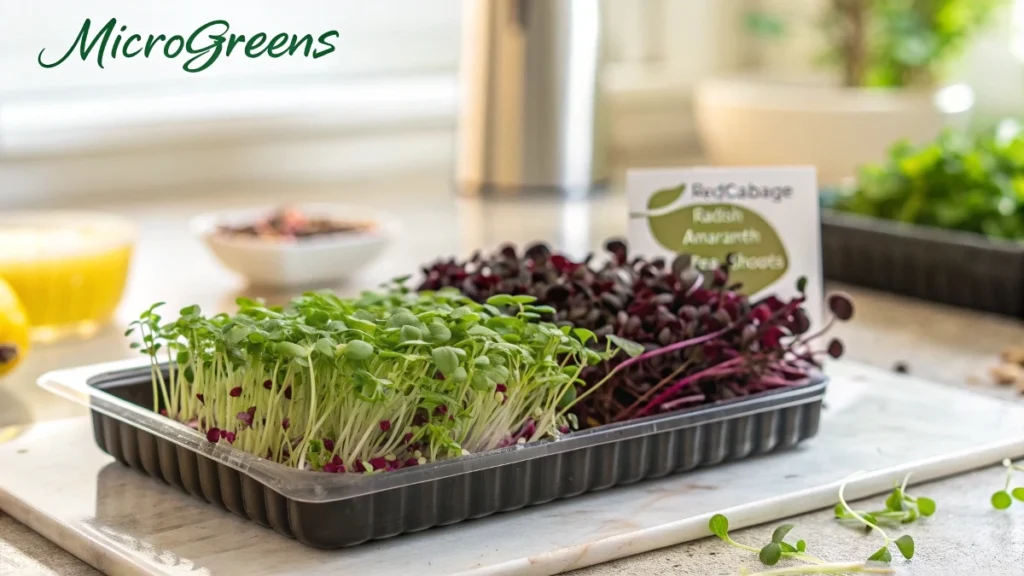
Microgreens pack impressive nutrition into very few calories. This guide explains microgreens’ calories with clear nutritional facts, practical health benefits, and a simple comparison with mature greens.
You will see why a small handful can raise vitamin C, vitamin K1, and vitamin E, along with carotenoids such as lutein, zeaxanthin, and beta carotene, without moving your daily energy budget.
We will also touch on standout compounds like sulforaphane from young brassicas and what that means for everyday meals. You will learn how sprouts differ from microgreens, how growing and handling affect nutrient density, and smart ways to use them in salads, bowls, and smoothies.
If you want more nutrients for fewer calories, microgreens make it easy.
Why microgreens gained attention
Chefs liked the flavor and visual pop. Nutrition researchers noticed another story. The early stage concentrates vitamins and phytochemicals that are often diluted as plants mature. When you combine that nutrient density with very low mass per serving, you get a food that is easy to eat frequently. For a reader who cares about healthy eating without overhauling every recipe, microgreens are a gentle upgrade that fits into salads, bowls, eggs, wraps, and smoothies.
Calories in Microgreens — How Low Is Low
Calories in microgreens stay modest because the harvested tissue is mostly water and fiber with very little fat or sugar. What matters far more is nutrient return per bite. Several studies measuring young leaves showed large jumps in vitamin concentration at this stage. That translates to a practical advantage. You can layer a small pile of microgreens on a sandwich or blend a small handful into a smoothie and meaningfully raise vitamins C, K1, and E and carotenoids while barely moving your calorie count.
How nutrient density changes the equation
Diet quality improves when more vitamins and antioxidants appear in the same or smaller energy budget. Microgreens help because of concentrated C, K1, E, beta carotene, lutein, and zeaxanthin across many species. The effect is even clearer when you compare equal weights. In several brassica microgreens, vitamin levels increase several-fold compared with mature leaves. You get more benefit for the same grams eaten and still keep the plate light.
Why are fiber and sugars lower than in mature plants?
Microgreens contain less structural fiber and less total plant material than a full head of greens. That was highlighted in comparisons that noted easier digestion and lower sugar load than mature vegetables. People who struggle with bulky salads sometimes find microgreens more comfortable because a small serving gives noticeable nutrient value without the heaviness.
🌿 Recommended Microgreens Supplies |
Sprouts, Microgreens, and Mature Greens — What’s the Difference
Understanding stages explains the calorie and nutrition story. Sprouts are germinated seeds grown without light and are eaten whole, including the seed and root. They are enzyme-rich and can show dramatic jumps in certain vitamins compared with the dry seed. Microgreens are the next stage. They grow with light, form cotyledons and early leaves, and are harvested as stem and leaf. Mature greens are the fully developed plants with higher total fiber and water.
What you actually eat at each stage
Sprouts include the seed coat and root, which change texture and digestion. Microgreens are trimmed to remove the seed and root, and you eat the tender stem and leaves. This difference matters for food safety. Sprouts have a higher contamination risk and benefit from meticulous cleanliness and, in some cases, light cooking for certain beans and grains. Microgreens carry a lower risk because only the above-ground portion is harvested and rinsed.
Enzymes and vitamins across stages
Sprouting unlocks nutrients. Lentils show roughly four times more vitamin C by weight after sprouting than in the raw seed. Mung beans show about four times more vitamin K and about three times more vitamin C after sprouting compared with the raw seed, while boiling removes much of the vitamin C. When you compare sprouts to mature vegetables, the effect can be dramatic for specific compounds.
Per one hundred grams, radish sprouts contained about four and a half times more magnesium, about fifty-six times more vitamin A, about forty five times more monounsaturated fatty acids, and about six times more phosphorus than mature radishes. Microgreens push the story further for leaf vitamins and carotenoids because of light-driven synthesis during early growth.
What this means for calories
Sprouts and microgreens both offer high returns for little energy. Sprouts often shine for specific compounds such as sulforaphane precursors in broccoli. Microgreens often shine for leaf vitamins and pigments. Mature greens still matter for fullness and total fiber, yet they are not always the best source of concentrated vitamins per gram. A smart plate uses all three stages where they fit.
Nutritional Facts Backed by Studies
The widely cited assessment of twenty-five commercially grown microgreens measured vitamin C, vitamin E, vitamin K1, and carotenoids, including lutein and beta carotene, in equal weights and compared them with mature counterparts. The results explain why these tiny leaves are so effective in a low-calorie eating pattern.
Vitamins and carotenoids that stand out
Red cabbage microgreens delivered about six times more vitamin C than mature red cabbage. They also delivered about forty times more vitamin E and about two hundred sixty times more beta carotene. Lutein and zeaxanthin were about twenty times higher. Garnet amaranth showed about four times more vitamin K and about eleven times more vitamin C than mature amaranth. Cilantro microgreens carried about three times more beta carotene and about eleven times more lutein and zeaxanthin than mature cilantro. Green daikon radish ranked among the top for vitamin E. Because portions are small, even a modest serving can cover a large share of daily needs without adding much energy.
Mineral comparison and nitrates
Work on lettuce microgreens reported higher concentrations of calcium, magnesium, iron, manganese, zinc, and selenium than found in mature lettuce with lower nitrate levels. Within the brassica group, potassium is the most abundant macro element. Wasabi microgreens ranked highest for potassium, while savoy cabbage microgreens showed the highest calcium among the brassica set measured. These mineral gains add to the vitamin picture and come with minimal calorie cost.
Antioxidants and polyphenols you actually get
Analytical profiling in Brassica microgreens identified one hundred sixty-four polyphenols across families such as anthocyanins, flavonol glycosides, phenolic acids, and others. These compounds support antioxidant and anti-inflammatory activity in the body. The important user-friendly point is variety. A mixed tray of brassica types gives broad coverage of polyphenols in a very small serving, which works well for people watching calories.
Sulforaphane — The Potent Compound in Broccoli Sprouts
Broccoli sprouts are a special case for bioactive density. They can contain up to one hundred times more glucoraphanin, the direct precursor to sulforaphane, than mature broccoli. Measurements often show about twenty to fifty times more sulforaphane itself compared with the mature vegetable when equal weights are compared. This matters because sulforaphane activates the body’s NRF2 pathway that coordinates cellular defense and detox systems, a mechanism explored in metabolic and inflammatory research.
Practical intake that fits a low-calorie day
Guidance commonly used by practitioners targets about forty to sixty milligrams of sulforaphane per day. That corresponds to roughly one hundred to one hundred forty grams of broccoli sprouts. A pint jar of fresh sprouts yields about sixty milligrams, which makes rotation planning feasible at home. Even when your goal is not a specific target, adding a modest serving of broccoli sprouts a few times per week supplies a meaningful amount of this compound without adding significant energy to the diet.
Why combine sprouts with microgreens
Sulforaphane is a strength of sprouts. Vitamins C, K1, E, and carotenoids are strengths of microgreens like red cabbage, garnet amaranth, daikon radish, and cilantro. Using both brings complementary benefits. The total calories remain low, the flavor stays bright, and the nutrient coverage becomes more complete across the week.
Health Benefits Linked to Microgreens
Microgreens help you raise nutrient quality without adding many calories. Their effect shows up most clearly in controlled models and early lab work that explore how concentrated vitamins and plant compounds interact with common health markers.
Cardiometabolic markers that respond in models
In controlled feeding of red cabbage microgreens to animals on a high-fat regimen, researchers observed lower LDL cholesterol, lower liver triglycerides, reduced inflammatory cytokines, and less weight gain across the study period. These findings point to a dietary pattern that supports healthier lipid handling. While this work is not a human trial, it lines up with the high antioxidant and carotenoid levels measured in young brassica leaves and helps explain why a small serving can be meaningful in a calorie-aware plan.
Glucose handling and plant compounds
Fenugreek microgreens increased cellular sugar uptake by about 25 to 44 percent in lab experiments. That signal suggests a supportive role for insulin action and post-meal glucose control when these tender leaves are part of regular meals. Because servings are light, you can layer them onto bowls and wraps to raise nutrient density while keeping energy intake stable.
Brain and healthy aging context
Diets rich in polyphenols are repeatedly associated with lower oxidative stress and better maintenance of cognitive function with age. Microgreens supply families of polyphenols along with vitamins C and E and carotenoids that protect delicate tissues like the retina. Small human studies using extracts from young brassica stages point to possible benefits for neurological and metabolic pathways. These foods do not replace treatment. They offer concentrated nutrition that fits comfortably into everyday eating.
Factors That Affect Nutrition Value
The way you grow and handle microgreens can shift their nutrient profile. Paying attention to light, substrate, and timing gives you better results for the same calories.
Light exposure and pigment formation
Light drives chlorophyll formation and supports the synthesis of carotenoids like lutein and zeaxanthin. Trays that receive consistent light produce deeper green leaves and stronger pigment values. That means better antioxidant coverage per bite without changing the portion size.
Growing medium and mineral content
Comparisons across substrates show that soil blended with organic matter, such as well-composted manure, can deliver both higher yields and higher mineral concentrations than inert media. Studies that looked at vermiculite, coconut fiber, jute, foam, soil, and soil plus manure found that the soil plus manure option produced the most nutritious harvests. Brassicas grown this way often show more potassium, calcium, and magnesium for the same small serving.
Harvest timing and nutrient retention
Cut close to the time you plan to eat. Vitamin C and other sensitive compounds decline when cut greens sit at room temperature for hours. Rinse gently in cool water, spin dry, and refrigerate in a breathable container. Use within a few days for the best vitamin return per calorie.
Water quality during sprouting
During sprouting, the seeds take up minerals from rinse water. Using clean filtered water helps limit contaminants while supporting absorption of trace elements like iodine and zinc. This matters most for jars of sprouts and is still a smart practice for microgreen rinsing.
Practical Use — How to Add Microgreens Without Adding Calories
You can build a plate that feels abundant while keeping the energy budget lean. The trick is to think in small, purposeful portions that layer color and function.
A simple weekly mix that covers key nutrients
Use sunflower shoots and pea shoots for body and a mild bite. Add red cabbage microgreens for vitamin C, vitamin E, and beta carotene. Fold in daikon or other radish microgreens for additional vitamin E. Sprinkle cilantro or garnet amaranth for lutein, zeaxanthin, and vitamin K. This mix turns a salad or grain bowl into a high-return meal without moving calories much.
Serving sizes that make sense
A practical serving is about 20 to 30 grams for a garnish on a plate. Smoothies can take 30 to 40 grams of tender microgreens such as pea shoots or red cabbage without changing the taste too much. Sandwiches do well with a loose cup of mixed greens. These amounts are small, yet they supply a meaningful share of daily C, K1, E, and carotenoids thanks to the high concentration seen in young leaves.
Ways to use them throughout the day
At breakfast, place a handful of eggs or blend them into a fruit smoothie for a vitamin C bump. At lunch, layer them into wraps or bowls in place of part of the lettuce. At dinner, finish soups, roasted vegetables, or rice with a bright tangle of greens. Keep heat exposure brief or add them after cooking to protect heat-sensitive nutrients.
Food Safety and Cooking Notes
Good handling lets you enjoy the nutrition story with peace of mind.
Sprouts and microgreens are not the same for safety reasons
Sprouts are eaten whole and grow in a warm, moist environment. They need careful cleanliness and fresh water, and some bean or grain sprouts are best eaten lightly cooked for comfort and safety. Microgreens are clipped from above the medium and are rinsed before eating, which lowers risk. Use clean trays and tools, and store harvests cold.
Heat and nutrient loss
Vitamin C and some polyphenols are sensitive to high heat and long cooking times. Boiling was shown to strip much of the vitamin C from mung beans compared with the raw sprouted form. If you want warmth, add microgreens at the end of cooking or use a gentle steam for seconds rather than minutes.
Myths and Cautions
A few careful clarifications will keep your article accurate and trustworthy.
The famous forty times claim needs context.
In young leaves and sprouts, certain vitamins and carotenoids can reach four to fortyfold higher concentrations than in mature plants when you compare equal weights. This is not universal across all species and all nutrients. Red cabbage often tops the tables for vitamin C, vitamin E, and beta carotene. Daikon and cilantro shine for specific nutrients. Present the claim as crop and nutrient specific, and your readers will trust the guidance.
About alkaline language
People often say these foods make the body alkaline. The real advantage is more likely from potassium-rich plants and the mix of vitamins and polyphenols that support normal acid-base handling. Blood pH is tightly controlled by the body. It is better to speak about nutrient density, fiber quality, and mineral balance.
Evidence stage and realistic expectations
Animal models and lab studies provide clear signals. Small human studies and dietary patterns support the benefit. These foods do not cure disease. They raise the quality of a meal plan at very low calorie cost and can help people meet daily needs for C, K1, E, and carotenoids while keeping plates light.
Final Thoughts — Tiny Calories, Big Returns
Microgreens and sprouts let you add serious nutrition to ordinary meals without adding bulk or energy. Red cabbage, garnet amaranth, cilantro, and daikon deliver standout vitamins and carotenoids in small portions. Broccoli sprouts offer unusually high levels of sulforaphane precursors that support key defense pathways. Use steady light, a nutrient-rich medium, clean water, and quick harvest to table timing. With these small steps, your bowl gains color and function while your calorie count stays steady.
🌿 Recommended Microgreens Supplies |