
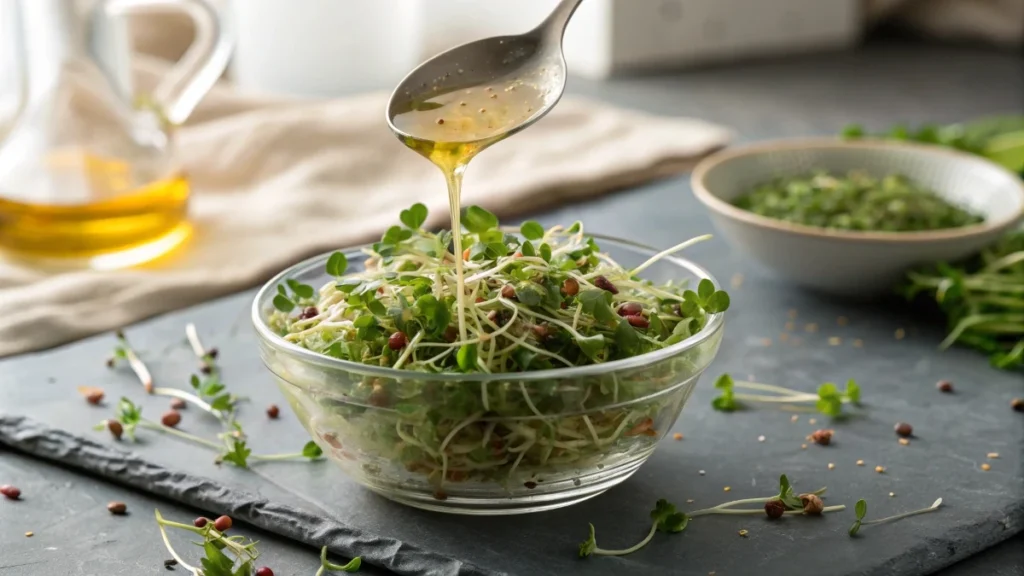
Microgreens dressing should be light and designed to let tender leaves shine. In this guide, you will learn how to build a microgreens salad dressing that balances bright acid with gentle oil for clean flavor and glossy cling.
We cover flavor pairing for peppery radish, mild pea shoots, sunflower shoots, aromatic basil and cilantro, and brassica greens like broccoli.
You will see when to choose creamy yogurt or tahini, and when a citrus-forward vinaigrette works best. We also explain texture tuning, emulsion stability, and safe storage so every batch stays fresh.
Use these recipes and techniques to make healthy dressing for microgreens with vivid color, aroma, and kitchen results.
What is microgreens dressing
A microgreens dressing is built to complement the small leaves and tender stems of very young plants. Two approaches work best. First, make a light and aromatic dressing that coats without weighing down. Second, blend a small portion of fresh microgreens directly into the dressing for a green, vivid flavor and color.
Flavor mapping that actually works
Peppery greens such as radish and mustard love bright acids like lemon and rice vinegar with a little sweetness and a savory nudge from miso or mustard.
Mild or sweet greens such as pea shoots and sunflower shoots pair well with cultured dairy like kefir or yogurt, plus lemon zest and soft herbs.
Herbal greens such as basil, cilantro, or shiso shine in green goddess-style dressings or a citrus-heavy chimichurri-style drizzle.
Slightly bitter brassica greens such as broccoli or kale balance well with orange juice, maple syrup, and toasted sesame or a touch of soy.
Design principles for delicate greens
Aim for a thinner body than a typical salad dressing so the liquid sheets across tiny leaves. A good starting ratio is one part acid to two parts oil for vinaigrettes. If you want more punch, push toward one to one and a half. Blend just until glossy so you capture cling without a heavy mayonnaise texture. Salt lightly first, then finish with fresh pepper, citrus zest, or flaky salt at the end.
Core frameworks to build from
Bright vinaigrette
Use a neutral or soft fruit oil, a lively acid, a small amount of sweetness, and fine salt. Think grapeseed plus lemon juice plus honey. For cling, add a small spoon of Dijon or white miso.
Creamy base
Use strained yogurt, kefir, buttermilk, avocado, or tahini. Thin with cold water or citrus juice until it barely coats a spoon. This keeps the dressing light enough for microgreens.
Umami accents in tiny amounts
Miso, anchovy parmesan, toasted sesame oil, and nutritional yeast add depth. Keep each to a teaspoon scale so the greens remain the focus. Typical miso provides about six hundred thirty milligrams of sodium per tablespoon, so small amounts go a long way.
Aromatic finish
Citrus zest, micro-chopped chives, or tender herb tips deliver aroma without weight. Add at the end, not during blending.
🌿 Recommended Microgreens Supplies |
Using microgreens inside the dressing
Green puree
Blend thirty to forty grams of microgreens with the acid and a portion of the oil until smooth, then whisk in the remaining oil by hand. This produces an emerald color and intense aroma.
Warm infusion
Heat oil to about sixty degrees Celsius, add herb-like greens such as basil or cilantro, steep for fifteen minutes, then chill and strain. Use this perfumed oil in the vinaigrette base.
Mortar mash
Pound a handful of microgreens with a pinch of salt until pasty, whisk into acid, then drizzle in oil while whisking. This builds body without added stabilizers.
Texture and stability tuning
To thin without losing flavor, use cold water, citrus juice, or whey from strained yogurt. To thicken, gently whisk in tahini, a small amount of chia gel, or a few cubes of ripe avocado. A teaspoon of mustard or white miso increases emulsion stability without a dominant flavor. Keep total fat reasonable because a small amount of monounsaturated fat helps absorb carotenoids from leafy greens.
Nutrition notes with real numbers
Microgreens can carry concentrated vitamins and carotenoids compared with mature leaves. Reported ranges include vitamin C from about twenty to one hundred forty seven milligrams per one hundred grams fresh weight, and beta carotene from about zero point six to twelve point one milligrams per one hundred grams. Vitamin K as phylloquinone can range from about zero point six to four point one micrograms per gram. Red cabbage, cilantro, garnet amaranth, and green daikon radish often test high across several vitamins.
Broccoli-type microgreens contain glucoraphanin that can convert to sulforaphane when tissues are disrupted. These young brassicas can supply the precursor when eaten raw and lightly dressed.
Because many of these compounds are fat-soluble, include at least a few grams of oil in the dressing to support uptake. Oils with more monounsaturated fat, such as olive or canola, are efficient for this purpose.
Food safety and storage that matters
Keep cold and acidic. For dressings that include fresh alliums or herbs blended into oil, refrigeration is essential. A practical rule at home is to refrigerate oils that contain garlic or fresh herbs and use them within four days.
Aim for a finished pH below four point six for safety in acidified dressings. You can verify with pH strips or a food-safe meter.
Vinaigrettes without dairy typically last one week refrigerated if no fresh alliums or fresh herbs are mixed in. If you include dairy, eggs, or blended greens, make small batches and use them within three to four days.
Cost, waste, and sustainability
Use tender tops as garnish and blend stems and trimmings into the dressing base. Swap to what you have. Lemon juice can stand in for rice vinegar. Grapeseed oil can stand in for light olive oil. Save specialty oils for finishing, so you need less.
Troubleshooting
If the dressing tastes too sharp, whisk in a teaspoon of honey or a splash of cold water.
If it tastes flat, add a pinch of salt or a few drops of acid and a little zest.
If it is too thick, thin it with water or citrus juice.
If it splits whisk in a teaspoon of yogurt or mustard to bring it back together.
Signature formulas
Lemon miso vinaigrette for radish microgreens
Ingredients
- Fresh lemon juice, forty-five milliliters
- Rice vinegar, fifteen milliliters
- White miso ten grams
- Honey five grams
- Light olive oil, ninety milliliters
- Fine salt, one gram
- Freshly ground pepper to taste
- Take one to two tablespoons as needed
Method
- Whisk lemon juice, rice vinegar, miso, and honey until smooth.
- Drizzle in olive oil while whisking until glossy.
- Season with salt and pepper. Thin with a little ice water if needed.
Yield and use
Makes about one hundred sixty milliliters. Toss three cups of radish microgreens lightly until just coated. Miso is sodium-dense at about six hundred thirty milligrams per tablespoon, so taste before adding more salt.
Kefir herb dressing for pea shoots
Ingredients
- Kefir one hundred twenty milliliters
- Greek yogurt, sixty milliliters
- Lemon zest, half a teaspoon
- Lemon juice, thirty milliliters
- Chives, two tablespoons finely sliced
- Parsley, two tablespoons finely chopped
- Extra virgin olive oil, thirty milliliters
- Fine salt, one to two grams
- Fresh pepper to taste
Method
- Whisk kefir yogurt, zest, and lemon juice.
- Stream in olive oil while whisking.
- Fold in herbs. Adjust salt and pepper.
Yield and use
Makes about two hundred ten milliliters. Ideal for pea shoots, sunflower shoots, and mild mixes.
Orange sesame dressing for broccoli microgreens
Ingredients
- Fresh orange juice, sixty milliliters
- Rice vinegar, twenty milliliters
- Light soy sauce, ten milliliters
- Toasted sesame oil, five milliliters
- Grapeseed oil, sixty milliliters
- Honey, five to seven grams
- Fine salt to taste
Method
- Whisk orange juice, soy, vinegar, and honey.
- Whisk in grapeseed oil, then sesame oil.
- Salt to taste.
Why it pairs well
Citrus and a small amount of sweetness offset the gentle bitterness of brassica microgreens. Keep some fat present to support the uptake of carotenoids.
Basil lime chimichurri style drizzle for sunflower shoots
Ingredients
- Basil leaves thirty grams
- Cilantro leaves twenty grams
- Lime juice, forty milliliters
- Red wine vinegar, ten milliliters
- Extra virgin olive oil, one hundred milliliters
- Garlic, half a small clove minced
- Fine salt, one to two grams
Method
- Pulse basil, cilantro, garlic, and salt with lime juice and vinegar until rough.
- With the motor running, stream in olive oil until loosely blended.
- Taste and adjust acidity with a little more lime if needed.
Yield and use
Makes about one hundred eighty milliliters. Spoon over dressed sunflower shoots and roast vegetables.
Creamy avocado yuzu dressing for mixed microgreens
Ingredients
- Ripe avocado, one half, about eighty grams
- Yuzu or lemon juice, thirty milliliters
- Rice vinegar, ten milliliters
- Water thirty to sixty milliliters
- Light olive oil, thirty milliliters
- Fine salt, one gram
- Fresh pepper to taste
Method
- Blend avocado with citrus juice and vinegar.
- Add water to reach a pourable texture.
- Blend in oil just to combine. Season.
Yield and use
Makes about two hundred milliliters. Great on mixed trays of pea, radish, and herb greens.
Serving and plating
Dress immediately before serving. Microgreens soften if they sit in acid for too long. Use your hands to toss gently in a chilled bowl. For layered salads, dress the base leaves lightly, crown with undressed microgreens, then spoon a little extra dressing over the top. Finish with zest seeds or a pinch of flaky salt.