
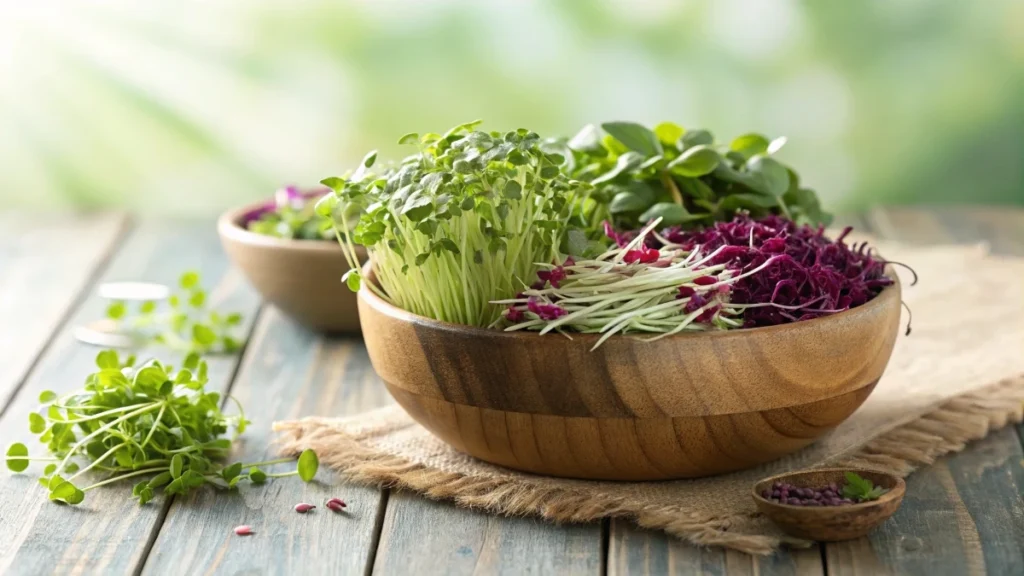
Microgreens are young edible plants harvested just after the first true leaves appear, usually within 7–14 days of germination. Despite their small size, they are exceptionally rich in essential vitamins that support immunity, vision, heart health, and overall wellness.
Research shows that microgreens can contain 4 to 40 times more vitamins than their mature vegetable counterparts, making them a highly efficient way to boost nutrition.
Red cabbage microgreens, for example, deliver many times more vitamin C, E, and beta-carotene compared to full-grown cabbage.
From antioxidant-rich vitamin A to bone-strengthening vitamin K, these tiny greens are a concentrated source of nutrients. Understanding the vitamin content of microgreens helps you make smarter choices for a balanced, nutrient-dense diet.
| No precise ratios reported; wheatgrass juice is commonly used for health benefits. | Top Microgreens Sources | Comparative Data (Microgreens vs Mature) |
|---|---|---|
| Vitamin A (Beta-carotene) | Red cabbage, cilantro, red sorrel, wasabi greens, basil, pea tendrils, garnet amaranth, radish sprouts | Red cabbage has 260× more beta-carotene than mature cabbage; cilantro has 3× more than mature cilantro; radish sprouts contain 56× more than mature radishes |
| Vitamin C | Red cabbage, garnet amaranth, radish, basil, sprouted lentils, sprouted mung beans | Red cabbage has 6× more vitamin C than mature cabbage; lentil sprouts have 4× more; mung bean sprouts have 3× more |
| Vitamin E | Red cabbage, green daikon radish, cilantro, opal radish, peppercress, buckwheat microgreens | Red cabbage has 40× more vitamin E than mature cabbage; green daikon radish is extremely high; buckwheat is notable |
| Vitamin K | Garnet amaranth, red sorrel, basil, pea tendrils, red cabbage | 18 of 25 microgreens tested had equal or higher vitamin K than broccoli; garnet amaranth particularly high |
| B Vitamins (general) | Wheatgrass (not quantified but cited for metabolic and cardiovascular benefits) | No precise ratios reported; wheatgrass juice commonly used for health benefits |
| Vitamin D (uncertain) | Mentioned broadly; no specific microgreen confirmed as a reliable source | Not quantified; suggested possible presence but not confirmed by studies |
🌿 Recommended Microgreens Supplies |
Vitamin A in Microgreens
Why vitamin A matters
Vitamin A supports vision, immune defense, skin integrity, and mucosal health. In young plant tissue, es this vitamin most often comes as provitamin carotenoids such as beta carotene, which the body converts to retinol as needed.
Standout microgreens for vitamin A
Multiple sources you shared highlight striking carotenoid density in select microgreens. Red cabbage microgreens repeatedly test far above their mature counterparts for beta carotene. One frequently cited 2012 study in the Journal of Agricultural and Food Chemistry reported red cabbage microgreens with two hundred sixty times more beta carotene than mature red cabbage. Cilantro microgreens were measured at three times more beta carotene than mature cilantro. Additional high carotenoid performers called out include red sorrel, wasabi greens, green basil, pea tendrils, and garnet amaranth, with several of these showing beta carotene concentrations comparable to carrot or sweet potato on a weight basis.
What the numbers mean for real intake
Because carotenoids are fat-soluble, combining a small portion of carotenoid-rich microgreens with a source of dietary fat improves bioavailability. The data above indicate that a modest serving of red cabbage or cilantro microgreens can contribute meaningfully to daily vitamin A needs, and the elevated carotenoid to mass ratio helps explain why small additions to meals visibly move the needle on intake.
Context from early growth stages
Early plant stages often concentrate precursors for rapid growth. That pattern underlies the high carotenoid readings in microgreens and also appears in other young forms such as radish sprouts, which were reported to contain fifty-six times more vitamin A by weight than mature radishes. While sprouts and microgreens are distinct growth stages, both illustrate how early development can concentrate vitamin A-related compounds.
Vitamin C in Microgreens
Why vitamin C matters
Vitamin C contributes to immune function, collagen synthesis, iron absorption, and antioxidant defense. It is water-soluble and sensitive to heat, light, and prolonged storage, so fresher is better.
Standout microgreens for vitamin C
The same 2012 compositional work found red cabbage microgreens with six times more vitamin C than mature red cabbage. Garnet amaranth also ranked among the top microgreens for vitamin C in that dataset. Radish and several basil types were mentioned as strong sources in comparative summaries that drew from the same research stream.
Preservation through preparation
Heat sharply reduces vitamin C in many foods. In the material you shared, boiled mung beans were described as retaining very little vitamin C compared with their sprouted form. The practical takeaway for microgreens is simple. Use them raw and add them at the end of cooking to protect the vitamin C content.
Context from early growth stages
Although the focus here is on microgreens, the pattern of vitamin C rising during early development is clear in sprouts as well. Sprouted lentils contained about four times more vitamin C than raw lentils by weight. Sprouted mung beans showed roughly three times more vitamin C than raw mung beans. This reinforces the principle that young plant tissues trend higher for vitamin C and helps explain why microgreens consistently outscore mature leaves in head-to-head comparisons.
Vitamin E in Microgreens
Why vitamin E matters
Vitamin E, primarily as alpha tocopherol in foods, protects cell membranes from oxidative damage and supports immune function.
Standout microgreens for vitamin E
Red cabbage microgreens again stand out. In the 2012 analysis, they contained forty times more vitamin E than mature red cabbage. Green daikon radish was highlighted as extremely high in vitamin E. Cilantro, opal radish, and peppercress were also cited as rich sources. Buckwheat microgreens were noted for meaningful alpha tocopherol alongside flavonoids and carotenoids, a combination that supports antioxidant capacity.
Practical use
Since vitamin E is fat-soluble, pairing microgreens rich in alpha tocopherol with foods that naturally contain healthy fats can aid absorption. Given the very high multiples reported for red cabbage microgreens, even small garnish-sized servings can make a measurable contribution to daily alpha tocopherol intake.
Vitamin K in Microgreens
Why vitamin K matters
Vitamin K is essential for normal blood clotting and supports bone metabolism. Leafy greens are classic sources, and many microgreens concentrate this vitamin further.
Standout microgreens for vitamin K
Garnet amaranth microgreens were singled out as especially rich in vitamin K, with one comparative figure noted as four times more vitamin K than mature garnet amaranth when expressed by volume. Across a set of twenty-five microgreens evaluated in the 2012 work, eighteen had vitamin K levels equal to or higher than broccoli, which itself is considered a strong reference food for this nutrient.
Using the data
Because vitamin K is fat-soluble, the same absorption guidance applies. A small serving of vitamin K-rich microgreens in a meal that includes oil, nuts, seeds, eggs, or dairy can improve uptake. People on vitamin K antagonists should follow medical guidance regarding consistent intake.
Other Notable Vitamins in Microgreens
B complex
Several items you shared emphasize wheatgrass for practical reasons. It grows quickly, can be harvested two to three times from a tray, and is commonly consumed as juice or dried powder. While exact B vitamin assay numbers were not listed, wheatgrass was repeatedly presented for metabolic and cardiovascular applications, which aligns with the role of B vitamins in energy metabolism. In general, young cereal grasses contribute folate and other B vitamins, and the fresh use pattern preserves heat-sensitive compounds.
Vitamin D mentions
One source described microgreens broadly as containing vitamins A, B, C, D, andE K. Direct quantitative data for vitamin D were not provided, and sunlight or specific light spectra would be expected to influence any vitamin D pathway activity. Until assay data are reported, treat vitamin D contributions from microgreens as possible but not guaranteed.
Vitamin A, C, and E patterns across families
Beyond the standout examples, brassica microgreens such as red cabbage, broccoli, wasabi, and radish tend to be rich in vitamins A, C, E, and related carotenoids. Cilantro and amaranth types add carotenoids and vitamin K. This family-wise pattern helps guide variety selection when targeting specific vitamins.
Factors That Influence Vitamin Content
Growth stage and organ harvested.
Young tissues concentrate precursors and vitamins that support rapid development. That is why microgreens frequently test four to forty fold higher in key vitamins than mature leaves. The edible portion matters as well. Microgreens are harvested as stems and leaves, unlike sprouts that are eaten with the seed and root. This difference in edible tissue reduces microbial risk and shifts the nutrient profile toward leaf-focused vitamins such as C, E, and K.
Light exposure and timing
Chlorophyll accumulation and carotenoid synthesis respond to light. The materials you shared emphasized that microgreens grown with adequate light develop richer green color and stronger flavor, and that immediate use after cutting preserves delicate vitamins. Allowing cut greens to sit for hours was cautioned against because of potential nutrient loss.
Growing medium and nutrition
Substrate influences both yield and nutrient density. Comparative work referenced in the material noted that soil blended with manure produced the most nutritious microgreens among the media tested, outperforming options like vermiculite, coco fiber, jute, tissue foam, and plain soil for combined yield and nutrient values. This suggests that modest organic fertility during the microgreen stage can translate into higher vitamin readings at harvest.
Moisture, airflow, and seed density
Successful germination and early growth rely on consistent moisture without waterlogging. Several growers wet the soil before sowing, mist during germination, and, for the first few days, cover trays to conserve humidity. Good airflow reduces mold risk, which protects quality and reduces losses. Dense sowing is typical for microgreens, but avoiding extreme overcrowding improves light access and helps the crop fully develop cotyledons and first true leaves, where many vitamins concentrate.
Minimal heat and gentle handling
Because vitamin C and some carotenoids degrade with heat and prolonged exposure to air and light, the shared guidance converges on raw use. Add microgreens at the end of meal assembly or just before serving to capture the vitamin advantage that makes this category compelling.