
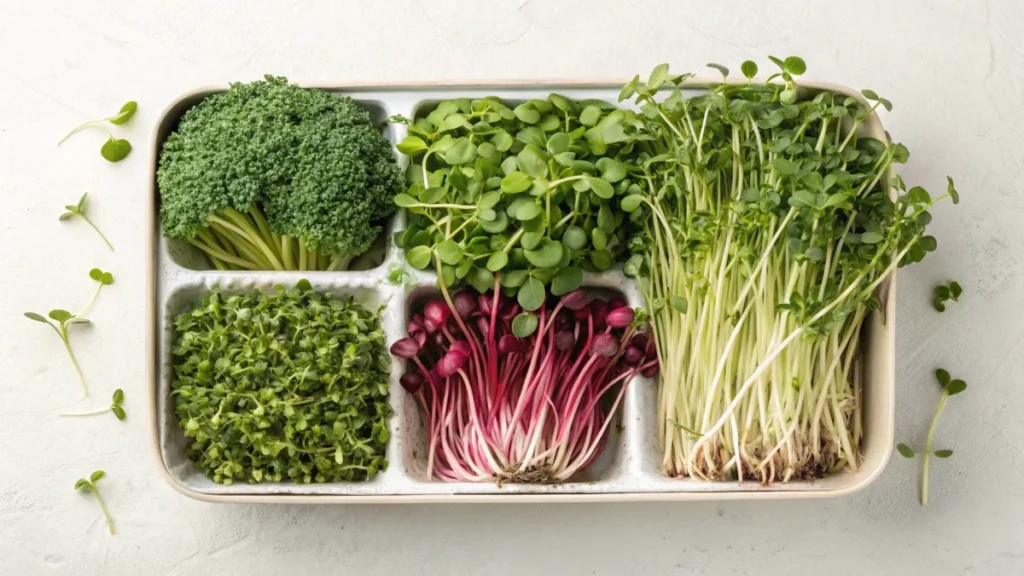
Walk through any farmers’ market or scroll through social media, and it feels like microgreens are everywhere. They show up on breakfast bowls, in smoothies, on steak dinners and even on top of waffles for kids. A few years ago, they were something only chefs and foodies talked about. Now they are sitting on kitchen counters, in basements, and under grow lights in tiny apartments.
So why are microgreens so popular right now?
There are quite a few reasons for working together. People want more nutrition in less food. They want simple ways to support their health without swallowing more pills. New growers want a crop that is fast and forgiving. Families want something their kids will actually eat. Gardeners want fresh salad greens when the garden outside is frozen. And on top of all that, microgreens taste good and look beautiful on a plate.
When you put all of these pieces together, you start to understand why microgreens have gone from niche garnish to everyday essential. To really see the bigger picture, it helps to start with a clear idea of what microgreens actually are.
What Microgreens Really Are
Young plants at a very specific stage
Microgreens are not just small vegetables. They are young edible plants harvested at a very precise moment in their life.
A seed wakes up when it takes in water and begins to germinate. It sends out a tiny root and pushes a shoot toward the light. The first two leaves that open are called cotyledons. These are like the plant’s starter leaves. They hold stored energy that helps the plant get going before it can fully photosynthesise.
Microgreens are usually harvested right at the cotyledon stage or just as the very first true leaves are starting to peek out between them. In many setups, this happens around day seven to day fourteen after sowing, depending on the variety and growing conditions. Some growers keep certain crops at the pure cotyledon stage because the true leaves become tough or bitter. Sunflower is a good example. Others allow the first true leaves to form when they add beauty or better texture, like some mustard types.
This timing matters. At this age, the plants are small, tender and extremely concentrated in nutrients and flavour. That is one of the main reasons they have captured so much attention.
How microgreens differ from sprouts and baby greens
It is easy to mix up sprouts, microgreens and baby greens, but they are quite different.
Sprouts are usually grown in jars or special sprouting trays without a true growing medium. The whole sprout is eaten, including the seed coat and root, after only a few days of growth. They stay in very humid conditions, which is why sprouting seeds must be carefully tested for safety.
Microgreens, on the other hand, are grown in a tray, bed or container with a medium such as soil, coco coir or a fibre mat. They grow upright in the light. Only the stem and leaves above the medium are harvested. They are older than sprouts but still much younger than baby greens.
Baby greens and baby leaf mixes come later in the life cycle. At that stage, you are eating the first true leaves of the plant. Baby spinach, baby kale and baby arugula are good examples. They take longer to reach harvest and need more space per plant.
Microgreens sit neatly between sprouts and baby greens. They give you the speed of sprouting, with the flavour and structure of a young salad crop.
🌿 Recommended Microgreens Supplies |
A wide range of flavours in one category
Another reason people love microgreens is the variety that fits under one simple method. You can grow familiar vegetables as microgreens, such as broccoli, cabbage, radish, kale, peas and sunflowers. You can also grow blends such as salad mixes that combine brassicas like collards, arugula and mustard.
The method is the same,e but the experience on the plate can be mild, sweet, crunchy, peppery or hot. That variety keeps people interested and makes microgreens feel like more than a single product.
🌿 Recommended Microgreens Supplies |
Nutrient Density: The Biggest Reason Behind the Hype
When people ask why microgreens are so popular, the first honest answer is nutrition. These tiny plants are incredibly rich in vitamins, minerals and protective compounds compared to their full-sized versions.
Up to forty times the nutrient content
Research has shown that some microgreens can contain up to forty times the nutrient content of the mature vegetable from the same seed. That means a small handful of micro broccoli or micro kale can match or even beat a full bowl of the adult vegetable in terms of certain vitamins and antioxidants.
You see this especially clearly in cruciferous crops like broccoli. Several educators in the microgreens space repeatedly point to broccoli microgreens because their numbers stand out. Some estimates suggest that broccoli microgreens may offer ten to one hundred times the amount of sulforaphane compared to a standard head of broccoli. Even if you take the lower end of that range, it is still a huge difference.
For someone who is trying to boost nutrient intake without increasing the volume of food, that is a very compelling reason to add microgreens to daily meals.
Vitamins, minerals, enzymes and chlorophyll in a small bite
Microgreens contain concentrated amounts of vitamins A, C and E. These vitamins are recognised antioxidants that help protect cells from damage by free radicals. Alongside them, you often get iron, potassium, zinc and other minerals that support immune function and energy production.
Because the plants are so young, they also hold active enzymes and high levels of chlorophyll. These are often reduced as plants age, are harvested, stored, shipped and sit on a shelf. With microgreens, you cut them and eat them almost immediately. The nutrients go from the tray to your plate with minimal delay.
Microgreens also contain fibre, even in their tiny stems and leaves. That fibre feeds beneficial gut bacteria and helps keep digestion regular. People who focus on gut health often combine microgreens with other plant foods to support a healthy microbiome.
The sulforaphane story
One of the most talked about compounds in microgreens is sulforaphane. This is a natural substance found in cruciferous vegetables like broccoli and cauliflower. It has been studied for its strong antioxidant and anti-inflammatory effects. Many people are interested in it because research suggests it may help protect cells and support normal detoxification processes in the body.
Broccoli microgreens are a rich source of sulforaphane. When you cut and chew them, you trigger the reaction that creates this compound. The fact that micro broccoli can contain far more sulforaphane than the mature plant makes it particularly attractive for people who want practical ways to increase their intake.
Real health stories that spread the message
Nutrient charts and lab numbers are convincing, but what really drives popularity are real stories. Some customers credit regular broccoli microgreen deliveries as an important part of their routine after serious illness. Some families turned to microgreens after discovering their child had vitamin-related issues. One educator openly shares how a shift to a nutrient-rich diet with daily microgreens coincided with a dramatic drop in inflammation markers and a return to normal daily life after years of unexplained health problems.
When these stories are told on social platforms and in communities, they travel fast. The idea that a simple living food can be part of a real turnaround resonates with people who are tired of complicated solutions. This word-of-mouth effect plays a big role in why microgreens are so popular today.
Flavour Freshness and Everyday Cooking
Health benefits get people curious. Flavour keeps them coming back. If microgreens were only good for you but tasted boring or strange, they would not have spread so quickly. The truth is, they are surprisingly fun to eat.
Concentrated flavour in a small handful
Because microgreens are harvested so young, their flavours are intense compared to many store-bought greens. A tray of radish microgreens delivers the same peppery bite that you would expect from a full radish, but in a delicate, tender form. Mustard types can taste very close to wasabi and add a bright kick to tacos, eggs or rice bowls. Pea shoots taste like sweet fresh peas straight from the garden. Sunflower shoots bring a nutty crunch that feels almost like a snack food.
Even milder varieties such as broccoli and kale have a pleasant fresh taste that works well on almost any savoury dish. They are not tough or fibrous the way some mature greens can be. That makes them much easier for children and hesitant adults to enjoy.
How people actually use microgreens at home
One of the most helpful concepts shared by growers is something they call piggybacking. Instead of trying to build entirely new recipes around microgreens, you simply add a small handful to whatever you are already eating.
Someone making a sandwich can throw broccoli or salad mix inside for crunch and colour. A quick bowl of scrambled eggs becomes more interesting with a small bed of pea shoots underneath. A basic frozen pizza looks more like something from a restaurant when you scatter radish or mustard greens over it right after it comes out of the oven.
Smoothies are another favourite. People who do not enjoy the taste of vegetables often blend microgreens into fruit or chocolate-based smoothies. The flavour is easily hidden while the nutrition is still present. Parents also stir mild greens into applesauce and yoghurt for kids, or sprinkle them over waffles as a fun topping.
Because microgreens are so small and tender, there is almost no prep. You cut them above the medium, rinse if needed, and they are ready. This ease of use encourages people to reach for them every day.
Why chefs and home cooks both love them
Microgreens first gained attention in restaurants because of how they look on a plate. Their delicate leaves and bright colours instantly make a dish feel more finished. Chefs use them to add height, colour contrast and a flavour accent to both savoury and sweet plates.
Home cooks quickly realised that theycouldn get the same effect on their own meals. It does not take training to scatter a small bunch of sunflowers or radish over soup or curry, and suddenly the bowl looks like something from a cafe. For people who care about presentation, and for anyone sharing food photos online, this visual impact is a big part of the appeal.
When a food offers strong nutrition, an enjoyable flavour and an easy way to make meals look better, it is no surprise that it spreads quickly.
Fast, Easy and Space Saving Growing
Another major reason microgreens are so popular is that they give regular people a way to grow real food without needing a backyard or a lot of time. In a world where many feel disconnected from where their food comes from, that matters a lot.
Seven to ten days from seed to plate
Most common microgreen crops are ready to harvest in roughly one to two weeks. In warm, controlled conditions, some trays of broccoli or salad mix reach cutting height in about seven days. Others may take up to fourteen days, but compared to traditional gardening, that is still incredibly fast.
For someone used to waiting months for tomatoes or peppers, this short cycle feels almost magical. You soak the seed, spread it over a tray, keep it dark and moist for a few days, then move it to the light. Within a week or so, you are cutting fresh greens for dinner. That quick win keeps new growers motivated.
This fast turnover also helps people learn. If something goes wrong with one tray, they can adjust their method and see the result in the next run without losing an entire season. One gardener who was sceptical about microgreens changed his mind after realising how quickly he could test different sowing methods, watering patterns and varieties over one winter.
Very little space is needed.
Microgreens fit into the lives of people who live in small spaces. You can grow them on a sunny windowsill, a section of kitchen counter or a simple shelf unit. One common arrangement uses a rack about four feet wide and six feet tall with four shelves. That setup can hold around sixteen standard trays.
When those trays hold crops that often retail around twenty to thirty dollars each, the value per square foot becomes obvious. Even for people who are not selling their greens, the ability to grow a significant amount of fresh food in a small corner of a room is a big advantage.
Microgreens do not require outdoor land, raised beds or complex irrigation systems. They can be grown in basements, spare rooms, garages or rented spaces. That makes them accessible to urban residents and renters who cannot change the property around them.
Simple equipment that feels manageable
The basic kit for growing microgreens is easy to understand. You need trays, a growing medium, seeds, water and light. Many growers prefer a two-tray system where one tray nests inside another. Water is poured into the bottom tray, and the roots drink from below. This bottom watering method reduces the risk of mould because the foliage stays dry.
For growing medium, coco coir is a favourite because it is a clean fibre made from coconut husk. It has been processed so that it is free from bugs and most pathogens. Others use soil mixes or specialised mats.
Seed quality matters, so serious growers choose seeds that are tested for safety and intended for microgreen production. Good water also helps. Some people use filtered water with a balanced pH to avoid stressing the plants.
Light can be as simple as a bright window. Where natural light is limited, basic grow lights make a big difference and are now relatively affordable. You do not need an advanced greenhouse system to get started.
Why do beginners find microgreens less intimidating
Traditional gardening can feel overwhelming for someone new. There are questions about soil, seasons, pests, pruning, and so much more. Microgreens strip many of those worries away. No one is asking you to design a whole garden. You just prepare one tray, plant seeds, keep them moist, then move them to the light.
The time frame is short enough that failure does not feel like a disaster. Seeds are relatively cheap per tray, and a new attempt can be sown the same day if something goes wrong. This low emotional and financial risk encourages people who have never grown anything before to give it a try.
When you combine fast results, minimal space requirements and simple tools, you get a crop that fits modern life very well. That is a huge part of why microgreens are so popular with both experienced growers and complete beginners.
High Value Crop and Simple Home Business Potential
One of the quiet reasons microgreens have exploded in popularity is money. They are not only a healthy food. They are also a practical income source for people who want to work from home or add a flexible side business.
Microgreens are a classic example of a high-value crop. From a single standard growing tray, you can harvest enough greens to sell for around twenty to thirty dollars in many markets. The tray itself does not take much space. Yet the value that comes from that small rectangle of growing medium can rival what some field crops produce in a much larger area.
The cost to set up a basic microgreens operation is relatively low compared to many other types of farming. With a few trays, a rack, some lights, good seeds and a growing medium, it is possible to start growing for sale with an investment often under five hundred dollars. You do not need a tractor or acres of land. You can begin in an apartment, a basement or a spare room.
The short growth cycle creates fast cash flow. Traditional farm animals such as cattle can take a year or more before they generate a saleable product. Field crops often take months. Microgreens go from seed to harvest in one to two weeks. That means the money spent on seeds and supplies returns relatively quickly once you begin selling. For a new grower, this quick turnover reduces stress and makes it easier to keep going.
Real-life examples make this more tangible. Some families now run their microgreens business from home and use the income to cover real expenses like groceries and mortgage payments. In one household, the main grower handles watering, seeding and harvesting in roughly ten to fifteen hours per week and earns half of her income doing work she enjoys in the same building where she lives. The same business pays rent to the property for the space it uses. That rent then helps cover property taxes and, later, mortgage costs. In this way, the farm is not separate from family life. It helps support it.
Teachers in the microgreens space share stories of students who turned a simple tray challenge into a thriving small business. One student reportedly went from first tray to roughly two thousand dollars in weekly sales within a few months by taking the method seriously and serving local demand. While not everyone will grow that quickly, stories like that show why so many people are curious about microgreens as a business.
Because microgreens can be grown all year, there is no complete off-season. This steadiness is rare in agriculture, and it gives families and solo growers a more predictable income stream. That combination of low startup cost, high value per tray, fast cycles and continuous production is a big reason microgreens are so popular with new farmers and home-based entrepreneurs.